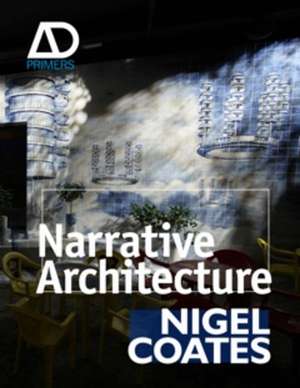
Narrative Architecture: Architectural Design Primer
Autor Nigel Coatesen Limba Engleză Paperback – 2 apr 2012
Publicată într-un context în care discursul teoretic caută punți de legătură între spațiul construit și experiența umană subiectivă, Narrative Architecture reprezintă prima analiză aprofundată a modului în care clădirile „povestesc” mediul urban. Descoperim în paginile acestui volum o pledoarie vizuală și textuală semnată de Nigel Coates, care propune o evadare din rigorile funcționalismului pur către o arhitectură a trăirii. Autorul ne invită să privim dincolo de fațade, explorând modul în care orașul este simțit și navigat prin prisma narațiunii. Experiența de lectură este una profund senzorială, susținută de cele peste 120 de fotografii color care punctează parcursul de la antichitate la contemporaneitate. Tonul este unul analitic, dar plin de vitalitate, reflectând spiritul vizionar al lui Coates. Analiza sa nu se limitează la propria practică, ci integrează perspective diverse, de la onirismul lui Antoni Gaudí la radicalismul celor de la Superstudio sau pragmatismul conceptual al lui Rem Koolhaas. Pe raftul de artă, alături de Architecture and Narrative de Sophia Psarra, acest album se distinge prin accentul pus pe practica directă și pe capacitatea narațiunii de a menține arhitectura relevantă într-o lume în continuă schimbare. Dacă Psarra se concentrează pe organizarea conceptuală a spațiului, Coates aduce în prim-plan vibrația și „sentimentul” orașului, transformând teoria într-un instrument de design viu. Considerăm că această lucrare completează perfect parcursul autorului, oferind fundamentul teoretic pentru estetica subversivă pe care a promovat-o de-a lungul întregii sale cariere.
Preț: 330.65 lei
Carte disponibilă
Livrare economică 09-23 noiembrie
Livrare express 24-30 octombrie pentru 30.95 lei
Specificații
ISBN-10: 0470057440
Pagini: 176
Dimensiuni: 170 x 244 x 10 mm
Greutate: 0.31 kg
Editura: John Wiley & Sons, Inc.
Colecția Architectural Design Primer
Seria Architectural Design Primer
Locul publicării:Chichester, United Kingdom
V-ar putea interesa
-
 Mathematics for the Green IndustryMichael L Agnew-19%Preț: 474.51 lei585.81 lei
 -
 Tournament ManagementMiller-8%Preț: 552.45 lei600.49 lei
 -
 Quality Facility ManagementFriday-9%Preț: 705.47 lei775.25 lei
 -
 PlacemakingLynda H Schneekloth-8%Preț: 551.14 lei599.07 lei
 -
 Finding Lost SpaceRoger Trancik-9%Preț: 701.40 lei770.77 lei
 -
 -24%Preț: 311.04 lei407.71 lei
 -
 In the Midst of Chaos. My 30 Days at Ground ZeroDavid W AusmusPreț: 157.40 lei
 -
 Die Oberschwäbische BarockstrasseRaimund KolbPreț: 151.69 lei
 -
 -19%Preț: 383.64 lei473.63 lei
 -
 Interaktive E-Participation bei StadtplanungsprozessenJan Hendrik Lauffer-23%Preț: 926.41 lei1203.13 lei
 -
 Warum ist Landschaft schön?Lucius BurckhardtPreț: 136.24 lei
Public țintă
Architects, interior designers, designers and studentsDe ce să citești această carte
Această carte este esențială pentru arhitecți și designeri care doresc să depășească limitele tehnice ale profesiei. Cititorul câștigă o nouă perspectivă asupra modului în care clădirile comunică și interacționează cu emoțiile umane. Este un ghid practic și teoretic despre cum poți folosi povestea pentru a crea spații cu impact, fiind totodată un album vizual de excepție ce reunește viziuni arhitecturale iconice din epoci diferite.
Despre autor
Nigel Coates este un arhitect, designer de interior și de produs de renume internațional, recunoscut pentru estetica sa vizionară și adesea subversivă care provoacă normele tradiționale. A condus departamentul de Arhitectură și Interioare de la Royal College of Art din Londra, influențând generații de creatori. În opera sa, care include și volumul autobiografic Lives in Architecture, Coates explorează intersecția dintre artă și viața cotidiană, militând pentru o arhitectură care să reflecte complexitatea și dinamismul societății contemporane. Cariera sa de peste 40 de ani este marcată de un spirit iconoclast și o dorință constantă de inovare.