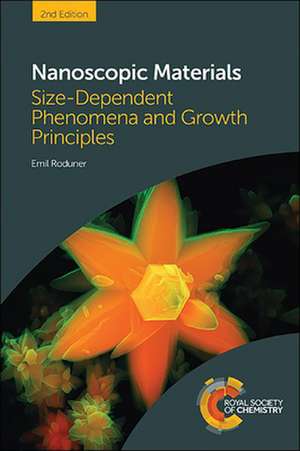
Nanoscopic Materials
Autor Emil Roduneren Limba Engleză Hardback – 31 iul 2014
Preț: 606.95 lei
Preț vechi: 778.14 lei
-22%
Puncte Express: 910
Carte indisponibilă temporar
Doresc să fiu notificat când acest titlu va fi disponibil:
Se trimite...
Specificații
ISBN-13: 9781849739078
ISBN-10: 1849739072
Pagini: 457
Dimensiuni: 165 x 236 x 31 mm
Greutate: 0.84 kg
Ediția:Nouă
Editura: RSC Publishing
ISBN-10: 1849739072
Pagini: 457
Dimensiuni: 165 x 236 x 31 mm
Greutate: 0.84 kg
Ediția:Nouă
Editura: RSC Publishing
V-ar putea interesa
-
 Nanotechnology: A Very Short IntroductionPhilip MoriartyPreț: 67.98 lei
 -
 -14%Preț: 297.86 lei345.80 lei
 -
 Introduction to NanophotonicsHenri Benisty-9%Preț: 365.52 lei399.73 lei
 -
 Preț: 452.65 lei
 -
 Nanotechnology: Principles, Applications and Ethical ConsiderationsDr Paresh Chandra Ray-27%Preț: 1257.62 lei1732.91 lei
 -
 Nanophysics, Nanoclusters & NanodevicesKimberly S Gehar-26%Preț: 1446.34 lei1964.46 lei
 -
 Focus on Nanomaterials ResearchB M Caruta-26%Preț: 1255.31 lei1703.13 lei
 -
 Advances in Nanotechnology: Volume 7Zacharie Bartul-26%Preț: 780.52 lei1058.23 lei
 -
 Nanoscience, Nanomanufacturing & NanoelectronicsJoseph G Devin-26%Preț: 1162.50 lei1580.83 lei
 -
 -44%Preț: 122.28 lei217.77 lei
 -
 NanochemistryGeoffrey A Ozin-15%Preț: 386.40 lei452.20 lei
 -
 NanotechnologySulabha K. Kulkarni-18%Preț: 1117.73 lei1363.08 lei
 -
 -18%Preț: 1353.80 lei1650.97 lei
 -
 Chemical Principles of NanoengineeringAndrea R. Tao-11%Preț: 500.63 lei562.50 lei
 -
 Principles of Nanoscience and Molecular EngineeringRené M. Overney-23%Preț: 697.15 lei905.38 lei
 -
 Preț: 393.15 lei
 -
 Springer Handbook of NanomaterialsRobert Vajtai-18%Preț: 1916.75 lei2337.49 lei
Textul de pe ultima copertă
In recent years there have been great advances in the development of new nanomaterials. To facilitate the progress of new materials it is essential to understand the underlying principles at the nanoscale.
Nanosciopic Materials provides an accessible overview of the physico-chemical and physical principles of nanomaterials including electronic structure, magnetic properties, thermodynamics of size dependence and phase transitions and dynamics of clusters and two-dimensional systems. This new edition has been fully revised and updated to reflect recent developments in new nanomaterials including graphene and core shell structures, properties of nano-structured and intelligent surfaces as well as applications in catalysis and energy. Additional chapters cover the development of nucleation and crystal shape engineering; self-assembly and biomimetics for fabricating nanostructures.
With helpful illustrations and summaries of key points in every chapter, this advanced textbook is ideal for graduate students of chemistry and materials science and researchers new to the field of nanoscience and nanotechnology.
"
Nanosciopic Materials provides an accessible overview of the physico-chemical and physical principles of nanomaterials including electronic structure, magnetic properties, thermodynamics of size dependence and phase transitions and dynamics of clusters and two-dimensional systems. This new edition has been fully revised and updated to reflect recent developments in new nanomaterials including graphene and core shell structures, properties of nano-structured and intelligent surfaces as well as applications in catalysis and energy. Additional chapters cover the development of nucleation and crystal shape engineering; self-assembly and biomimetics for fabricating nanostructures.
With helpful illustrations and summaries of key points in every chapter, this advanced textbook is ideal for graduate students of chemistry and materials science and researchers new to the field of nanoscience and nanotechnology.
"
Cuprins
1: Introduction; 1.1: Clusters and nanoparticles; 1.2: Feynman's vision;2: Bulk and interface; 2.1: Gradients near surfaces; 2.2: The coordination number rules the game; 2.3: Surface science, a source of information; for nanoscience 2.4: Particle size and microstrain; 2.5: Biomimetics: nature as a source of inspiration for strategies in nanotechnology; 3: Geometric structure, magic numbers, and coordination numbers of small clusters; 3.1: The consequences of the range of the radial potential energy function; 3.2: Magic numbers by geometric shells closing; 3.3: Magic numbers by electronic shells closing; 3.4: Cohesive energy and coordination number; 4: Electronic structure; 4.1: Discrete states versus band structure; 4.2: The effects of dimensionality and symmetry in quantum structures; 4.3: The nonmetal-to-metal transition; 4.4: Work function, ionisation potential and electron affinity; 4.5: Electronic structure of semiconductor and metal clusters; 4.6: A semiconductor quantum dot electronic device; 5: Magnetic properties; 5.1: A brief primer on magnetism; 5.2: The concept of frustration; 5.3: Magnetic properties of small clusters; 5.4: Ferromagnetic order in thin films and monoatomic chains; 5.5: Finite size effects in magnetic resonance detection; 6: Thermodynamics for finite size systems; 6.1: Limitations of macroscopic thermodynamics; 6.2: The basics of capillarity; 6.3: Phase transitions of free liquid droplets; 6.4: The Lotus effect; 6.5: Classical nucleation theory; 6.6: Shape control of nanocrystals; 6.7: Size effects on ion conduction in solids; 6.8: Principles of self-assembly; 7: Adsorption, phase behaviour and dynamics of surface layers and in pores; 7.1: Surface adsorption and pore condensation; 7.2: Adsorption hysteresis and pore criticality; 7.3: The melting point of pore-confined matter; 7.4: Layering transitions; 7.5: Liquid coexistence and ionic solutions in pores; 7.6: The effect of pressure; 7.7: Dynamics in pores; 8: Phase transitions and dynamics of clusters; 8.1: Melting point and melting enthalpy; 8.2: Dynamics of metal clusters; 9: Phase transitions of two-dimensional systems; 9.1: Melting of thin layers; 9.2: Structural phase transitions in thin layers; 9.3: Glass transition of a polymer thin film; 9.4: Surface alloy phases; 10: Catalysis by metallic nanoparticles; 10.1: Some general principles of catalysis by nanoparticles; 10.2: Size-controlled catalytic clusters; 10.3: Shape dependent catalytic activity; 10.4: The effect of strain; 10.5: The effect of alloying; 10.6: Metal-support interaction; 10.7: The influence of external bias voltage; 11: Applications: facts and fictions; 11.1: Nanomaterials; 11.2: Nanotechnology; 11.3: Hopes, hazards and hype
Recenzii
Lots of helpful illustrations and some of them in full colour....each of the eleven chapters includes a summary box at the end where the 'key points' are reiterated in clear and concise language, complete with bullet points. A timely reminder of how much every-thing we think we know about matter can change when the packaging unit of that matter becomes very small.
Descriere
Descriere de la o altă ediție sau format:
Ideal for graduate students, this book focuses on the physico-chemical and physical aspects of nanoscience.