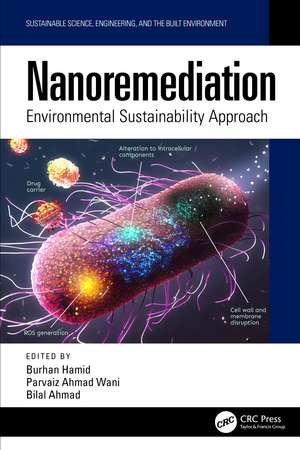
Nanoremediation: Environmental Sustainability Approach: Sustainable Science, Engineering, and the Built Environment
Editat de Burhan Hamid, Parvaze Ahmad Wani, Bilal Ahmeden Limba Engleză Hardback – 30 noi 2026
Nanoremediation represents a sustainable alternative to conventional remediation methods, supporting environmental sustainability through eco-friendly bioremediation strategies. The book reveals potent information on microbe-based nanoparticles and their multipurpose applications for environmental sustainability; it provides comprehensive and significant data on nanoremediation and tactics for the restoration of polluted sites and includes insights into microbial nanoparticles and their applications in promoting sustainable agroecosystems. It also explores the application of microbe-based nanoparticles and discusses innovative applications in pollutant remediation, environmental restoration, and promoting sustainability.
This book is aimed at graduate students and researchers in environmental engineering, nanotechnology, remediation, and nanobiotechnology.

Preț: 834.29 lei
Preț vechi: 1088.49 lei
-23% Precomandă
Puncte Express: 1251
Carte nepublicată încă
Livrare prin curier în România Precomanda se expediază când titlul devine disponibil.
Transport gratuit pentru acest produs Plată online sau ramburs, în funcție de opțiunile comenzii.
Retur gratuit în 14 zile Comandă securizată și suport în română.
Doresc să fiu notificat când acest titlu va fi disponibil:
Se trimite...
Specificații
ISBN-13: 9781041161752
ISBN-10: 1041161751
Pagini: 510
Ilustrații: 68
Dimensiuni: 156 x 234 mm
Ediția:1
Editura: CRC Press
Colecția CRC Press
Seria Sustainable Science, Engineering, and the Built Environment
ISBN-10: 1041161751
Pagini: 510
Ilustrații: 68
Dimensiuni: 156 x 234 mm
Ediția:1
Editura: CRC Press
Colecția CRC Press
Seria Sustainable Science, Engineering, and the Built Environment
Public țintă
Academic and PostgraduateCuprins
Chapter 1 Microbially Synthesized Nanoparticles and Their Real-World Applications Chapter 2 Toxicological Effects of Microbially Synthesized Silver Nanoparticles: Recent Findings Chapter 3 Microbial-Assisted Nanotechnology: A Frontier In Eco-Friendly Remediation Chapter 4 Microbially Synthesized Nanoparticles for Bioremediation of Heavy Metals: Concepts and Applications Chapter 5 Clean-Up of Copper Polluted Environment by Nano-Remediation: Comprehensive Insights Chapter 6 Microbial Approaches and Nano Technological Tools for Environmental Remediation: Synergistic Strategies for Pollution Control Chapter 7 Protein-Based Bacterial Resistance to Heavy Metal Pollution in Heavy-Metal Polluted Soil Chapter 8 Microbially Synthesized Nanoparticles for Remediation of Microplastic Pollution in Contaminated Environment Chapter 9 Nanoremediation of Dyes: Case Studies in Textile-Affected Ecosystem Chapter 10 Role of Nanomaterials in the Remediation of Salt Contaminated Soils: Recent Developments with special reference to Saudi Arabia Chapter 11 Role of Microbially Synthesized Nanoparticles in the Degradation of Hydrocarbons in Marine Environments Chapter 12 Bacterial Nanotechnology for Detoxification of Pollutants From Industrial Wastewater Chapter 13 Microbially Synthesized Zinc Nanoparticles: Role in Plant Disease Management Chapter 14 Nanoremediation Methodologies for Viable Agriculture: Current Findings and Future Perspectives Chapter 15 Role of Artificial Intelligence in Nanoremedation: Potential Toxicity Imposed by Nanoremediation Chapter 16 Environmental Monitoring and Risk Assessment Using Nanotechnology Chapter 17 Nanoremediation and Environmental Sustainability: International Policies and Sustainability Goals Chapter 18 Nanotechnology in the bioremediation of dairy industry effluents: Current status and future prospects Chapter 19 Nanoremediation of Heavy Metal Contaminated Environments
Notă biografică
Dr. Burhan Hamid, Ph.D., has been serving as an Assistant Professor at the Centre of Research for Development (CORD) and the P.G. Program in Microbiology, University of Kashmir, J&K, India, since 2019. He has over 14 years of teaching and research experience. He previously worked as a researcher at the Regional Research Station, Sher-e-Kashmir University of Agricultural Sciences and Technology of Kashmir (SKUAST-K), India. His teaching and research interests include environmental microbiology, psychrophiles, psychrozymes, bioremediation, agricultural microbiology, food microbiology, and industrial microbiology. Dr. Hamid has published more than 75 scientific articles, including original research papers, review articles, and book chapters with internationally renowned publishers such as Taylor & Francis and many more. He has also authored two books published by CRC Press/Taylor & Francis and Elsevier. He serves as a peer reviewer and editorial board member for several internationally reputed journals published by leading publishers. He is also a subject expert and project evaluator for the National Science Centre (NCN), Poland, where he evaluates government-funded research proposals. Prior to joining academia, Dr. Hamid worked as a Senior Microbiologist at Auriga Research Ltd., an NABL-accredited laboratory in Himachal Pradesh, India, where he gained extensive experience in microbiological analysis, quality assurance, laboratory management, and regulatory compliance. He also supervises M.Sc. Microbiology dissertations and research projects. His current research focuses on microbial biotechnology, environmental microbiology, psychrophilic microorganisms, enzyme production, nanobiotechnology, food microbiology, and bioremediation.
Parvaze Ahmad Wani, PhD, is working as faculty at Department of Microbiology, Centre of Research for Development (CORD), University of Kashmir, Srinagar, India since 2022. Previously he worked as an Associate Professor of Microbiology at Department of Biological Sciences, College of Natural and Applied Sciences, Crescent University, Abeokuta, Ogun State, Nigeria from 2014 to 2022. He also worked as Assistant Professor of Microbiology from December, 2009 to October, 2014. He has more than 16 years of teaching and research experience at UG and PG level. He worked as post-doctoral fellow in the department of environmental sciences, Baba Sahib Bhim Rao Ambedkar (Central University), Lucknow and IARA, New Delhi from September 2008 to November, 2009. His research is focused on the bioremediation of pollutants such as hydrocarbons, metals etc. He also works on the Antimicrobial, ant diabetic activity of medicinal plants. He has published more than 70 research and review articles in reputed journals of Elsevier, Springer, Wiley, Taylor and Francis. He is member of many associations and also reviewer of many reputed journals.
Bilal Ahmed, Ph.D., is a multidisciplinary researcher and academic currently serving as a Research Scientist at Agricultural & Biological Engineering (ABE), College of Agriculture, Purdue University, USA. He holds a Ph.D. in Agricultural Microbiology with a focus on Environmental Nanotoxicology from Aligarh Muslim University, India. His research bridges microbiology, nanotechnology, and molecular diagnostics, with a particular emphasis on sustainable agriculture and biosensor development. He has received three Gold Medals at the Postgraduate level. Dr. Ahmed has teaching experience as a Foreign Faculty member and research experience in the School of Chemical Engineering, Yeungnam University, South Korea, where he also won a research grant from the National Research Foundation (NRF) of Korea. Besides, he worked as a Research Assistant for three years on a research project funded by CST, U.P., Lucknow, India. He has published over 58 research publications in peer-reviewed high-impact journals. He has also published 11 book chapters in different books published by leading international publishers. His work has received over 4,800 citations and has earned him recognition among the World's Top 2% Scientists by Stanford University and Elsevier, 2024 and 2025. Dr. Ahmed has also served as a Guest Editor for two special issues in Molecules. Recently, he has published an edited volume with Springer, Switzerland, and another with Academic Press, Elsevier, UK. Currently, he is also serving as a reviewer and member of the editorial board of different journals.
Parvaze Ahmad Wani, PhD, is working as faculty at Department of Microbiology, Centre of Research for Development (CORD), University of Kashmir, Srinagar, India since 2022. Previously he worked as an Associate Professor of Microbiology at Department of Biological Sciences, College of Natural and Applied Sciences, Crescent University, Abeokuta, Ogun State, Nigeria from 2014 to 2022. He also worked as Assistant Professor of Microbiology from December, 2009 to October, 2014. He has more than 16 years of teaching and research experience at UG and PG level. He worked as post-doctoral fellow in the department of environmental sciences, Baba Sahib Bhim Rao Ambedkar (Central University), Lucknow and IARA, New Delhi from September 2008 to November, 2009. His research is focused on the bioremediation of pollutants such as hydrocarbons, metals etc. He also works on the Antimicrobial, ant diabetic activity of medicinal plants. He has published more than 70 research and review articles in reputed journals of Elsevier, Springer, Wiley, Taylor and Francis. He is member of many associations and also reviewer of many reputed journals.
Bilal Ahmed, Ph.D., is a multidisciplinary researcher and academic currently serving as a Research Scientist at Agricultural & Biological Engineering (ABE), College of Agriculture, Purdue University, USA. He holds a Ph.D. in Agricultural Microbiology with a focus on Environmental Nanotoxicology from Aligarh Muslim University, India. His research bridges microbiology, nanotechnology, and molecular diagnostics, with a particular emphasis on sustainable agriculture and biosensor development. He has received three Gold Medals at the Postgraduate level. Dr. Ahmed has teaching experience as a Foreign Faculty member and research experience in the School of Chemical Engineering, Yeungnam University, South Korea, where he also won a research grant from the National Research Foundation (NRF) of Korea. Besides, he worked as a Research Assistant for three years on a research project funded by CST, U.P., Lucknow, India. He has published over 58 research publications in peer-reviewed high-impact journals. He has also published 11 book chapters in different books published by leading international publishers. His work has received over 4,800 citations and has earned him recognition among the World's Top 2% Scientists by Stanford University and Elsevier, 2024 and 2025. Dr. Ahmed has also served as a Guest Editor for two special issues in Molecules. Recently, he has published an edited volume with Springer, Switzerland, and another with Academic Press, Elsevier, UK. Currently, he is also serving as a reviewer and member of the editorial board of different journals.
Descriere
This text discusses the application of microbe-based nanoparticles as an environmentally responsible solution to address persistent pollutants and hazardous substances. The multidisciplinary approach covers production methods for microbial nanoparticles, applications in wastewater treatment, petroleum contamination remediation and so forth.