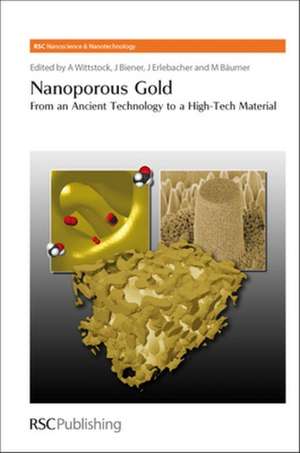
Nanoporous Gold
Editat de Arne Wittstock, Jürgen Biener, Jonah Erlebacher, Marcus Bäumeren Limba Engleză Hardback – 12 apr 2012
Descoperim aici resurse fundamentale și date experimentale care definesc stadiul actual al cercetării în domeniul aurului nanoporos, un material a cărui importanță este susținută de creșterea exponențială a publicațiilor științifice. Suntem de părere că volumul Nanoporous Gold reușește să sintetizeze complexitatea acestui material mesoporos, pornind de la premisa că proprietățile sale nu mai sunt determinate de masa metalului, ci de arhitectura sa nanometrică. Subliniem că abordarea este una tehnică și multidisciplinară, oferind o platformă riguroasă pentru înțelegerea fenomenelor de suprafață. Organizarea volumului este concepută pentru a ghida cititorul printr-o progresie logică: de la contextul istoric al coroziunii aliajelor și mecanismele de de-aliere, până la proprietățile mecanice și tehnicile de microfabricație. Fiecare capitol funcționează ca o unitate de sine stătătoare, dedicată unei tehnici sau aplicații specifice, facilitând accesul rapid la informații despre chimia suprafețelor sau utilizarea în sisteme de actuare. Complementar lucrării Electrochemically Engineered Nanoporous Materials de Dusan Losic, care se concentrează pe siliciu, alumină și titaniu, acest volum acoperă specificitatea metalelor nobile și dinamica lor în cataliza în fază gazoasă și electrocataliză, zone pe care literatura generală despre nanoporozitate le atinge doar tangențial. De asemenea, spre deosebire de Gold and Silver Nanoparticles, care analizează particulele izolate, lucrarea editată de Arne Wittstock și colegii săi se concentrează pe structurile metalice continue, esențiale pentru stabilitatea senzorilor și a dispozitivelor de recoltare a energiei.
Preț: 1046.79 lei
Preț vechi: 1217.19 lei
-14%
Carte disponibilă
Livrare economică 12-26 noiembrie
Specificații
ISBN-10: 1849733740
Pagini: 252
Dimensiuni: 163 x 238 x 21 mm
Greutate: 0.54 kg
Editura: RSC Publishing
V-ar putea interesa
-
 Introduction to NanophotonicsHenri Benisty-8%Preț: 373.74 lei406.24 lei
 -
 -23%Preț: 1262.27 lei1639.31 lei
 -
 Porous Glass & Nanostructured MaterialsVyacheslav N Pak PhD-27%Preț: 998.93 lei1362.04 lei
 -
 -30%Preț: 97.81 lei139.80 lei
 -
 NanochemistryGeoffrey A Ozin-14%Preț: 388.63 lei453.06 lei
 -
 Nanoparticles in Anti-Microbial MaterialsFiona Regan-14%Preț: 1160.21 lei1349.07 lei
 -
 -27%Preț: 2367.23 lei3242.78 lei
 -
 Environmental Catalysis Over Gold-Based MaterialsGeorge Avgouropoulos-14%Preț: 1121.88 lei1304.51 lei
 -
 -18%Preț: 1162.44 lei1417.60 lei
 -
 Black SiliconGagik AyvazyanPreț: 337.27 lei
 -
 -18%Preț: 1453.61 lei1772.69 lei
 -
 Plasmonic Metal NanostructuresCaixia Kan-14%Preț: 981.73 lei1141.55 lei
 -
 Gas Sensing FundamentalsClaus-Dieter Kohl-9%Preț: 1238.80 lei1361.33 lei
 -
 -18%Preț: 1153.46 lei1406.65 lei
 -
 -18%Preț: 813.56 lei992.15 lei
De ce să citești această carte
Această lucrare este esențială pentru inginerii în nanotehnologie și cercetătorii din electrochimie care doresc să stăpânească utilizarea aurului nanoporos. Cititorul câștigă o înțelegere profundă a modului în care microstructura influențează performanța în cataliză și senzori. Este un instrument practic pentru proiectarea materialelor cu suprafață specifică mare, oferind soluții concrete pentru optimizarea dispozitivelor de stocare a energiei și a sistemelor optice avansate.
Despre autor
Volumul este coordonat de o echipă de editori de elită, printre care se numără Arne Wittstock, Jürgen Biener, Jonah Erlebacher și Marcus Bäumer. Aceștia sunt cercetători recunoscuți la nivel mondial pentru contribuțiile lor în chimia materialelor și nanotehnologie. Expertiza lor combinată acoperă un spectru larg, de la fizica suprafețelor la aplicații industriale în cataliză, asigurând o rigoare științifică ridicată fiecărui capitol și o viziune integrată asupra viitorului aurului nanoporos în tehnologiile avansate.