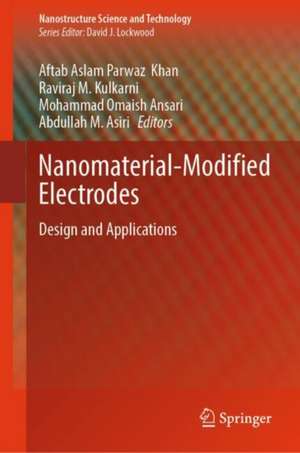
Nanomaterial-Modified Electrodes: Nanostructure Science and Technology
Editat de Aftab Aslam Parwaz Khan, Raviraj M. Kulkarni, Mohammad Omaish Ansari, Abdullah M. Asirien Limba Engleză Hardback – 9 oct 2024
Nivel de studiu: master, doctorat și referință pentru cercetători în electrochimie și nanotehnologie. Publicat recent în 2024 în prestigioasa serie Nanostructure Science and Technology de la Springer, acest volum colectiv sub coordonarea editorului Aftab Aslam Parwaz Khan sintetizează progresele de ultimă oră în ingineria suprafețelor senzorilor. Considerăm că valoarea acestui tratat rezidă în echilibrul dintre fundamentele teoretice ale senzorilor electrochimici și aplicațiile lor practice în monitorizarea mediului și analize farmaceutice.
Structura editorială este riguroasă, debutând cu proprietățile și sinteza nanomaterialelor, pentru a trece ulterior la capitole aplicative dedicate unor materiale specifice. Apreciem în mod deosebit secțiunile despre electrozii modificați cu grafen și nanotuburi de carbon, esențiali pentru detectarea biomoleculelor. Cartea completează perspectiva oferită de Fabrication and Advanced Applications of Nanomaterial-Based Electrochemical Sensors de Shashanka Rajendrachari, adăugând un accent necesar pe tehnologiile emergente de tip lab-on-a-chip și pe dezvoltarea electrozilor flexibili, subiecte mai puțin explorate în lucrările anterioare.
Progresia conținutului ghidează cititorul de la tehnici de imobilizare în fabricarea electrozilor până la aplicații critice, precum detecția metalelor grele în apă sau monitorizarea glucozei. Cu aproximativ 50 de ilustrații tehnice care sprijină textul, lucrarea oferă o claritate metodologică necesară într-un domeniu marcat de o evoluție tehnologică rapidă. Este o resursă care depășește nivelul introductiv, oferind soluții specifice pentru provocările actuale din chimia fizică și bioelectronică.
Din seria Nanostructure Science and Technology
- 18%
 Preț: 1066.78 lei
 -
 Preț: 411.30 lei
 - 18%
 Preț: 910.71 lei
 -
 Preț: 391.84 lei
 - 18%
 Preț: 953.42 lei
 - 18%
 Preț: 1273.41 lei
 - 18%
 Preț: 984.21 lei
 - 15%
 Preț: 699.78 lei
 - 18%
 Preț: 953.28 lei
 - 18%
 Preț: 824.74 lei
 - 18%
 Preț: 908.29 lei
 - 15%
 Preț: 669.16 lei
 - 18%
 Preț: 758.73 lei
 - 15%
 Preț: 651.00 lei
 - 20%
 Preț: 604.92 lei
 - 18%
 Preț: 1009.76 lei
 - 15%
 Preț: 608.98 lei
 - 19%
 Preț: 636.10 lei
 - 18%
 Preț: 988.22 lei
 - 5%
 Preț: 796.05 lei
 - 18%
 Preț: 988.65 lei
 - 20%
 Preț: 613.16 lei
 -
 Preț: 414.34 lei
 - 18%
 Preț: 1004.28 lei
 - 15%
 Preț: 617.23 lei
 -
 Preț: 409.48 lei
 - 15%
 Preț: 668.04 lei
 - 18%
 Preț: 988.57 lei
 - 15%
 Preț: 616.34 lei
 - 20%
 Preț: 667.25 lei
 - 15%
 Preț: 668.72 lei
 - 15%
 Preț: 669.40 lei
 - 15%
 Preț: 666.21 lei
 -
 Preț: 391.62 lei
 - 18%
 Preț: 918.00 lei
 - 18%
 Preț: 1224.46 lei
 - 15%
 Preț: 663.90 lei
Preț: 1121.21 lei
Preț vechi: 1367.33 lei
-18%
Carte disponibilă
Livrare economică 05-19 noiembrie
Specificații
ISBN-10: 3031671759
Pagini: 320
Ilustrații: Approx. 450 p. 50 illus.
Dimensiuni: 160 x 241 x 22 mm
Greutate: 0.71 kg
Ediția:2024
Editura: Springer
Colecția Nanostructure Science and Technology
Seria Nanostructure Science and Technology
Locul publicării:Cham, Switzerland
V-ar putea interesa
-
 Functional Nanomaterials for SensorsSuresh Sagadevan-8%Preț: 436.41 lei474.36 lei
 -
 -23%Preț: 1262.27 lei1639.31 lei
 -
 -31%Preț: 95.45 lei137.35 lei
 -
 -14%Preț: 1283.26 lei1492.16 lei
 -
 Nanosensors for Environmental ApplicationsSatish Kumar Tuteja-20%Preț: 615.76 lei769.70 lei
 -
 -20%Preț: 630.25 lei787.81 lei
 -
 Modified Nanomaterials for Environmental ApplicationsOnoyivwe Monday Ama-18%Preț: 1067.14 lei1301.40 lei
 -
 Nanobiosensors for Environmental MonitoringRavindra Pratap Singh-18%Preț: 1395.00 lei1701.23 lei
 -
 Handbook of NanosensorsGomaa A. M. Ali-18%Preț: 4923.32 lei6004.05 lei
 -
 -18%Preț: 4821.81 lei5880.26 lei
 -
 -14%Preț: 829.86 lei964.95 lei
 -
 Graphene Field-Effect TransistorsOmar Azzaroni-14%Preț: 923.58 lei1073.93 lei
 -
 -14%Preț: 919.32 lei1068.99 lei
 -
 Bio-Nanomaterials in Environmental RemediationNarendra K. Sharma-9%Preț: 837.87 lei920.73 lei
 -
 Environmental, Chemical and Medical SensorsShantanu Bhattacharya-15%Preț: 679.75 lei799.71 lei
 -
 Smart Nanostructure Materials and Sensor TechnologyRakesh Kumar Sonker-19%Preț: 600.09 lei740.85 lei
 -
 Handbook of NanobioelectrochemistryUday Pratap Azad-18%Preț: 3888.95 lei4742.62 lei
 -
 -18%Preț: 1121.10 lei1367.20 lei
 -
 -18%Preț: 1155.98 lei1409.72 lei
De ce să citești această carte
Recomandăm această lucrare profesioniștilor care au nevoie de o actualizare la zi (ediția 2024) asupra materialelor avansate folosite în biosenzori. Cititorul câștigă o înțelegere profundă a modului în care modificarea electrozilor cu nanoparticule de aur sau compozite polimerice poate îmbunătăți limita de detecție în analizele farmaceutice. Este un instrument de lucru esențial pentru proiectarea noilor generații de senzori electrochimici portabili.
Despre autor
Echipa de editori este condusă de Aftab Aslam Parwaz Khan, cercetător recunoscut în domeniul nanotehnologiei aplicate. Alături de Raviraj M. Kulkarni, Mohammad Omaish Ansari și Abdullah M. Asiri, aceștia reunesc expertiză internațională în chimie fizică și materiale nanostructurate. Contribuțiile lor anterioare în jurnale de specialitate și experiența în dezvoltarea senzorilor pentru aplicații de mediu și biomedicale garantează acuratețea științifică a acestui volum publicat de Springer.
Descriere scurtă
Cuprins
Notă biografică
Prof. Raviraj M. Kulkarni is presently working as a Professor of Chemistry and Coordinator at the Centre for Nanoscience and Nanotechnology, KLS Gogte Institute of Technology, Udyambag, Belagavi, Karnataka, INDIA 590008. He was awarded a Ph.D. in Chemistry from Karnatak University Dharwad, India in 2003. He worked as a Postdoctoral fellow at Katholieke Universiteit Leuven Belgium (2003-2005), a Visiting Fellow at Tata Institute of Fundamental Research, Mumbai (2005-2006), and Postdoctoral Fellow at the University of Alberta, Edmonton Canada (2006-2007). He has published more than 110 research papers in various peer-reviewed international journals and published 5 book chapters. He has successfully guided 4 Ph.D. students and 11 M. Tech students. He is also Editorial Board Member and reviewer of many international journals of high repute. He is the recipient “Young Scientist Award” with seed money and the “Award for Research Publication” by VGST Govt. of Karnataka, INDIA. His research interests include all aspects of nanomaterials, electrochemical sensors, photocatalysis, electrode development, spectroscopy, environmental chemistry, and kinetics.
Prof. Abdullah Mohammed Ahmed Asiri is Professor in the Chemistry Department – Faculty of Science -at King Abdulaziz University. Ph.D. (1995) From University of Walls College of Cardiff, U.K. on tribochromic compounds and their applications. He is currently the chairman of the chemistry department, at King Abdulaziz University and also the Director of the Center of Excellence for Advanced Materials Research. He is HiCi researcher in 2018 list. Director of Education Affair Unit–Deanship of Community Services. Member of Advisory Committee for advancing materials, (National Technology Plan, King Abdul Aziz City of Science and Technology, Riyadh, Saudi Arabia). His interests are focused on color chemistry, synthesis of novel photochromic and thermochromic systems, synthesis of novel colorants and coloration of textiles and plastics, molecular modeling, applications of organic materials into optics such as OEDS, High-performance organic Dyes and pigments, new applications of organic photochromic compounds in new novelty, organic synthesis of heterocyclic compounds as a precursor for dyes, synthesis of polymers functionalized with organic dyes. Preparation of some coating formulations for different applications, photodynamic thereby using Organic Dyes and Pigments Virtual Labs and Experimental Simulations. He is a member of the Editorial board of the Journal of Saudi Chemical Society, Journal of King Abdul Aziz University, Pigment, and Resin Technology Journal, Organic Chemistry Insights, Libertas Academica, Recent Patents on Materials Science. Besides that, he has professional membership in International and National Societies and professional bodies.
Dr. Mohammad Omaish Ansari is currently working as an Associate Professor at the Center of Nanotechnology, King Abdulaziz University, Kingdom of Saudi Arabia. He obtained his PhD in the field of electrically conducting polymers from the Department of Applied Chemistry, Aligarh Muslim University, India in 2012. Before joining King Abdulaziz University, he also worked as Assistant Professor at Yeungnam University, South Korea from 2013-2015. Apart from research activities, he has also taught various courses on nanocomposites and conducting polymers to graduate and undergraduate students. Dr Ansari has published sixty papers in refereed journals of international repute, contributed five book chapters, and edited one book. His research interests include conducting polymer synthesis, properties and device applications, chemical and biosensors, polymer nanocomposites, and polyblends besides having an interest in environmental issues and energy storage devices.