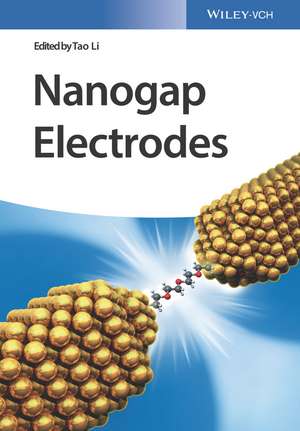
Nanogap Electrodes
Autor T. Lien Limba Engleză Hardback – 3 aug 2021
Preț: 922.22 lei
Preț vechi: 1013.43 lei
-9%
Puncte Express: 1383
Carte tipărită la comandă
Livrare economică 21 noiembrie-05 decembrie
Livrare prin curier în România Termenul estimat este afișat lângă disponibilitate.
Transport gratuit pentru acest produs Plată online sau ramburs, în funcție de opțiunile comenzii.
Retur gratuit în 14 zile Comandă securizată și suport în română.
Specificații
ISBN-13: 9783527332717
ISBN-10: 3527332715
Pagini: 432
Dimensiuni: 178 x 247 x 26 mm
Greutate: 0.89 kg
Editura: Wiley Vch
Locul publicării:Weinheim, Germany
ISBN-10: 3527332715
Pagini: 432
Dimensiuni: 178 x 247 x 26 mm
Greutate: 0.89 kg
Editura: Wiley Vch
Locul publicării:Weinheim, Germany
Public țintă
Materials Scientists, Semiconductor Physicists, Physical Chemists, Electrochemists, Ph.D. Students in Material Sciences, Ph.D. Students in Physics, Ph.D. Students in Chemistry, LibrariesNotă biografică
Tao Li is Associate Professor in the Department of Chemistry at Shanghai Jiao Tong University. His research interests are molecular electronics, molecular-scale devices, sythesis and application of organic functional materials and molecular solar thermal batteries.
Cuprins
1 NANOGAP ELECTRODES AND MOLECULAR ELECTRONIC DEVICE
1.1 Introduction
1.2 Overview of Molecular Electronic
1.3 Introduction to Nanogap Electrodes
1.4 Summary and Outlook
References
2 ELECTRON TRANSPORT IN SINGLE MOLECULAR DEVICE
2.1 Introduction
2.2 General Method
2.3 Single Electron Transport Through Single Molecular Junction
2.4 Effect of Many-Body Interactions
2.5 Thermoelectric Transport
2.6 First-Principles Simulations of Transport in Molecular Devices
2.7 Conclusions
References
3 FABRICATING METHODS AND MATERIALS FOR NANOGAP ELECTRODE
3.1 Introduction
3.2 Mechanical Controllable Break Junction
3.3 Electrochemical and Chemical Deposition Method
3.4 Oblique Angle Shadow Evaporation
3.5 Electromigration and Electrical Breakdown Method
3.6 Molecular Scale Template
3.7 Focused Ion Beam
3.8 Scanning Probe Lithography and Conducting Probe-Atomic Force Microscopy
3.9 Nanogap Electrodes Prepared with Non-Metallic Materials
3.10 Summary and Outlook
References
4. CHARACTERIZATION METHODS AND ANALYTICAL TECHNIQUES FOR NANOGAP JUNCTION
4.1 Current-Voltage Analysis
4.2 Inelastic Tunneling Spectroscopy (IETS)
4.3 Optical and Optoelectronic Spectroscopy
4.4 Concluding Remarks
Appendix
References
5. SINGLE-MOLECULE ELECTRONIC DEVICE
5.1 Introduction
5.2 Wiring Molecules Into "Gaps": Anchoring Groups and Assembly Method
5.3 Electrical Rectifier
5.4 Conductance Switches
5.5 Gating the Transport: Transistor-Like Single-Molecule Devices
5.6 Challenges and Outlooks
References
6 MOLECULAR ELECTRONIC JUNCTIONS BASED ON SELF-ASSEMBLED MONOLAYER
6.1 Introduction
6.2 Molecular Monolayers for Molecular Electronics Device
6.3 Top Electrodes
6.4 Experimental Progress with Ensemble Molecular Junctions
6.5 Outlook
References
7 TOWARDS DEVICES AND APPLICATION
7.1 Major Issues: Reliability and Robustness
7.2 Potential Integration Solutions
7.3 Beyond Simple Charge Transport
7.4 Electrochemistry with Nanogap Electrodes
References