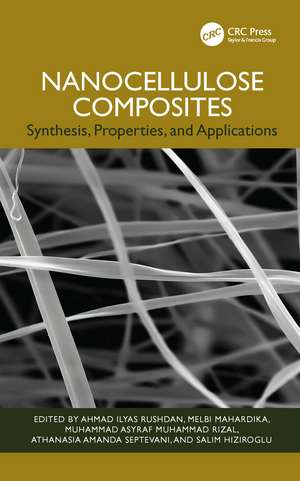
Nanocellulose Composites: Synthesis, Properties, and Applications
Editat de Ahmad Ilyas Rushdan, Melbi Mahardika, Muhammad Asyraf Muhammad Rizal, Athanasia Amanda Septevani, Salim Hizirogluen Limba Engleză Hardback – 23 dec 2026
Key Features
- Serves as a complete resource on nanocellulose composites.
- Helps the readers understand the use of nanocellulose composites in various fields, such as packaging, automotive, marine, medicine, construction, environmental protection, and emerging applications.
- Provides practical advice on the environmental and economic aspects of nanocellulose, with the purpose of assisting readers to make better decisions in their projects.
Offering clear direction on the latest techniques, practical applications, and environmental impacts of these materials, this book is designed for researchers, engineers, and scientists who work in the areas of sustainable materials.
Preț: 1242.73 lei
Preț vechi: 1629.26 lei
-24% Precomandă
Puncte Express: 1864
Carte nepublicată încă
Livrare prin curier în România Precomanda se expediază când titlul devine disponibil.
Transport gratuit pentru acest produs Plată online sau ramburs, în funcție de opțiunile comenzii.
Retur gratuit în 14 zile Comandă securizată și suport în română.
Doresc să fiu notificat când acest titlu va fi disponibil:
Se trimite...
Specificații
ISBN-13: 9781041075103
ISBN-10: 1041075103
Pagini: 556
Ilustrații: 160
Dimensiuni: 156 x 234 mm
Ediția:1
Editura: CRC Press
Colecția CRC Press
ISBN-10: 1041075103
Pagini: 556
Ilustrații: 160
Dimensiuni: 156 x 234 mm
Ediția:1
Editura: CRC Press
Colecția CRC Press
Public țintă
PostgraduateCuprins
0. Front Matter. Part I: Introduction to Nanocellulose. 1. Introduction to Nanocellulose Composites Synthesis, Structure, Properties, and Applications. 2. Sources and Types of Nanocellulose. Part II: Synthesis and Processing. 3. Chemical Approaches for Nanocellulose Production and Functionalization. 4. Mechanical Synthesis of Nanocellulose. 5. Biological and Green Synthesis Methods. Part III: Structure and Properties. 6. Structural Characteristics of Nanocellulose. 7. Surface Chemistry and Functionalization of Nanocellulose. 8. Mechanical Properties of Nanocellulose. 9. Thermal and Rheological Properties of Cellulose and Cellulose-Based Nanomaterials. Part IV: Nanocellulose Composites. 10. Fabrication of Nanocellulose Composites. 11. Nanocellulose-Reinforced Concrete Composite Materials in Construction and Highway Engineering. 12. Nanocellulose-Reinforced Polymer Composites: Performance and Prospects as Sustainable Materials. 13. Nanocellulose-Reinforced Biopolymer Composites. 14. Nanocellulose-Reinforced Ceramic Composite Materials for Energy Applications. Part V: Applications. 15. Nanocellulose Composites in Biomedical Applications. 16. Nanocellulose-Based Porous Polymer Composites for Thermal Building Insulation. 17. Industrial Application of Nanocellulose-Based Nanocomposites. 18. Progress in Nanocellulose: A Green Solution for Electrochemical Energy Systems. 19. Nanocellulose Composites in Food Packaging. 20. Application of Nanocellulose Materials for Wastewater Treatment: Mechanisms, Efficiencies, and Future Approaches. 21. Future Directions and Emerging Applications in Nanocellulose Composites. Part VI: Sustainable and Perspectives. 22. Recycling of Nanocellulose Composites. 23. Life Cycle Assessment of Nanocellulose-Based Bioplastics: Environmental Opportunities, Challenges, and Pathways to Sustainable Practice. 24. Life Cycle Costing and Economic Feasibility of Nanocellulose-Reinforced Composite Materials. 25. Challenges and Future Perspectives.
Notă biografică
Ahmad Ilyas Rushdan is with the Faculty of Chemical and Energy Engineering and the Centre for Advanced Composite Materials (CACM), Universiti Teknologi Malaysia, Malaysia.
Melbi Mahardika is with the Research Center for Biomass and Bioproducts, National Research and Innovation Agency, Indonesia.
Muhammad Asyraf Muhammad Rizal is with the Centre for Advanced Composite Materials and Department of Applied Mechanics and Design, Faculty of Mechanical Engineering, Universiti Teknologi Malaysia, Malaysia.
Athanasia Amanda Septevani is with the Research Center for Electronics, National Research and Innovation Agency (BRIN), Bandung, Indonesia, Research Collaboration Center for Nanocellulose BRIN‑Andalas University, Padang, Indonesia, and Research Collaboration Center for Electrochemistry, BRIN – UNDIP, Semarang, Indonesia.
Salim Hiziroglu is Professor Emeritus, Natural Resource Ecology and Management, Oklahoma State University, USA.
Melbi Mahardika is with the Research Center for Biomass and Bioproducts, National Research and Innovation Agency, Indonesia.
Muhammad Asyraf Muhammad Rizal is with the Centre for Advanced Composite Materials and Department of Applied Mechanics and Design, Faculty of Mechanical Engineering, Universiti Teknologi Malaysia, Malaysia.
Athanasia Amanda Septevani is with the Research Center for Electronics, National Research and Innovation Agency (BRIN), Bandung, Indonesia, Research Collaboration Center for Nanocellulose BRIN‑Andalas University, Padang, Indonesia, and Research Collaboration Center for Electrochemistry, BRIN – UNDIP, Semarang, Indonesia.
Salim Hiziroglu is Professor Emeritus, Natural Resource Ecology and Management, Oklahoma State University, USA.
Descriere
This text details the fast-growing area of nanocellulose materials. It explains how nanocellulose is made, its structure, and how it is used in different fields. Content covered starts at the basics, such as types and sources of nanocellulose, to more advanced topics like sustainability assessment, recycling and environmental impact.