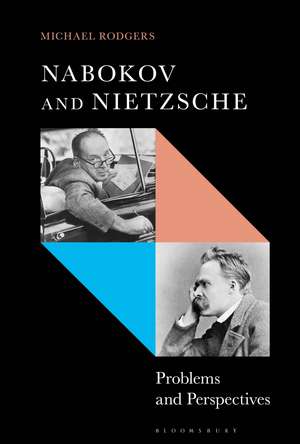
Nabokov and Nietzsche: Problems and Perspectives
Autor Dr Michael Rodgersen Limba Engleză Paperback – 31 oct 2019
Shortlisted for The European Society for the Study of English (ESSE) Book Award
Nabokov and Nietzsche: Problems and Perspectives addresses the many knotted issues in the work of Vladimir Nabokov - Lolita's moral stance, Pnin's relationship with memory, Pale Fire's ambiguous internal authorship - that often frustrate interpretation. It does so by arguing that the philosophy of Friedrich Nietzsche, as both a conceptual instrument and a largely unnoticed influence on Nabokov himself, can help to untie some of these knots.
The study addresses the fundamental problems in Nabokov's writing that make his work perplexing, mysterious and frequently uneasy rather than simply focusing on the literary puzzles and games that, although inherent, do not necessarily define his body of work. Michael Rodgers shows that Nietzsche's philosophy provides new, but not always palatable, perspectives in order to negotiate interpretative impasses, and that the uneasy aspects of Nabokov's work offer the reader manifold rewards.
Preț: 247.54 lei
Preț vechi: 324.69 lei
-24%
Puncte Express: 371
Carte tipărită la comandă
Livrare economică 23 noiembrie-07 decembrie
Livrare prin curier în România Termenul estimat este afișat lângă disponibilitate.
Transport gratuit de la 400.00 lei Plată online sau ramburs, în funcție de opțiunile comenzii.
Retur gratuit în 14 zile Comandă securizată și suport în română.
Specificații
ISBN-13: 9781501359132
ISBN-10: 1501359134
Pagini: 192
Ilustrații: 2 b/w illustrations
Dimensiuni: 152 x 229 x 14 mm
Greutate: 0.26 kg
Editura: Bloomsbury Publishing
Colecția Bloomsbury Academic
Locul publicării:New York, United States
ISBN-10: 1501359134
Pagini: 192
Ilustrații: 2 b/w illustrations
Dimensiuni: 152 x 229 x 14 mm
Greutate: 0.26 kg
Editura: Bloomsbury Publishing
Colecția Bloomsbury Academic
Locul publicării:New York, United States
V-ar putea interesa
-
 The Cambridge Companion to Anthony TrollopeCarolyn DeverPreț: 239.01 lei
 -
 The Color of a Woman's HeartCasey S LeasurePreț: 73.97 lei
 -
 Aesop and the Imprint of Medieval ThoughtJacqueline De WeeverPreț: 430.99 lei
 -
 Preț: 228.22 lei
 -
 Preț: 383.88 lei
 -
 Black on EarthKimberly N RuffinPreț: 259.80 lei
 -
 -23%Preț: 590.06 lei766.32 lei
 -
 Warriors of the TaoDamien BroderickPreț: 134.64 lei
 -
 Late Book Culture in ArgentinaDr. Craig Epplin-24%Preț: 275.29 lei360.32 lei
 -
 Cormac McCarthy's Borders and LandscapesLouise Jillett-14%Preț: 899.28 lei1045.68 lei
 -
 Falling After 9/11: Crisis in American Art and LiteratureDr. Aimee Pozorski-16%Preț: 274.81 lei327.84 lei
 -
 The Testimonies of Russian and American Postmodern Poetry: Reference, Trauma, and HistoryDr. Albena Lutzkanova-Vassileva-25%Preț: 279.26 lei370.21 lei
 -
 -25%Preț: 279.66 lei370.42 lei
 -
 The Introspective Art of Mark TwainProf. Douglas Anderson-25%Preț: 208.15 lei275.96 lei
 -
 -22%Preț: 84.66 lei107.90 lei
 -
 Live PoetryJulia NovakPreț: 388.94 lei
Cuprins
Acknowledgments
Permissions
List of Abbreviations
Introduction
Section I: Nietzschean Engagements
1. Eternal Recurrence and Nabokov's Art of Memory
2. The Will to Disempower: Nabokov and His Readers
Section II: Nietzschean Readings
3. Lolita's Nietzschean Morality
4. Pale Fire: A Differing Perspective
Section III: Beyond Nietzsche
5. Rewriting Nietzsche
6. Nabokov's 'Other' World
Conclusion
Bibliography
Index
Permissions
List of Abbreviations
Introduction
Section I: Nietzschean Engagements
1. Eternal Recurrence and Nabokov's Art of Memory
2. The Will to Disempower: Nabokov and His Readers
Section II: Nietzschean Readings
3. Lolita's Nietzschean Morality
4. Pale Fire: A Differing Perspective
Section III: Beyond Nietzsche
5. Rewriting Nietzsche
6. Nabokov's 'Other' World
Conclusion
Bibliography
Index
Recenzii
Like many Russian writers during the Silver Age, Nabokov was familiar with the philosophy of Friedrich Nietzsche. Rather than providing a traditional study of influence, however, Rodgers uses Nietzschean themes that surface in Nabokov's work-including eternal recurrence, amor fati, master-slave morality, the Übermensch, and productive experiences of moral disorientation and perspectivism (which demands individuals' active engagement with truth)- to examine, often with insight and subtlety, problems in interpreting the author and his writing that have haunted Nabokov studies for decades.
Nabokov and Nietzsche identifies a new, previously unexamined and capaciously illuminating intellectual context for the writings and opinions of this émigré Russian novelist turned international celebrity, even as it provides a wide range of insights into contemporary Nabokov criticism.
Offers a much richer and more complex engagement with Nabokov and Nietzsche, as [Rodgers'] book exemplifies the productive ways literature and philosophy can be read together, can reflect but, more importantly, challenge each other ... Well organized.
Nabokov and Nietzsche: Problems and Perspectives is the first in-depth examination of the relationship between Vladimir Nabokov's writing and Friedrich Nietzsche's philosophy. Rodgers delivers on his promise to provide an interesting contribution that covers an existing lacuna in the Nabokov studies. His book is engaging reading for all those interested in the history of ideas and in the adoption of philosophical concepts by modernist literature.
Michael Rodgers' study, initiated by his discovery of Zarathustra on a book list compiled by Nabokov in Bolshevik Russia in 1918, constructs an engaging and compelling argument for the validity of reading Nabokov in the light of Nietzschean thought. Through its lively and insightful analysis of Nabokov's fiction, criticism and auto/biography, set against the principal tenets of Nietzsche's philosophy-eternal recurrence, the fluidity of truth and the Übermensch-Nabokov and Nietzsche enriches our responses both to problematic issues of transgression, alienation and discomfort across Nabokov's work, and to fundamental questions of morality and metaphysics.
Nabokov was certainly influenced by Nietzsche because almost every European writer in his generation was, but this subtle and intelligent book takes us far beyond the question of direct debt. A series of astute readings of key moments in Nabokov's work suggests that his achievement was the creation not of bliss, as he said, or of pure art or indirect morality, but of a complex 'uneasiness' that is the artistic measure of the unsettled world Nietzsche set us on the path to understanding.
Michael Rogers' book Nabokov and Nietzsche: Problems and Prospects is of great interest. Its author offers something more than a comparative study . offers a fascinating journey through the world of Nabokov's works . Rogers' concept as a whole is compelling, fruitful, and indeed allows us to see the many intersections between Nabokov's work and Nietzsche's philosophy.
Nabokov and Nietzsche identifies a new, previously unexamined and capaciously illuminating intellectual context for the writings and opinions of this émigré Russian novelist turned international celebrity, even as it provides a wide range of insights into contemporary Nabokov criticism.
Offers a much richer and more complex engagement with Nabokov and Nietzsche, as [Rodgers'] book exemplifies the productive ways literature and philosophy can be read together, can reflect but, more importantly, challenge each other ... Well organized.
Nabokov and Nietzsche: Problems and Perspectives is the first in-depth examination of the relationship between Vladimir Nabokov's writing and Friedrich Nietzsche's philosophy. Rodgers delivers on his promise to provide an interesting contribution that covers an existing lacuna in the Nabokov studies. His book is engaging reading for all those interested in the history of ideas and in the adoption of philosophical concepts by modernist literature.
Michael Rodgers' study, initiated by his discovery of Zarathustra on a book list compiled by Nabokov in Bolshevik Russia in 1918, constructs an engaging and compelling argument for the validity of reading Nabokov in the light of Nietzschean thought. Through its lively and insightful analysis of Nabokov's fiction, criticism and auto/biography, set against the principal tenets of Nietzsche's philosophy-eternal recurrence, the fluidity of truth and the Übermensch-Nabokov and Nietzsche enriches our responses both to problematic issues of transgression, alienation and discomfort across Nabokov's work, and to fundamental questions of morality and metaphysics.
Nabokov was certainly influenced by Nietzsche because almost every European writer in his generation was, but this subtle and intelligent book takes us far beyond the question of direct debt. A series of astute readings of key moments in Nabokov's work suggests that his achievement was the creation not of bliss, as he said, or of pure art or indirect morality, but of a complex 'uneasiness' that is the artistic measure of the unsettled world Nietzsche set us on the path to understanding.
Michael Rogers' book Nabokov and Nietzsche: Problems and Prospects is of great interest. Its author offers something more than a comparative study . offers a fascinating journey through the world of Nabokov's works . Rogers' concept as a whole is compelling, fruitful, and indeed allows us to see the many intersections between Nabokov's work and Nietzsche's philosophy.