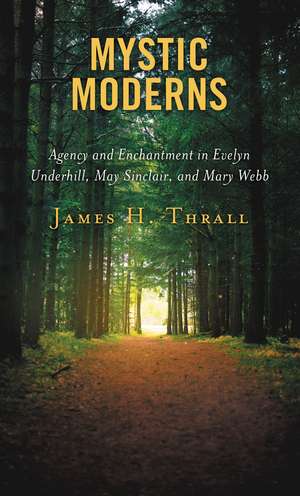
Mystic Moderns: Agency and Enchantment in Evelyn Underhill, May Sinclair, and Mary Webb
Autor James H. Thrallen Limba Engleză Hardback – 21 ian 2020
Working as they did within the shadow of the First World War, Underhill, Sinclair, and Webb were, in the end, attempting to determine what might be of authentic value for a modern age marked by ubiquitous death. While not themselves utopian authors, each was touched by her era's complicated hunger for the best of all possible worlds. Their constructions of how an individual should be and act in the midst of modernity thus simultaneously projected visions of what that modernity itself should become.
Preț: 674.72 lei
Preț vechi: 1055.29 lei
-36%
Puncte Express: 1012
Carte tipărită la comandă
Livrare economică 23 noiembrie-07 decembrie
Livrare prin curier în România Termenul estimat este afișat lângă disponibilitate.
Transport gratuit pentru acest produs Plată online sau ramburs, în funcție de opțiunile comenzii.
Retur gratuit în 14 zile Comandă securizată și suport în română.
Specificații
ISBN-13: 9781498583770
ISBN-10: 1498583776
Pagini: 336
Ilustrații: 3 b/w photos;
Dimensiuni: 161 x 227 x 26 mm
Greutate: 0.59 kg
Editura: Bloomsbury Publishing
Colecția Lexington Books
Locul publicării:New York, United States
ISBN-10: 1498583776
Pagini: 336
Ilustrații: 3 b/w photos;
Dimensiuni: 161 x 227 x 26 mm
Greutate: 0.59 kg
Editura: Bloomsbury Publishing
Colecția Lexington Books
Locul publicării:New York, United States
Cuprins
Introduction: Agencies and Innovations
Chapter One: Considering the New: "modern," "modernity," and "modernism"
Part One: Evelyn Underhill's Heroic Mysticism
Chapter Two: Mystic Modes: Living, Dying, Knowing
Chapter Three: Catholic Aesthetics and Medieval Modernity
Chapter Four: Magics and Mysticisms: Finding a New Orthodoxy
Chapter Five: The Heroic Individual on the Mystic Way
Chapter Six: Gender, Class, and Mysticism
Part Two: May Sinclair's Erotic Mysticism
Chapter Seven: Language and the Lure of Idealism
Chapter Eight: Deepest Desires: Embracing Erotic Mysticism
Chapter Nine: Maintaining Control: Will and the Boundaries of Self
Chapter Ten: Evolution's Promise: Consciousness, Species, Religion
Chapter Eleven: Modernity, War, and Death: Mystic Responses
Chapter Twelve: Meeting the Dead: Ghost Stories for Moderns
Part Three: Mary Webb's Mysticism of Nature
Chapter Thirteen: Country Living: Tales of Old and New
Chapter Fourteen: Agency and Choice: Romanticism, Mysticism, Capitalism
Chapter Fifteen: Acting Naturally: Christianity, Sexuality, Agency
Chapter Sixteen: Other Ways to Think?: The Puzzle of a Medieval Turn
Conclusion: Connections and Crossings
Chapter One: Considering the New: "modern," "modernity," and "modernism"
Part One: Evelyn Underhill's Heroic Mysticism
Chapter Two: Mystic Modes: Living, Dying, Knowing
Chapter Three: Catholic Aesthetics and Medieval Modernity
Chapter Four: Magics and Mysticisms: Finding a New Orthodoxy
Chapter Five: The Heroic Individual on the Mystic Way
Chapter Six: Gender, Class, and Mysticism
Part Two: May Sinclair's Erotic Mysticism
Chapter Seven: Language and the Lure of Idealism
Chapter Eight: Deepest Desires: Embracing Erotic Mysticism
Chapter Nine: Maintaining Control: Will and the Boundaries of Self
Chapter Ten: Evolution's Promise: Consciousness, Species, Religion
Chapter Eleven: Modernity, War, and Death: Mystic Responses
Chapter Twelve: Meeting the Dead: Ghost Stories for Moderns
Part Three: Mary Webb's Mysticism of Nature
Chapter Thirteen: Country Living: Tales of Old and New
Chapter Fourteen: Agency and Choice: Romanticism, Mysticism, Capitalism
Chapter Fifteen: Acting Naturally: Christianity, Sexuality, Agency
Chapter Sixteen: Other Ways to Think?: The Puzzle of a Medieval Turn
Conclusion: Connections and Crossings
Recenzii
In the novels of three early twentieth century English women writers-Evelyn Underhill, May Sinclair and Mary Webb-Thrall finds similarities and divergences in their various attempts to refute the notion that mysticism has no place in secular and rational modernity. Underhill defends a heroic mysticism, and Sinclair and Webb an erotic and natural mysticism, respectively. As such, they are pioneers of a "New Mysticism." All three focus on the authority of individual experience, the importance of psychology, the primacy of the life force, and the necessity of ethical purpose. Thrall is ploughing new terrain, the fruit of which will be of interest to historians, biographers, scholars of religious thought and of gender studies. Thrall's deep research and clear and accessible writing make Mystic Moderns an important and provocative contribution.
Thrall's book offers an rich exploration of the "modern mysticism" of three distinctive and important writers from the early twentieth century. The work of this trio of women illuminates the cultural complexities and potentials of this period, the deep tensions within the notion of the "modern," and the shifting and permeable boundary between the natural and the supernatural. Thrall's analysis is an invaluable addition to our understanding of the social contexts and effects of modern enchantment.
An utterly engaging, enjoyable study of three British women writers of the late Victorian, Edwardian, and Great-War eras-Evelyn Underhill, May Sinclair, and Mary Webb-who each in her own way pushed back against the dominant materialist, worldly sway of their time through their creation of, among works in other genres, novels that interweave their deeply informed intellectual and existential engagements with mysticism. Composed in admirably lucid prose, James Thrall's work is a tour de force of interdisciplinary scholarship that skillfully brings the perspectives of religious studies, cultural studies, and women-and-gender studies to bear upon his thorough and exacting historical and biographical research into the lives of the three authors and insightful textual analyses of their mystically-informed novels. The book bears out his conclusion that "the terms, aspirations, and stakes of [these three women's] responses to modernity may be markedly relevant today," for "there will always be a need to ask their overarching question about what values are valid to pursue in the context of unsettling change."
Thrall's study productively opens a space for future scholarship to explore the ways in which mystical and spiritual themes continue to find new modes of expression in modernity; to further investigate how mystical themes have been transformed and translated so as to speak to new concerns, address new tensions, and provide new avenues of hope in modernity.
Thrall's book offers an rich exploration of the "modern mysticism" of three distinctive and important writers from the early twentieth century. The work of this trio of women illuminates the cultural complexities and potentials of this period, the deep tensions within the notion of the "modern," and the shifting and permeable boundary between the natural and the supernatural. Thrall's analysis is an invaluable addition to our understanding of the social contexts and effects of modern enchantment.
An utterly engaging, enjoyable study of three British women writers of the late Victorian, Edwardian, and Great-War eras-Evelyn Underhill, May Sinclair, and Mary Webb-who each in her own way pushed back against the dominant materialist, worldly sway of their time through their creation of, among works in other genres, novels that interweave their deeply informed intellectual and existential engagements with mysticism. Composed in admirably lucid prose, James Thrall's work is a tour de force of interdisciplinary scholarship that skillfully brings the perspectives of religious studies, cultural studies, and women-and-gender studies to bear upon his thorough and exacting historical and biographical research into the lives of the three authors and insightful textual analyses of their mystically-informed novels. The book bears out his conclusion that "the terms, aspirations, and stakes of [these three women's] responses to modernity may be markedly relevant today," for "there will always be a need to ask their overarching question about what values are valid to pursue in the context of unsettling change."
Thrall's study productively opens a space for future scholarship to explore the ways in which mystical and spiritual themes continue to find new modes of expression in modernity; to further investigate how mystical themes have been transformed and translated so as to speak to new concerns, address new tensions, and provide new avenues of hope in modernity.