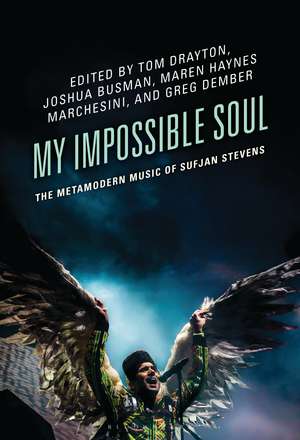
My Impossible Soul: The Metamodern Music of Sufjan Stevens: Studies in Metamodernism: Theory and Criticism across the Disciplines
Editat de Dr Tom Drayton, Joshua Kalin Busman, Author Maren Haynes Marchesini, Greg Demberen Limba Engleză Hardback – 5 feb 2026
Contributors critically examine Stevens' output and impact across the relevant fields of musicology, literature, queer theory, performance studies, religious studies, and cultural studies. The volume provides the first international and interdisciplinary analysis of the music, lyrics, performance process and cultural impact of Sufjan Stevens, through the framework of metamodernism.


Preț: 551.21 lei
Preț vechi: 783.02 lei
-30%
Puncte Express: 827
Carte disponibilă
Livrare economică 31 octombrie-14 noiembrie
Livrare prin curier în România Termenul estimat este afișat lângă disponibilitate.
Transport gratuit pentru acest produs Plată online sau ramburs, în funcție de opțiunile comenzii.
Retur gratuit în 14 zile Comandă securizată și suport în română.
Specificații
ISBN-13: 9798216365549
Pagini: 272
Dimensiuni: 148 x 230 x 20 mm
Greutate: 0.53 kg
Editura: Bloomsbury Publishing
Colecția Bloomsbury Academic
Seria Studies in Metamodernism: Theory and Criticism across the Disciplines
Locul publicării:New York, United States
Pagini: 272
Dimensiuni: 148 x 230 x 20 mm
Greutate: 0.53 kg
Editura: Bloomsbury Publishing
Colecția Bloomsbury Academic
Seria Studies in Metamodernism: Theory and Criticism across the Disciplines
Locul publicării:New York, United States
Cuprins
List of Figures and Tables
Acknowledgements
"Words are Futile Devices": An Introduction
Tom Drayton (The University of East London, UK) & Greg Dember (independent scholar)
PART I: FAITH
1. "I Heard a Voice in My Mind": Sacred Self-Protagonizing and the Oscillations of American Evangelicals
Joshua K. Busman (University of North Carolina at Pembroke, USA)
2. A Metamodern Analysis of Spirituality Through Music in Sufjan Stevens' Cover of Bob Dylan's "Ring Them Bells"
Libby Myers (Griffith University, Australia)
PART II: LOVE
3. "No Shade in the Shadow of the Cross": Sufjan Stevens - in Search of (Queer) Faith
Ka Ki Samuel Wan (Robert Menzies College, Australia)
4. "Saying It Out Loud Is Hard": Sufjan Stevens, Queer Interpretation and Fan Reception
Heather Salus (independent scholar)
5. "Make Me an Offer I Cannot Refuse:" New Sincerity and the Hermeneutics of Platitude in Sufjan Stevens' The Ascension
Paria Rahmani (University of North Texas, USA)
PART III: AMERICANA
6. America, My Beloved: "A Picture of the Scenery" in Sufjan Stevens' National Mythology
Tanya Jones (Queensland Conservatorium Griffith University, Australia)
7. "Christmas in July": A Musicological Analysis of Metamodernist Impulses in Sufjan Stevens' Christmas Collections
Daniel White (University of Huddersfield, UK)
8. Sufjan Stevens and the Metamodern Holiday
Michael Blouin (Milligan University, USA)
PART IV: DEATH
9. The Persistence of the "Murdering Ghost": Sufjan Stevens and the Hauntology of (Im)Possibilities
Debakanya Haldar (University of Florida, USA)
10. Genuflecting Ghost: Sufjan Stevens' Javelin as Metamodern Mystical Memento Mori
Joel Mayward (George Fox University, USA)
11. Sufjan Stevens' Impossible Soul: Metamodern Intimacy, Polysubjectivity, and Plausible Deniability
Maren Haynes Marchesini (independent scholar)
About the Contributors
Index
Acknowledgements
"Words are Futile Devices": An Introduction
Tom Drayton (The University of East London, UK) & Greg Dember (independent scholar)
PART I: FAITH
1. "I Heard a Voice in My Mind": Sacred Self-Protagonizing and the Oscillations of American Evangelicals
Joshua K. Busman (University of North Carolina at Pembroke, USA)
2. A Metamodern Analysis of Spirituality Through Music in Sufjan Stevens' Cover of Bob Dylan's "Ring Them Bells"
Libby Myers (Griffith University, Australia)
PART II: LOVE
3. "No Shade in the Shadow of the Cross": Sufjan Stevens - in Search of (Queer) Faith
Ka Ki Samuel Wan (Robert Menzies College, Australia)
4. "Saying It Out Loud Is Hard": Sufjan Stevens, Queer Interpretation and Fan Reception
Heather Salus (independent scholar)
5. "Make Me an Offer I Cannot Refuse:" New Sincerity and the Hermeneutics of Platitude in Sufjan Stevens' The Ascension
Paria Rahmani (University of North Texas, USA)
PART III: AMERICANA
6. America, My Beloved: "A Picture of the Scenery" in Sufjan Stevens' National Mythology
Tanya Jones (Queensland Conservatorium Griffith University, Australia)
7. "Christmas in July": A Musicological Analysis of Metamodernist Impulses in Sufjan Stevens' Christmas Collections
Daniel White (University of Huddersfield, UK)
8. Sufjan Stevens and the Metamodern Holiday
Michael Blouin (Milligan University, USA)
PART IV: DEATH
9. The Persistence of the "Murdering Ghost": Sufjan Stevens and the Hauntology of (Im)Possibilities
Debakanya Haldar (University of Florida, USA)
10. Genuflecting Ghost: Sufjan Stevens' Javelin as Metamodern Mystical Memento Mori
Joel Mayward (George Fox University, USA)
11. Sufjan Stevens' Impossible Soul: Metamodern Intimacy, Polysubjectivity, and Plausible Deniability
Maren Haynes Marchesini (independent scholar)
About the Contributors
Index
Recenzii
My Impossible Soul interweaves cultural theory and philosophy, fan accounts, music
journalism, and personal musical experiences to create a fabric that is, in-keeping with
metamodernism, both carefully interlaced yet thoughtfully frayed. Through examining
the work of Sufjan Stevens, the authors present a compelling case for a metamodern
mode of hearing and reading music."
Sufjan Stevens's fans know that his music moves between seemingly dichotomous poles: intimate and expansive, playfully ironic and sincere, programmatic and impressionistic, sacred and profane. It can be difficult to reconcile the personal singer-songwriterly introspection heard on Seven Swans and Carrie and Lowell with the experimental, orchestral sweep of The BQE or The Age of Adz. Stevens is clearly a master of pop aesthetics and form-crystallized on The Ascension and Javelin, as a foundation for the ambitious Michigan and Illinois albums, or reduced to pastiche on his sprawling Christmas EP collections-and yet he remains unafraid to explore more ambient soundworlds on Aporia and Convocations or classicism on Planetarium.
As the editors of My Impossible Soul argue, Stevens does not resolve these tensions but appears to relish inhabiting them. It is precisely this inhabiting that provides the metamodern foundation for this volume. As a framework that foregrounds the oscillation and interleaving of skepticism and sincerity as a critical state, metamodernism enables My Impossible Soul's contributors to investigate how Stevens, his music, and its listeners trace "ironesty" (the braiding together of irony and honesty) through similarly complicated (and seemingly contradictory) approaches to understanding Christian faith, grief, love, national identity, and queerness, among other themes.
When he emerged in the early aughts (initially gaining visibility as part of experimental gospel/folk artist Daniel Smith's cadre), Sufjan Stevens marked a clear progression from indie rock's ironic detachment in the 1990s. Like Stevens, My Impossible Soul marks a turn to a new critical approach to popular music: moving fluidly between introspective and outward-looking gestures, centering affect and analysis not as contradictions, nor tensions to be resolved, but rather as a productive critical space to feel and inhabit.
journalism, and personal musical experiences to create a fabric that is, in-keeping with
metamodernism, both carefully interlaced yet thoughtfully frayed. Through examining
the work of Sufjan Stevens, the authors present a compelling case for a metamodern
mode of hearing and reading music."
Sufjan Stevens's fans know that his music moves between seemingly dichotomous poles: intimate and expansive, playfully ironic and sincere, programmatic and impressionistic, sacred and profane. It can be difficult to reconcile the personal singer-songwriterly introspection heard on Seven Swans and Carrie and Lowell with the experimental, orchestral sweep of The BQE or The Age of Adz. Stevens is clearly a master of pop aesthetics and form-crystallized on The Ascension and Javelin, as a foundation for the ambitious Michigan and Illinois albums, or reduced to pastiche on his sprawling Christmas EP collections-and yet he remains unafraid to explore more ambient soundworlds on Aporia and Convocations or classicism on Planetarium.
As the editors of My Impossible Soul argue, Stevens does not resolve these tensions but appears to relish inhabiting them. It is precisely this inhabiting that provides the metamodern foundation for this volume. As a framework that foregrounds the oscillation and interleaving of skepticism and sincerity as a critical state, metamodernism enables My Impossible Soul's contributors to investigate how Stevens, his music, and its listeners trace "ironesty" (the braiding together of irony and honesty) through similarly complicated (and seemingly contradictory) approaches to understanding Christian faith, grief, love, national identity, and queerness, among other themes.
When he emerged in the early aughts (initially gaining visibility as part of experimental gospel/folk artist Daniel Smith's cadre), Sufjan Stevens marked a clear progression from indie rock's ironic detachment in the 1990s. Like Stevens, My Impossible Soul marks a turn to a new critical approach to popular music: moving fluidly between introspective and outward-looking gestures, centering affect and analysis not as contradictions, nor tensions to be resolved, but rather as a productive critical space to feel and inhabit.