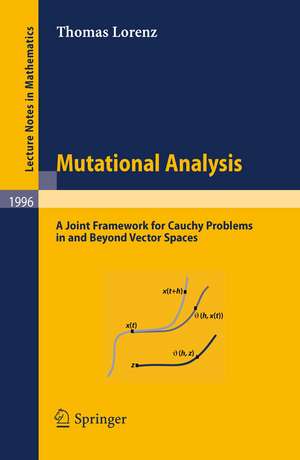
Mutational Analysis
Autor Thomas Lorenzen Limba Engleză Paperback – 9 iun 2010
Preț: 439.06 lei
Puncte Express: 659
Carte tipărită la comandă
Livrare economică 18-24 august
Livrare prin curier în România Termenul estimat este afișat lângă disponibilitate.
Transport gratuit pentru acest produs Plată online sau ramburs, în funcție de opțiunile comenzii.
Retur gratuit în 14 zile Comandă securizată și suport în română.
Specificații
ISBN-13: 9783642124709
ISBN-10: 3642124704
Pagini: 532
Ilustrații: XIV, 509 p. 57 illus. in color.
Dimensiuni: 155 x 235 x 27 mm
Greutate: 0.89 kg
Ediția:2010
Editura: Springer
Locul publicării:Berlin, Heidelberg, Germany
ISBN-10: 3642124704
Pagini: 532
Ilustrații: XIV, 509 p. 57 illus. in color.
Dimensiuni: 155 x 235 x 27 mm
Greutate: 0.89 kg
Ediția:2010
Editura: Springer
Locul publicării:Berlin, Heidelberg, Germany
V-ar putea interesa
-
 -27%Preț: 750.95 lei1028.69 lei
 -
 User and Task Analysis for Interface DesignJoann T Hackos-20%Preț: 513.40 lei641.75 lei
 -
 Iterative Krylov Methods for Large Linear SystemsHenk A. van der Vorst-11%Preț: 462.00 lei519.10 lei
 -
 DistributionsJ J Duistermaat-15%Preț: 578.42 lei680.50 lei
 -
 Implicit Functions and Solution MappingsAsen L. Dontchev-15%Preț: 575.02 lei676.50 lei
 -
 More Calculus of a Single VariablePeter R. MercerPreț: 167.15 lei
 -
 Mathematical Cardiac ElectrophysiologyPiero Colli Franzone-15%Preț: 655.77 lei771.48 lei
 -
 Complex AnalysisEberhard Freitag-15%Preț: 486.93 lei572.86 lei
 -
 Spectral Analysis on Graph-like SpacesOlaf PostPreț: 477.09 lei
 -
 The Concept of Stability in Numerical MathematicsWolfgang HackbuschPreț: 383.27 lei
 -
 An Introduction to Teichmüller SpacesYoichi Imayoshi-15%Preț: 567.01 lei667.07 lei
 -
 Wiener Chaos: Moments, Cumulants and DiagramsGiovanni PeccatiPreț: 382.57 lei
 -
 -15%Preț: 438.43 lei515.79 lei
Public țintă
GraduateCuprins
Extending Ordinary Differential Equations to Metric Spaces: Aubin’s Suggestion.- Adapting Mutational Equations to Examples in Vector Spaces: Local Parameters of Continuity.- Less Restrictive Conditions on Distance Functions: Continuity Instead of Triangle Inequality.- Introducing Distribution-Like Solutions to Mutational Equations.- Mutational Inclusions in Metric Spaces.
Recenzii
From the reviews:
“This monograph contains bibliographical notes, references, index of notations and index. In short the entire monograph is written clearly … . This monograph is suitable for graduate students and researchers in this field.” (Seenith Sivasundaram, Zentralblatt MATH, Vol. 1198, 2010)
“The book Mutational analysis by Thomas Lorenz is a tour de force for a young mathematician working in a new field. It is indeed an excellent, innovative and highly technical book of over 500 pages, clearly and carefully written … . this excellent book is a basic, original and very useful monograph for the development of mutational analysis both in control theory and partial differential equations.” (Jean-Pierre Aubin, Mathematical Reviews, Issue 2011 h)
“This monograph contains bibliographical notes, references, index of notations and index. In short the entire monograph is written clearly … . This monograph is suitable for graduate students and researchers in this field.” (Seenith Sivasundaram, Zentralblatt MATH, Vol. 1198, 2010)
“The book Mutational analysis by Thomas Lorenz is a tour de force for a young mathematician working in a new field. It is indeed an excellent, innovative and highly technical book of over 500 pages, clearly and carefully written … . this excellent book is a basic, original and very useful monograph for the development of mutational analysis both in control theory and partial differential equations.” (Jean-Pierre Aubin, Mathematical Reviews, Issue 2011 h)
Textul de pe ultima copertă
Ordinary differential equations play a central role in science and have been extended to evolution equations in Banach spaces. For many applications, however, it is difficult to specify a suitable normed vector space. Shapes without a priori restrictions, for example, do not have an obvious linear structure.This book generalizes ordinary differential equations beyond the borders of vector spaces with a focus on the well-posed Cauchy problem in finite time intervals.Here are some of the examples:- Feedback evolutions of compact subsets of the Euclidean space- Birth-and-growth processes of random sets (not necessarily convex)- Semilinear evolution equations- Nonlocal parabolic differential equations- Nonlinear transport equations for Radon measures- A structured population model- Stochastic differential equations with nonlocal sample dependence and how they can be coupled in systems immediately - due to the joint framework of Mutational Analysis. Finally, the book offers new tools for modelling.
Caracteristici
A broad class of evolution problems handled. Each chapter is quite self-contained so that the reader can select rather freely according to the examples of personal interest. Each example provides a table about its main results and the underlying choice of basic sets, distances etc.- The main points of the general framework are summarized in the introduction so that the reader can get the gist quickly.