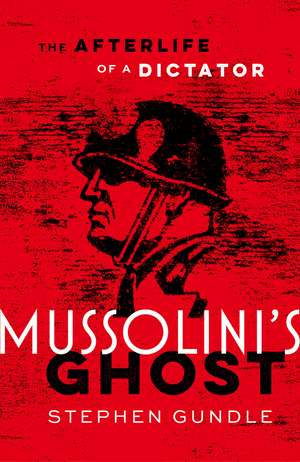
Mussolini's Ghost: The Afterlife of a Dictator
Autor Stephen Gundleen Limba Engleză Hardback – 27 aug 2026
Preț: 150.28 lei
Preț vechi: 193.51 lei
-22% Nou
Puncte Express: 225
Carte disponibilă
Livrare economică 13-18 noiembrie
Livrare express 29 octombrie-04 noiembrie pentru 83.77 lei
Livrare prin curier în România Termenul estimat este afișat lângă disponibilitate.
Transport gratuit de la 400.00 lei Plată online sau ramburs, în funcție de opțiunile comenzii.
Retur gratuit în 14 zile Comandă securizată și suport în română.
Specificații
ISBN-13: 9780198805908
ISBN-10: 019880590X
Pagini: 352
Ilustrații: 19 b&w illustrations
Dimensiuni: 162 x 240 x 30 mm
Greutate: 0.61 kg
Editura: OUP OXFORD
Colecția OUP Oxford
Locul publicării:Oxford, United Kingdom
ISBN-10: 019880590X
Pagini: 352
Ilustrații: 19 b&w illustrations
Dimensiuni: 162 x 240 x 30 mm
Greutate: 0.61 kg
Editura: OUP OXFORD
Colecția OUP Oxford
Locul publicării:Oxford, United Kingdom
Recenzii
Mussolini's Ghost is a tour de force in the history of cultural memory and collective psychology. Through innovative exploration of written and visual sources, memorabilia, artifacts and physical places, Stephen Gundle reveals the ways in which Mussolini's cult resonated in the post-war decades, while guiding the reader through the complex intricacy of aftermaths more generally.
Benito Mussolini died in April 1945, shot by Communist partisans and famously hung from his feet from a garage in Milan. But, as this fascinating book shows, he lived on in Italy in so many ways, haunting the country and continuing to provoke debate, but also books, plays, imaginary trials, artworks and numerous other cultural engagements. Stephen Gundle's original and brilliant study unpicks the way that Mussolini has continued to inspire love and hatred, in troubling but also extraordinary ways - from the serious to the absurd. Based on deep and creative research this book will change the way we see the impact and understanding of Italian fascism, and its afterlives.
Delving into the psychological legacy of the 1930's cult of the Duce, Gundle gives us a vivid, perceptive, and convincing explanation of why, almost 100 years on, the ghost of Mussolini still haunts the contemporary political scene in Italy. Arguing that Italy has failed to come to terms with its fascist past, he helps us understand why, despite the disaster of World War II, the fascist leader still retains his fascination for many Italians. Moreover, in confronting the complex relationship between past and present, this study invites us to reflect seriously on the broader question of the formation and role of memory itself.
Over the course of two decades of Fascist dictatorship, the figure of Benito Mussolini exerted a profound emotional and psychological grip on Italy. His hasty execution on the shores of Lake Como in April 1945, and the desecration of his lifeless form in Milan's Piazzale Loreto just afterwards, were never going to be enough to break the Duce's spell. Stephen's Gundle's fascinating and elegantly written study draws on an astonishing range of sources to account for Italians' enduring obsession with Mussolini, and their simultaneous inability to stage a collective reckoning with the hold that he had over them. Gundle's analysis is subtle, profound and utterly absorbing. This is a book destined to be a landmark in our understanding of Fascism's insidious legacy.
Gundle's book offers much of interest. It is well-written, ably structured, and draws on a wide range of sources and texts which are carefully discussed.
This is a well-researched and thought-provoking book with a pressing modern relevance ... [Gundle] makes good points about how important history is to politics (****).
[Gundle] does an excellent job in explaining how the dictator's family ... worked tirelessly to humanise the Duce's posthumous image in the 1950s. ... Gundle is surely right to say that the lack of a full national reckoning with Mussolini's rule is unsettling.
An engrossing study of how a country and its people come to terms with a dictatorship (if they ever do at all)
fascinating and ground breaking ... thought-provoking and beautifully-written
Benito Mussolini died in April 1945, shot by Communist partisans and famously hung from his feet from a garage in Milan. But, as this fascinating book shows, he lived on in Italy in so many ways, haunting the country and continuing to provoke debate, but also books, plays, imaginary trials, artworks and numerous other cultural engagements. Stephen Gundle's original and brilliant study unpicks the way that Mussolini has continued to inspire love and hatred, in troubling but also extraordinary ways - from the serious to the absurd. Based on deep and creative research this book will change the way we see the impact and understanding of Italian fascism, and its afterlives.
Delving into the psychological legacy of the 1930's cult of the Duce, Gundle gives us a vivid, perceptive, and convincing explanation of why, almost 100 years on, the ghost of Mussolini still haunts the contemporary political scene in Italy. Arguing that Italy has failed to come to terms with its fascist past, he helps us understand why, despite the disaster of World War II, the fascist leader still retains his fascination for many Italians. Moreover, in confronting the complex relationship between past and present, this study invites us to reflect seriously on the broader question of the formation and role of memory itself.
Over the course of two decades of Fascist dictatorship, the figure of Benito Mussolini exerted a profound emotional and psychological grip on Italy. His hasty execution on the shores of Lake Como in April 1945, and the desecration of his lifeless form in Milan's Piazzale Loreto just afterwards, were never going to be enough to break the Duce's spell. Stephen's Gundle's fascinating and elegantly written study draws on an astonishing range of sources to account for Italians' enduring obsession with Mussolini, and their simultaneous inability to stage a collective reckoning with the hold that he had over them. Gundle's analysis is subtle, profound and utterly absorbing. This is a book destined to be a landmark in our understanding of Fascism's insidious legacy.
Gundle's book offers much of interest. It is well-written, ably structured, and draws on a wide range of sources and texts which are carefully discussed.
This is a well-researched and thought-provoking book with a pressing modern relevance ... [Gundle] makes good points about how important history is to politics (****).
[Gundle] does an excellent job in explaining how the dictator's family ... worked tirelessly to humanise the Duce's posthumous image in the 1950s. ... Gundle is surely right to say that the lack of a full national reckoning with Mussolini's rule is unsettling.
An engrossing study of how a country and its people come to terms with a dictatorship (if they ever do at all)
fascinating and ground breaking ... thought-provoking and beautifully-written
Notă biografică
Stephen Gundle is Professor of Film and Television Studies at the University of Warwick. He is the author of several works of political and cultural history, including Between Hollywood and Moscow: The Italian Communists and the Challenge of Mass Culture, 1943-91 (2000), Bellissima: Feminine Beauty and the Idea of Italy (2007), Glamour: A History (2009), and co-author of Mass Culture and Italian Society from Fascism to the Cold War (2007).