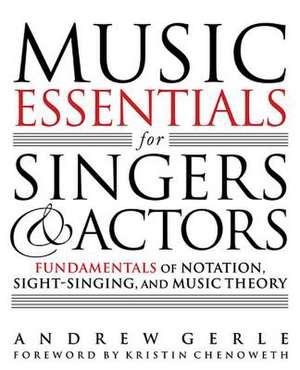
Music Essentials for Singers and Actors: Fundamentals of Notation, Sight-Singing and Music Theory
Autor Andrew Gerle Cuvânt înainte de Kristin Chenowethen Limba Engleză Paperback – aug 2018
Gerle leads readers step by step through every aspect of written music, using over one hundred real-world examples from Broadway scores. His common-sense, methodical approach demystifies abstract concepts, and his unique 1-STARRT method teaches singers to read musical "words" instead of single notes, enabling confident sight-singing of any score. Drawing on his years of experience as a Broadway vocal coach, Gerle also shows readers how to use music theory to think like a composer, analyzing scores for dramatic clues to create a more detailed and powerful performance. Each chapter is accompanied by downloadable audio examples and exercises to lock in newly learned concepts.
Preț: 276.50 lei
Preț vechi: 344.71 lei
-20%
Puncte Express: 415
Carte disponibilă
Livrare economică 03-17 noiembrie
Livrare prin curier în România Termenul estimat este afișat lângă disponibilitate.
Transport gratuit de la 400.00 lei Plată online sau ramburs, în funcție de opțiunile comenzii.
Retur gratuit în 14 zile Comandă securizată și suport în română.
Specificații
ISBN-13: 9781495073762
ISBN-10: 1495073769
Pagini: 256
Dimensiuni: 188 x 232 x 20 mm
Greutate: 0.64 kg
Editura: Bloomsbury Publishing
Colecția Hal Leonard
Locul publicării:New York, United States
ISBN-10: 1495073769
Pagini: 256
Dimensiuni: 188 x 232 x 20 mm
Greutate: 0.64 kg
Editura: Bloomsbury Publishing
Colecția Hal Leonard
Locul publicării:New York, United States
V-ar putea interesa
-
 Film Sound (Paper)B WeisPreț: 325.25 lei
 -
 Sound-On-Film: Interviews with Creators of Film SoundVincent LoBrutto-32%Preț: 259.97 lei379.72 lei
 -
 Sound Theory/Sound PracticeRick AltmanPreț: 401.24 lei
 -
 Singing and the ActorGillyanne Kayes-18%Preț: 155.61 lei190.91 lei
 -
 Voice and Speech in the TheatreJ. Clifford Turner-17%Preț: 162.58 lei195.95 lei
 -
 The Science of the Singing VoiceJohan SundbergPreț: 344.71 lei
 -
 Studying Musical Theatre: Theory and PracticeMillie Taylor-25%Preț: 188.23 lei251.33 lei
 -
 VoiceJane Boston-27%Preț: 212.78 lei292.55 lei
 -
 Musical Theatre, Realism and EntertainmentMillie Taylor-15%Preț: 473.86 lei557.49 lei
 -
 How to Direct a MusicalDavid Young-15%Preț: 418.00 lei491.77 lei
 -
 Voice into Acting: Integrating Voice and the Stanislavski ApproachChristina Gutekunst-18%Preț: 199.25 lei244.20 lei
 -
 The Alexander Technique for MusiciansJudith Kleinman-19%Preț: 191.73 lei236.64 lei
 -
 Preț: 238.55 lei
 -
 Le Théâtre en France, histoire de la littérature dramatique, (Éd.1892)Louis Petit De JullevillePreț: 216.09 lei
 -
 Preț: 208.71 lei
 -
 Preț: 192.26 lei
 -
 Les Transformations de l'Opéra-comique, (Éd.1865)Auguste ThurnerPreț: 164.31 lei
 -
 Preț: 169.36 lei
 -
 Preț: 131.07 lei
 -
 Mémoires d'Hyppolite Clairon, et réflexions sur l'art dramatique publiés (Éd.1798)Mademoiselle ClaironPreț: 185.41 lei
 -
 Nouvelle théorie du jeu de la canneLarribeauPreț: 101.98 lei
 -
 Preț: 207.95 lei
 -
 Preț: 87.38 lei
 -
 Preț: 86.92 lei
 -
 Preț: 401.81 lei
 -
 Preț: 307.35 lei
Cuprins
Foreword by Kristen Chenoweth
Author's Note
1. Willkommen
A Little Brains, a Little Talent: the ingredients for a career
Racing with the Clock: how to make the most of your rehearsal time
Side by Side: an artistic collaboration with the writer
The Sound of Music: the elements of musical notation
What More Do I Need?: required tools of the trade
2. I Got Rhythm: fundamentals
The Rhythm of Life: how we divide time
You Can't Stop the Beat: first definitions, quarter notes
Just in Time: time signatures, note shapes
The Speed Test: metronomes and their use
Breathe: rests
3. In Short: smaller note values
Tonight at Eight: the eighth note
We Go Together: beams
A Little Bit Off: off-beats and "and"s
I'm Old Fashioned: vocal notation in older scores
Pretty Little Picture: musical "words" and syncopation
Small World: the sixteenth note
4. Hold On: ties and dots
Married: ties
Stay with Me: dots
5. Play a Simple Melody: the piano keyboard, notes, clefs, and staves
I Love a Piano: finding notes on the keyboard
I Could Write a Book: writing notes on the staff
Me, Who Am I?: clefs, letter names, and the grand staff
You Will Be Found: matching notes on the piano with notes on the staff
6. I've Got Your Number: intervals and scale degrees
Go the Distance: basic interval sizes and names
Home: the tonic and scale degrees
Steppin' Out with My Baby: singing with scale degrees
Do-Re-Mi: the Kodály method
7. You Do Something to Me: accidentals, key signatures, and transposition
I am Changing: accidentals and the black keys of the piano
Ring of Keys: the major scale, key signatures, and the circle of fifths
They Just Keep Moving the Line: transposing songs
8. So Big/So Small: identifying and singing every interval type
9.Fascinatin' Rhythm: cut time, triplets, swing; compound, composite and irregular meters
Two by Two: cut time
Squeeze me: triplets and grace notes
By Threes: compound meter
It Don't Mean a Thing: swing notation
Unusual Way: irregular and composite meters
Change Don't Come Easy: shifting meters
10. Let It Sing: combining your ear and your eye for increased fluency
Doin' What Comes Natur'lly: diatonic versus chromatic melodies
Do You Want to Build a Snowman?: triads and inversions
Far from the Home I Love: strategies for chromatic melodies
11. Changing My Major: minor keys
Three Friends: the minor scales
Sing Happy: minor scales in context
Show Me the Key: distinguishing between minor and major keys
Sisters: minor, diminished, and augmented triads
12. I Know Things Now: combining multiple techniques to form a coherent strategy for reading
What Comes Next?: reading ahead
1-STARRT at the Very Beginning: a method for analyzing and annotating any new song
13. No One Is Alone: singing with other performers
Here I Am: finding your starting note
I'm a Part of That: consonance and dissonance with the piano accompaniment; piano/conductor scores
Do You Hear the People Sing?: choral singing and score layouts
14. The Writing on the Wall: musical markings, repeat structure, and other score "road maps"
Be Italian: tempo markings
Loud: dynamic and articulation markings
Stop, Time: pauses and held notes
Speak Low: other expressive markings and spoken text
Back to Before: repeats, D.C., D.S., and codas
Ah, But Underneath: underscoring and vamps
On the Street Where You Live: rehearsal numbers and letters
Do It Again: AABA form and other song structures
15. Hey, Look Me Over: close score reading for dramatic and character analysis
Mama, Look Sharp: every mark is a choice
The Wrong Note Rag: analyzing dissonance and contour to color your performance
Watch What Happens: dramatic inspiration from the piano accompaniment
A Change in Me: reading key changes and altered notes for textual insight
16. I Have Confidence: continuing to practice and consolidate your technique
I Can See It: eye-training exercises
A Trip to the Library: the joys of reading music alone and with others
Author's Note
1. Willkommen
A Little Brains, a Little Talent: the ingredients for a career
Racing with the Clock: how to make the most of your rehearsal time
Side by Side: an artistic collaboration with the writer
The Sound of Music: the elements of musical notation
What More Do I Need?: required tools of the trade
2. I Got Rhythm: fundamentals
The Rhythm of Life: how we divide time
You Can't Stop the Beat: first definitions, quarter notes
Just in Time: time signatures, note shapes
The Speed Test: metronomes and their use
Breathe: rests
3. In Short: smaller note values
Tonight at Eight: the eighth note
We Go Together: beams
A Little Bit Off: off-beats and "and"s
I'm Old Fashioned: vocal notation in older scores
Pretty Little Picture: musical "words" and syncopation
Small World: the sixteenth note
4. Hold On: ties and dots
Married: ties
Stay with Me: dots
5. Play a Simple Melody: the piano keyboard, notes, clefs, and staves
I Love a Piano: finding notes on the keyboard
I Could Write a Book: writing notes on the staff
Me, Who Am I?: clefs, letter names, and the grand staff
You Will Be Found: matching notes on the piano with notes on the staff
6. I've Got Your Number: intervals and scale degrees
Go the Distance: basic interval sizes and names
Home: the tonic and scale degrees
Steppin' Out with My Baby: singing with scale degrees
Do-Re-Mi: the Kodály method
7. You Do Something to Me: accidentals, key signatures, and transposition
I am Changing: accidentals and the black keys of the piano
Ring of Keys: the major scale, key signatures, and the circle of fifths
They Just Keep Moving the Line: transposing songs
8. So Big/So Small: identifying and singing every interval type
9.Fascinatin' Rhythm: cut time, triplets, swing; compound, composite and irregular meters
Two by Two: cut time
Squeeze me: triplets and grace notes
By Threes: compound meter
It Don't Mean a Thing: swing notation
Unusual Way: irregular and composite meters
Change Don't Come Easy: shifting meters
10. Let It Sing: combining your ear and your eye for increased fluency
Doin' What Comes Natur'lly: diatonic versus chromatic melodies
Do You Want to Build a Snowman?: triads and inversions
Far from the Home I Love: strategies for chromatic melodies
11. Changing My Major: minor keys
Three Friends: the minor scales
Sing Happy: minor scales in context
Show Me the Key: distinguishing between minor and major keys
Sisters: minor, diminished, and augmented triads
12. I Know Things Now: combining multiple techniques to form a coherent strategy for reading
What Comes Next?: reading ahead
1-STARRT at the Very Beginning: a method for analyzing and annotating any new song
13. No One Is Alone: singing with other performers
Here I Am: finding your starting note
I'm a Part of That: consonance and dissonance with the piano accompaniment; piano/conductor scores
Do You Hear the People Sing?: choral singing and score layouts
14. The Writing on the Wall: musical markings, repeat structure, and other score "road maps"
Be Italian: tempo markings
Loud: dynamic and articulation markings
Stop, Time: pauses and held notes
Speak Low: other expressive markings and spoken text
Back to Before: repeats, D.C., D.S., and codas
Ah, But Underneath: underscoring and vamps
On the Street Where You Live: rehearsal numbers and letters
Do It Again: AABA form and other song structures
15. Hey, Look Me Over: close score reading for dramatic and character analysis
Mama, Look Sharp: every mark is a choice
The Wrong Note Rag: analyzing dissonance and contour to color your performance
Watch What Happens: dramatic inspiration from the piano accompaniment
A Change in Me: reading key changes and altered notes for textual insight
16. I Have Confidence: continuing to practice and consolidate your technique
I Can See It: eye-training exercises
A Trip to the Library: the joys of reading music alone and with others