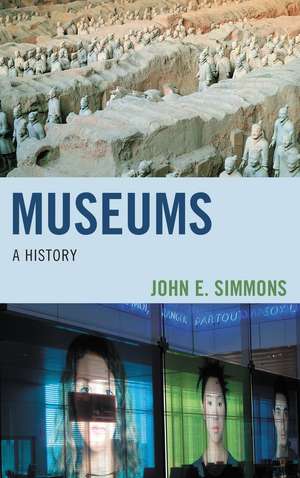
Museums: A History
Autor John E. Simmonsen Limba Engleză Hardback – 7 iul 2016
Readers will come away with an understanding of:
the comprehensive history of museums from prehistoric collections to the presentthe evolution of museums presented in the context of world historythe development of museums considered in diverse cultural contextsglobal perspective on museumsthe object-centered history of museumsmuseums as memory institutionsA constant theme throughout the book is that museums have evolved to become institutions in which objects and learning are associated to help human beings understand the world around them. Illustrations amplify the discussions.
| Toate formatele și edițiile | Preț | Express |
|---|---|---|
| Paperback (1) | 173.77 lei 6-8 săpt. | |
| Bloomsbury Publishing – 11 mai 2022 | 173.77 lei 6-8 săpt. | |
| Hardback (1) | 553.12 lei 6-8 săpt. | |
| Bloomsbury Publishing – 7 iul 2016 | 553.12 lei 6-8 săpt. |
Preț: 553.12 lei
Preț vechi: 830.21 lei
-33%
Puncte Express: 830
Preț estimativ în valută:
97.89€ • 114.40$ • 84.99£
97.89€ • 114.40$ • 84.99£
Carte tipărită la comandă
Livrare economică 19 februarie-05 martie
Preluare comenzi: 021 569.72.76
Specificații
ISBN-13: 9781442263628
ISBN-10: 1442263628
Pagini: 308
Ilustrații: 1 b/w illustrations; 26 b/w photos; 13 tables; 25 textboxes;
Dimensiuni: 156 x 237 x 25 mm
Greutate: 0.69 kg
Editura: Bloomsbury Publishing
Colecția Rowman & Littlefield Publishers
Locul publicării:New York, United States
ISBN-10: 1442263628
Pagini: 308
Ilustrații: 1 b/w illustrations; 26 b/w photos; 13 tables; 25 textboxes;
Dimensiuni: 156 x 237 x 25 mm
Greutate: 0.69 kg
Editura: Bloomsbury Publishing
Colecția Rowman & Littlefield Publishers
Locul publicării:New York, United States
V-ar putea interesa
-
 -29%Preț: 844.64 lei1195.20 lei
 -
 Leadership, Mission, and Governance: Small Museum Toolkit, Book OneCinnamon Catlin-Legutko-19%Preț: 312.75 lei385.21 lei
 -
 Organizational Management: Small Museum Toolkit, Book ThreeCinnamon Catlin-Legutko-19%Preț: 312.25 lei384.91 lei
 -
 Reaching and Responding to the Audience: Small Museum Toolkit, Book FourCinnamon Catlin-Legutko-19%Preț: 312.75 lei385.21 lei
 -
 Interpretation: Education, Programs, and Exhibits: Small Museum Toolkit, Book FiveCinnamon Catlin-Legutko-19%Preț: 312.25 lei384.91 lei
 -
 Stewardship: Collections and Historic Preservation: Small Museum Toolkit, Book SixCinnamon Catlin-Legutko-19%Preț: 313.23 lei385.51 lei
 -
 The SmithsonianWebster Prentiss TruePreț: 153.77 lei
Cuprins
Chapter 1. What is a Collection? What is a Museum?
Chapter 2. Hoards and Tombs?Collections in the Ancient World (to 700 BCE)
Chapter 3. The Temple of the Muses-the Conjunction of Objects and Knowledge (Classical Antiquity, 700 BCE to CE 400)
Chapter 4. The Power of Objects?Medieval Collections (400 to 1400)
Chapter 5. Of Cabinets and Kings?Renaissance Collections (1400 to 1600)
Chapter 6. The Museum Enlightened-1600 to 1800
Chapter 7. Emergence of the Modern Museum-1800 to 1900
Chapter 8. Museums in a World Gone Awry-1900 to 1970
Chapter 9. Learning to Read Objects (Again)-the Post-Postmodern Museum
Chapter 2. Hoards and Tombs?Collections in the Ancient World (to 700 BCE)
Chapter 3. The Temple of the Muses-the Conjunction of Objects and Knowledge (Classical Antiquity, 700 BCE to CE 400)
Chapter 4. The Power of Objects?Medieval Collections (400 to 1400)
Chapter 5. Of Cabinets and Kings?Renaissance Collections (1400 to 1600)
Chapter 6. The Museum Enlightened-1600 to 1800
Chapter 7. Emergence of the Modern Museum-1800 to 1900
Chapter 8. Museums in a World Gone Awry-1900 to 1970
Chapter 9. Learning to Read Objects (Again)-the Post-Postmodern Museum
Recenzii
Museums raises a series of pertinent questions.... Museums convincingly achieves the aim of giving a general summary of the key themes of the museum's history.... I recommend this book to museum studies students interested in the history of museums, but also to scholars who would like to have a complete and valuable summary of the subject.
In recent years, despite the growth of historical literature on museums, no single textbook has provided a concise introduction to museum history. Museums: A Historyhelps fill this void.... Thoughtfully selected examples, tables, and figures are interspersed throughout the text, making this an effective teaching resource.... I anticipate many will include this text on reading lists for undergraduate and graduate students interested in the history of museums and public history.
In his book, Museums: A History, John Simmons has given us an intellectual, yet easily readable, enjoyable publication. This book is so interesting that it is like a gripping novel that captures you from the beginning and holds you right through to the end. This reader could hardly put it down. Museums: A History is an excellent resource for anyone associated with museums, from museum studies students, to season professionals, to volunteers. This reviewer highly recommends this book as a textbook for introductory museum courses and others that cover the development of collecting and the history of museums. Because it is so well written and easy to comprehend, it is even a great book for non-professionals. Anyone interested in or involved with museums will find this book a rreal treasure that is not to be missed.
I am so pleased (and relieved) to have this book available! The field of museum studies is in great need of a synthesized and complete overview of museums' origins and development through time and space. The book is written in an accessible way; the organization is logical, clear, and topics are interesting. It's just what I need to teach my course on museum origins!
This lovely volume, simultaneously comprehensive and accessible, reveals the development of museums through the lens of their defining feature-collections. Between its covers, it impressively traces the history of organized collecting from prehistory to the digital age-from ancient hoards to virtual museums. It will be indispensable for students and professionals alike.
In recent years, despite the growth of historical literature on museums, no single textbook has provided a concise introduction to museum history. Museums: A Historyhelps fill this void.... Thoughtfully selected examples, tables, and figures are interspersed throughout the text, making this an effective teaching resource.... I anticipate many will include this text on reading lists for undergraduate and graduate students interested in the history of museums and public history.
In his book, Museums: A History, John Simmons has given us an intellectual, yet easily readable, enjoyable publication. This book is so interesting that it is like a gripping novel that captures you from the beginning and holds you right through to the end. This reader could hardly put it down. Museums: A History is an excellent resource for anyone associated with museums, from museum studies students, to season professionals, to volunteers. This reviewer highly recommends this book as a textbook for introductory museum courses and others that cover the development of collecting and the history of museums. Because it is so well written and easy to comprehend, it is even a great book for non-professionals. Anyone interested in or involved with museums will find this book a rreal treasure that is not to be missed.
I am so pleased (and relieved) to have this book available! The field of museum studies is in great need of a synthesized and complete overview of museums' origins and development through time and space. The book is written in an accessible way; the organization is logical, clear, and topics are interesting. It's just what I need to teach my course on museum origins!
This lovely volume, simultaneously comprehensive and accessible, reveals the development of museums through the lens of their defining feature-collections. Between its covers, it impressively traces the history of organized collecting from prehistory to the digital age-from ancient hoards to virtual museums. It will be indispensable for students and professionals alike.