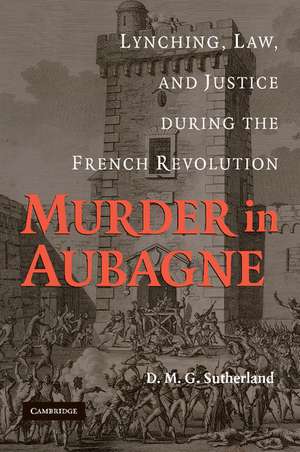
Murder in Aubagne
Autor D. M. G. Sutherlanden Limba Engleză Paperback – 31 ian 2012
Preț: 342.53 lei
Puncte Express: 514
Carte tipărită la comandă
Livrare economică 20 iulie-03 august
Livrare prin curier în România Termenul estimat este afișat lângă disponibilitate.
Transport gratuit de la 400.00 lei Plată online sau ramburs, în funcție de opțiunile comenzii.
Retur gratuit în 14 zile Comandă securizată și suport în română.
Specificații
ISBN-13: 9781107404281
ISBN-10: 1107404282
Pagini: 336
Dimensiuni: 152 x 229 x 20 mm
Greutate: 0.55 kg
Editura: Cambridge University Press
Locul publicării:New York, United States
ISBN-10: 1107404282
Pagini: 336
Dimensiuni: 152 x 229 x 20 mm
Greutate: 0.55 kg
Editura: Cambridge University Press
Locul publicării:New York, United States
V-ar putea interesa
-
 -27%Preț: 266.51 lei362.80 lei
 -
 Aristocracy and its Enemies in the Age of RevolutionWilliam DoylePreț: 324.46 lei
 -
 Writing the Revolution: A French Woman's History in LettersLindsay A. H. Parker-8%Preț: 659.30 lei720.46 lei
 -
 A Political RomanceS. FoleyPreț: 388.80 lei
 -
 Bureaucrats and Bourgeois SocietyR. KingstonPreț: 381.81 lei
 -
 Preț: 200.58 lei
 -
 -23%Preț: 457.40 lei594.02 lei
 -
 Invisible ArmiesMax BootPreț: 152.26 lei
 -
 Companion to the French RevoluPeter McPheePreț: 376.71 lei
 -
 -26%Preț: 178.08 lei240.85 lei
 -
 The Letters of Rosa LuxemburgRosa LuxemburgPreț: 392.73 lei
 -
 A People's History of the French RevolutionEric HazanPreț: 206.25 lei
 -
 In Defence of the TerrorSophie WahnichPreț: 104.38 lei
 -
 A New Dictionary of the French RevolutionRichard Ballard-25%Preț: 201.91 lei269.51 lei
Cuprins
List of figures; Preface; Acknowledgments; Abbreviations; Aubagne: an introduction to the problem; 1. Structures and events; 2. The Olive Festival; 3. Aubagne's universe: Marseille, Aix, and Arles, 1789–92; 4. Murders in Provence; 5. Vigilantism and federalism; 6. Federalism; 7. Terror in a small town: Aubagne; 8. The revolution of the antiterrorists: vengeance, massacre, and justice; 9. The Bande d'Aubagne; Appendix; Sources and methods; Index.
Recenzii
"One of the world's leading historians of the French Revolution has written a detailed, original and convincing picture of what living through the Revolution meant for ordinary people in a distinctive region of France. It will be widely hailed among students of the period as a remarkable addition to our knowledge and understanding of the complex and violent repercussions of the Terror." -William Doyle, University of Bristol
"Through meticulous historical research, Donald Sutherland has succeeded in reconstructing the tensions, divisions and passions which threw a southern French town into a horrific cycle of blood during the French Revolution. Murder in Aubagneilluminates the Revolution at ground level in a way that few other books have done." David A. Bell, Johns Hopkins University
"Donald Sutherland writes a fascinating study of revolution and violence as it was experienced in one community in Provence: of the complex interactions between local, regional, and national history; of the convergence of revolutionary strategies from above with vendetta, vigilantism, and factional hatreds from below. Though not all historians will agree with all of the book’s more provocative conclusions, it is a masterful study that must be read by anyone interested in understanding the complex and dramatic history of the French Revolution." Timothy Tackett, University of California Irvine, author of Religion, Revolution, and Regional Culture, Becoming a Revolutionary and When the King Took Flight
"Recommended." -Choice
"...an impressive research feat." -Anthony Crubaugh, H-France
"...exemplary, fascinating, and important..." -Edward J. Woell, H-France
"...a book that cannot be ignored, especially by historians of the Revolution in the provinces." -Alan Forrest, H-France
"Donald Sutherland is well qualified to provide a widely researched and closely argued study of the interplay of local, regional, and national interestes in the case of a single town...during the French Revolution." -Christopher English, Canadian Journal of History
"Sutherland skillfully demonstrates that the roots of this violence had as much to do with the local culture and social context as it did with any national trends." -Eric F. Johnson, Eighteenth-Century Studies
"Through meticulous historical research, Donald Sutherland has succeeded in reconstructing the tensions, divisions and passions which threw a southern French town into a horrific cycle of blood during the French Revolution. Murder in Aubagneilluminates the Revolution at ground level in a way that few other books have done." David A. Bell, Johns Hopkins University
"Donald Sutherland writes a fascinating study of revolution and violence as it was experienced in one community in Provence: of the complex interactions between local, regional, and national history; of the convergence of revolutionary strategies from above with vendetta, vigilantism, and factional hatreds from below. Though not all historians will agree with all of the book’s more provocative conclusions, it is a masterful study that must be read by anyone interested in understanding the complex and dramatic history of the French Revolution." Timothy Tackett, University of California Irvine, author of Religion, Revolution, and Regional Culture, Becoming a Revolutionary and When the King Took Flight
"Recommended." -Choice
"...an impressive research feat." -Anthony Crubaugh, H-France
"...exemplary, fascinating, and important..." -Edward J. Woell, H-France
"...a book that cannot be ignored, especially by historians of the Revolution in the provinces." -Alan Forrest, H-France
"Donald Sutherland is well qualified to provide a widely researched and closely argued study of the interplay of local, regional, and national interestes in the case of a single town...during the French Revolution." -Christopher English, Canadian Journal of History
"Sutherland skillfully demonstrates that the roots of this violence had as much to do with the local culture and social context as it did with any national trends." -Eric F. Johnson, Eighteenth-Century Studies
Descriere
This book is a study of faction, lynching, murder, terror and counter-terror during the French Revolution.