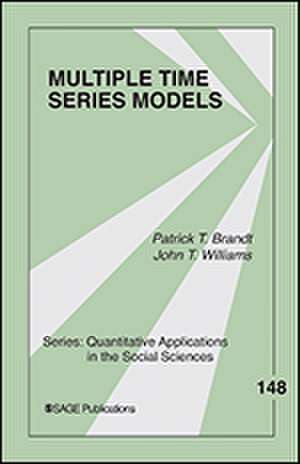
Multiple Time Series Models
Autor Patrick T. Brandt, John Taylor Williamsen Limba Engleză Paperback – sep 2006
Preț: 327.42 lei
Puncte Express: 491
Carte tipărită la comandă
Livrare economică 07-21 decembrie
Livrare prin curier în România Termenul estimat este afișat lângă disponibilitate.
Transport gratuit de la 400.00 lei Plată online sau ramburs, în funcție de opțiunile comenzii.
Retur gratuit în 14 zile Comandă securizată și suport în română.
Specificații
ISBN-13: 9781412906562
ISBN-10: 1412906563
Pagini: 112
Ilustrații: Illustrations
Dimensiuni: 140 x 216 x 6 mm
Greutate: 0.14 kg
Ediția:1
Editura: Sage Publications, Inc
Locul publicării:Thousand Oaks, United States
ISBN-10: 1412906563
Pagini: 112
Ilustrații: Illustrations
Dimensiuni: 140 x 216 x 6 mm
Greutate: 0.14 kg
Ediția:1
Editura: Sage Publications, Inc
Locul publicării:Thousand Oaks, United States
V-ar putea interesa
-
 -27%Preț: 238.14 lei325.27 lei
 -
 Social ResearchJan PriestPreț: 174.76 lei
 -
 Narrative Methods for the Human SciencesCatherine Kohler Riessman-15%Preț: 633.87 lei745.72 lei
 -
 Research Design in Social ResearchDavid De Vaus-22%Preț: 469.27 lei601.63 lei
 -
 Using Documents in Social ResearchLindsay Prior-18%Preț: 681.98 lei831.69 lei
 -
 Summated Rating Scale ConstructionPaul E. SpectorPreț: 325.75 lei
 -
 Introduction to Behavioral Research MethodsMark Leary-34%Preț: 408.22 lei620.71 lei
 -
 Doing Visual ResearchClaudia Mitchell-15%Preț: 528.43 lei621.68 lei
 -
 The Mixed Methods ReaderVicki L. Plano Clark-18%Preț: 946.33 lei1154.07 lei
 -
 Doing Real ResearchEric L. JensenPreț: 475.72 lei
 -
 Social Capital: Global Perspectives, Management Strategies & EffectivenessC. Douglas Johnson PhD-27%Preț: 1635.92 lei2229.04 lei
 -
 Social Theory: Ideas in Profile: Ideas in ProfileWilliam Outhwaite-22%Preț: 47.47 lei60.73 lei
Recenzii
"This book amazingly introduces multiple time series on varied levels to help the reader to understand their assumptions, their four approaches, how to build theories to accompany their modeling, and how to interpret their results. This book would be quite an initiation, sweet and succinct, in advanced undergraduate and graduate courses on time series. In addition, it is a useful and reliable resource . . . this book also makes a fun reading!"
Cuprins
List of Figures
List of Tables
Series Editor?s Introduction
Preface
1. Introduction to Multiple Time Series Models
1.1 Simultaneous Equation Approach
1.2 ARIMA Approach
1.3 Error Correction or LSE Approach
1.4 Vector Autoregression Approach
1.5 Comparison and Summary
2. Basic Vector Autoregression Models
2.1 Dynamic Structural Equation Models
2.2 Reduced Form Vector Autoregressions
2.3 Relationship of a Dynamic Structural Equation Model to a Vector Autoregression Model
2.4 Working With This Model
2.5 Specification and Analysis of VAR Models
2.6 Other Specification Issues
2.7 Unit Roots and Error Correction in VARs
2.8 Criticisms of VAR
3. Examples of VAR Analyses
3.1 Public Mood and Macropartisanship
3.2 Effective Corporate Tax Rates
3.3 Conclusion
Appendix: Software for Multiple Time Series Models
Notes
References
Index
About the Authors
List of Tables
Series Editor?s Introduction
Preface
1. Introduction to Multiple Time Series Models
1.1 Simultaneous Equation Approach
1.2 ARIMA Approach
1.3 Error Correction or LSE Approach
1.4 Vector Autoregression Approach
1.5 Comparison and Summary
2. Basic Vector Autoregression Models
2.1 Dynamic Structural Equation Models
2.2 Reduced Form Vector Autoregressions
2.3 Relationship of a Dynamic Structural Equation Model to a Vector Autoregression Model
2.4 Working With This Model
2.5 Specification and Analysis of VAR Models
2.6 Other Specification Issues
2.7 Unit Roots and Error Correction in VARs
2.8 Criticisms of VAR
3. Examples of VAR Analyses
3.1 Public Mood and Macropartisanship
3.2 Effective Corporate Tax Rates
3.3 Conclusion
Appendix: Software for Multiple Time Series Models
Notes
References
Index
About the Authors
Notă biografică
Patrick T. Brandt is an Assistant Professor of Political Science in the School of Social Science at the University of Texas at Dallas. He has published in the American Journal of Political Science and Political Analysis. He teaches courses in social science research methods and social science statistics. His current research focuses on the development and application of time series models to the study of political institutions, political economy, and international relations. He received an A.B. (1990) in Government from the College of William and Mary, an M.S. (1997) in Mathematical Methods in the Social Sciences from Northwestern University, and a Ph.D. (2001) in Political Science from Indiana University. Before joining the faculty at the University of Texas at Dallas, he held positions at the University of North Texas, Indiana University, and as a fellow at the Harvard-MIT Data Center.
Descriere
Multiple Time Series Models introduces researchers and students to the different approaches to modeling multivariate time series data including simultaneous equations, ARIMA, error correction models, and vector autoregression. Authors Patrick T. Brandt and John T. Williams focus on vector autoregression (VAR) models as a generalization of these other approaches and discuss specification, estimation, and inference using these models.