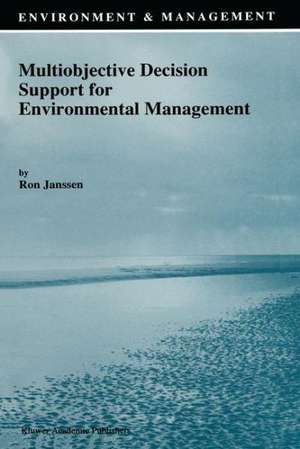
Multiobjective Decision Support for Environmental Management: Environment & Management, cartea 2
Autor R. Janssenen Limba Engleză Paperback – 3 oct 2013
The author's work on MODSS has resulted in the development of a decision support package, called DEFINITE (DEcisions on a FINITE set of alternatives). A demonstration version of this programme is included with the book.
This Demo Disk can be run on a MS-DOS compatible personal computer (version 2.0 or higher) having a 3,5 inch, 720 Kb disk drive and 640 Kb available RAM.


Preț: 374.51 lei
Puncte Express: 562
Carte tipărită la comandă
Livrare economică 18 noiembrie-02 decembrie
Livrare prin curier în România Termenul estimat este afișat lângă disponibilitate.
Transport gratuit de la 400.00 lei Plată online sau ramburs, în funcție de opțiunile comenzii.
Retur gratuit în 14 zile Comandă securizată și suport în română.
Specificații
ISBN-13: 9789401052474
ISBN-10: 9401052476
Pagini: 252
Ilustrații: XIII, 233 p.
Dimensiuni: 160 x 240 x 14 mm
Greutate: 0.41 kg
Ediția:Softcover reprint of the original 1st ed. 1992
Editura: Springer
Colecția Environment & Management
Seria Environment & Management
Locul publicării:Dordrecht, Netherlands
ISBN-10: 9401052476
Pagini: 252
Ilustrații: XIII, 233 p.
Dimensiuni: 160 x 240 x 14 mm
Greutate: 0.41 kg
Ediția:Softcover reprint of the original 1st ed. 1992
Editura: Springer
Colecția Environment & Management
Seria Environment & Management
Locul publicării:Dordrecht, Netherlands
V-ar putea interesa
-
 The Plundered PlanetPaul Collier-19%Preț: 62.93 lei77.79 lei
 -
 Environmental Economics: A Very Short IntroductionStephen Smith-21%Preț: 55.29 lei69.84 lei
 -
 Preț: 394.21 lei
 -
 Plundered Nations?Paul Collier-15%Preț: 487.18 lei573.15 lei
 -
 Sustainability AnalysisS. Shmelev-15%Preț: 649.16 lei763.72 lei
 -
 The Green to Gold Business PlaybookDaniel C. EstyPreț: 275.37 lei
 -
 Ending Dirty Energy PolicyJoseph P. TomainPreț: 249.64 lei
 -
 Smart Solutions to Climate ChangeBjørn LomborgPreț: 313.95 lei
 -
 Pricing CarbonA. Denny Ellerman-11%Preț: 446.31 lei501.46 lei
 -
 Consumption and Its ConsequencesDaniel MillerPreț: 148.04 lei
 -
 Climate Policy after CopenhagenKarsten NeuhoffPreț: 275.92 lei
 -
 Modeling Dynamic Economic SystemsMatthias Ruth-15%Preț: 595.36 lei700.42 lei
 -
 Energy, Environment and DevelopmentJose GoldembergPreț: 441.89 lei
 -
 Preț: 288.59 lei
 -
 Ecological Economics from the Ground UpHali Healy-15%Preț: 446.33 lei525.10 lei
 -
 -18%Preț: 1119.70 lei1365.49 lei
 -
 Economics UnmaskedManfred Max-Neef-40%Preț: 76.19 lei127.59 lei
Public țintă
ResearchCuprins
1. Introduction to Decision Support.- 1.1. A brief overview.- 1.2. Decision problems and decision processes.- 1.3. Objectives of multiobjective decision support.- 1.4. Functions of multiobjective decision support.- 1.5. Objectives, scope and outline of the study.- 2. Environmental Decision Making.- 2.1. Introduction.- 2.2. Sustainable development as objective of environmental management.- 2.3. The nature of environmental problems.- 2.4. A set of examples of environmental problems.- 2.5. Characteristics of environmental decision processes.- 2.6. Characteristics of environmental decision problems.- 2.7. Conclusions.- 3. Methods for Multiobjective Decision Support.- 3.1. Introduction.- 3.2. Classes of multiobjective decision support.- 3.3. Discrete quantitative methods.- 3.4. Discrete qualitative or mixed methods.- 3.5. Priority information.- 3.6. Cost-Benefit Analysis and discounting.- 3.7. Graphic presentation.- 3.8. Conclusions.- 4. Sensitivity Analysis for Multiobjective Decision Support.- 4.1. Introduction.- 4.2. Sensitivity of a ranking to overall uncertainty in scores and prioritie.- 4.3. Sensitivity of a ranking to changes in a priority or a criterion score.- 4.4. Sensitivity of a ranking to changes in all priorities.- 4.5. Sensitivity of a ranking to the choice of an evaluation method.- 4.6. Siting nuclear plants in the Netherlands: an application.- 4.7. Conclusions.- 5. A Multiobjective Decision Support System for Environmental Problems.- 5.1. Introduction.- 5.2. The DEFINITE program.- 5.3. Introduction to the applications.- 6. Valuation and Uncertainty in Multiobjective Decision Support.- A system to support decisions on cleaning up polluted sites.- 6.1. Introduction.- 6.2. Structure and procedures of the system.- 6.3. Problem definition.- 6.4. Valuation of theeffects.- 6.5. Evaluation of alternatives.- 6.6. Sensitivities of rankings to uncertainties in the predicted effects.- 6.7. Conclusions.- 7. Space in Multiobjective Decision Support.- A system to support decisions on the reallocation of agricultural land.- 7.1. Introduction.- 7.2. Problem definition.- 7.3. Ranking 118 agricultural regions for combined land use and change of land use.- 7.4. Map representations.- 7.5. Optimization: the optimal land use combination.- 7.6. Conclusions.- 8. Time and Space in Multiobjective Decision Support.- A system to support decisions on electricity production.- 8.1. Introduction.- 8.2. Alternatives for electricity production.- 8.3. Emissions.- 8.4. The time pattern of emissions.- 8.5. Concentrations, depositions and effects.- 8.6. Conclusions.- 9. Conclusions.- 9.1. Introduction.- 9.2. Classification and description.- 9.3. Development and implementation.- 9.4. Three applications.- 9.5. The effectiveness of MODSS for environmental problems.- 9.6. The future of MODSS for environmental problems.- References.