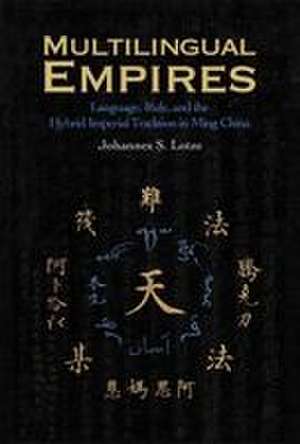
Multilingual Empires
Autor Johannes S Lotzeen Limba Engleză Hardback – 9 mar 2027
By situating the Ming in a cross-dynastic and global comparative perspective, Lotze shows how Ming rulers inherited and reshaped a Mongol legacy of cultural hybridity in language use and governance. The Ming continued this hybrid imperial tradition by employing multiple diplomatic languages, even as they promoted Chinese as the primary internal medium of communication. In contrast to the Qing, whose rulers incorporated non-Chinese languages into their core administration, the Ming developed a more restricted yet highly systematic approach to multilingualism.
As with other multilingual empires, from the Yuan to the Ottomans, Ming rulers adopted specific strategies for managing multilingual knowledge-from training language mediators to sponsoring large-scale translation projects. Translation and multilingualism emerge not merely as practical tools but as central instruments in the symbolic construction of imperial rule. Integrating political and linguistic history, this book offers a new framework for understanding the interplay of empire, language, and power in premodern Eurasia.
Preț: 441.65 lei
Precomandă
Puncte Express: 662
Carte nepublicată încă
Livrare prin curier în România Precomanda se expediază când titlul devine disponibil.
Transport gratuit pentru acest produs Plată online sau ramburs, în funcție de opțiunile comenzii.
Retur gratuit în 14 zile Comandă securizată și suport în română.
Doresc să fiu notificat când acest titlu va fi disponibil:
Se trimite...
Specificații
Notă biografică
Johannes S. Lotze is a Research Associate at the China Center at Kiel University, Germany.