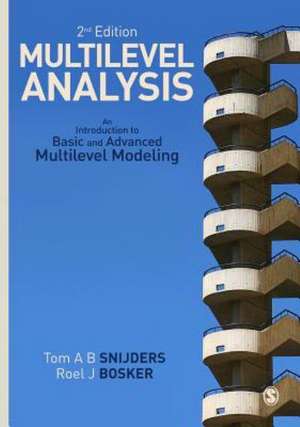
Multilevel Analysis: An Introduction to Basic and Advanced Multilevel Modeling
Autor Tom A.B. Snijders, Roel Boskeren Limba Engleză Electronic book text – 29 oct 2011
This book provides step-by-step coverage of:
• multilevel theories
• ecological fallacies
• the hierarchical linear model
• testing and model specification
• heteroscedasticity
• study designs
• longitudinal data
• multivariate multilevel models
• discrete dependent variables
There are also new chapters on:
• missing data
• multilevel modeling and survey weights
• Bayesian and MCMC estimation and latent-class models.
This book has been comprehensively revised and updated since the last edition, and now discusses modeling using HLM, MLwiN, SAS, Stata including GLLAMM, R, SPSS, Mplus, WinBugs, Latent Gold, and SuperMix.
This is a must-have text for any student, teacher or researcher with an interest in conducting or understanding multilevel analysis.
Tom A.B. Snijdersis Professor of Statistics in the Social Sciences at the University of Oxford and Professor of Statistics and Methodology at the University of Groningen.
Roel J. Boskeris Professor of Education and Director of GION, Groningen Institute for Educational Research, at the University of Groningen.
Preț: 284.91 lei
Puncte Express: 427
Preț estimativ în valută:
46.18€ • 53.18$ • 39.97£
46.18€ • 53.18$ • 39.97£
Indisponibil temporar
Doresc să fiu notificat când acest titlu va fi disponibil:
Se trimite...
Specificații
ISBN-13: 9781446254332
ISBN-10: 144625433X
Pagini: 368
Dimensiuni: 170 x 242 mm
Ediția:Second Edition
Editura: SAGE Publications
Colecția Sage Publications Ltd
Locul publicării:London, United Kingdom
ISBN-10: 144625433X
Pagini: 368
Dimensiuni: 170 x 242 mm
Ediția:Second Edition
Editura: SAGE Publications
Colecția Sage Publications Ltd
Locul publicării:London, United Kingdom
Recenzii
'Overall,
Snijders
and
Bosker
provide
an
accessible
and
readable
text
on
the
subject
of
multilevel
analysis.
It
is
as
much
tailored
to
the
needs
of
advanced
quantitative
researchers,
as
to
relative
beginners
in
the
field.
As
a
reader
with
limited
experience
in
quantitative
research,
but
an
interest
in
advancing
my
knowledge
and
understanding
of
multilevel
analysis,
I
found
this
text
an
ideal
introduction
to
the
area'
-
Emma Smith
Methodspace Book Reviews Club
This new edition is still intended for students, teachers, or researchers with an interest in conducting or understanding multilevel analysis. The book is definitely an excellent reference book for researchers working in social sciences, education, environmental sciences, and economic, biological, medical, and health disciplines.
Emma Smith
Methodspace Book Reviews Club
This new edition is still intended for students, teachers, or researchers with an interest in conducting or understanding multilevel analysis. The book is definitely an excellent reference book for researchers working in social sciences, education, environmental sciences, and economic, biological, medical, and health disciplines.
Cuprins
Preface
second
edition
Preface to first edition
Introduction
Multilevel analysis
Probability models
This book
Prerequisites
Notation
Multilevel Theories, Multi-Stage Sampling and Multilevel Models
Dependence as a nuisance
Dependence as an interesting phenomenon
Macro-level, micro-level, and cross-level relations
Glommary
Statistical Treatment of Clustered Data
Aggregation
Disaggregation
The intraclass correlation
Within-group and between group variance
Testing for group differences
Design effects in two-stage samples
Reliability of aggregated variables
Within-and between group relations
Regressions
Correlations
Estimation of within-and between-group correlations
Combination of within-group evidence
Glommary
The Random Intercept Model
Terminology and notation
A regression model: fixed effects only
Variable intercepts: fixed or random parameters?
When to use random coefficient models
Definition of the random intercept model
More explanatory variables
Within-and between-group regressions
Parameter estimation
'Estimating' random group effects: posterior means
Posterior confidence intervals
Three-level random intercept models
Glommary
The Hierarchical Linear Model
Random slopes
Heteroscedasticity
Do not force ?01 to be 0!
Interpretation of random slope variances
Explanation of random intercepts and slopes
Cross-level interaction effects
A general formulation of fixed and random parts
Specification of random slope models
Centering variables with random slopes?
Estimation
Three or more levels
Glommary
Testing and Model Specification
Tests for fixed parameters
Multiparameter tests for fixed effects
Deviance tests
More powerful tests for variance parameters
Other tests for parameters in the random part
Confidence intervals for parameters in the random part
Model specification
Working upward from level one
Joint consideration of level-one and level-two variables
Concluding remarks on model specification
Glommary
How Much Does the Model Explain?
Explained variance
Negative values of R2?
Definition of the proportion of explained variance in two-level models
Explained variance in three-level models
Explained variance in models with random slopes
Components of variance
Random intercept models
Random slope models
Glommary
Heteroscedasticity
Heteroscedasticity at level one
Linear variance functions
Quadratic variance functions
Heteroscedasticity at level two
Glommary
Missing Data
General issues for missing data
Implications for design
Missing values of the dependent variable
Full maximum likelihood
Imputation
The imputation method
Putting together the multiple results
Multiple imputations by chained equations
Choice of the imputation model
Glommary
Assumptions of the Hierarchical Linear Model
Assumptions of the hierarchical linear model
Following the logic of the hierarchical linear model
Include contextual effects
Check whether variables have random effects
Explained variance
Specification of the fixed part
Specification of the random part
Testing for heteroscedasticity
What to do in case of heteroscedasticity
Inspection of level-one residuals
Residuals at level two
Influence of level-two units
More general distributional assumptions
Glommary
Designing Multilevel Studies
Some introductory notes on power
Estimating a population mean
Measurement of subjects
Estimating association between variables
Cross-level interaction effects
Allocating treatment to groups or individuals
Exploring the variance structure
The intraclass correlation
Variance parameters
Glommary
Other Methods and Models
Bayesian inference
Sandwich estimators for standard errors
Latent class models
Glommary
Imperfect Hierarchies
A two-level model with a crossed random factor
Crossed random effects in three-level models
Multiple membership models
Multiple membership multiple classification models
Glommary
Survey Weights
Model-based and design-based inference
Descriptive and analytic use of surveys
Two kinds of weights
Choosing between model-based and design-based analysis
Inclusion probabilities and two-level weights
Exploring the informativeness of the sampling design
Example: Metacognitive strategies as measured in the PISA study
Sampling design
Model-based analysis of data divided into parts
Inclusion of weights in the model
How to assign weights in multilevel models
Appendix. Matrix expressions for the single-level estimators
Glommary
Longitudinal Data
Fixed occasions
The compound symmetry models
Random slopes
The fully multivariate model
Multivariate regression analysis
Explained variance
Variable occasion designs
Populations of curves
Random functions
Explaining the functions 27415.2.4
Changing covariates
Autocorrelated residuals
Glommary
Multivariate Multilevel Models
Why analyze multiple dependent variables simultaneously?
The multivariate random intercept model
Multivariate random slope models
Glommary
Discrete Dependent Variables
Hierarchical generalized linear models
Introduction to multilevel logistic regression
Heterogeneous proportions
The logit function: Log-odds
The empty model
The random intercept model
Estimation
Aggregation
Further topics on multilevel logistic regression
Random slope model
Representation as a threshold model
Residual intraclass correlation coefficient
Explained variance
Consequences of adding effects to the model
Ordered categorical variables
Multilevel event history analysis
Multilevel Poisson regression
Glommary
Software
Special software for multilevel modeling
HLM
MLwiN
The MIXOR suite and SuperMix
Modules in general-purpose software packages
SAS procedures VARCOMP, MIXED, GLIMMIX, and NLMIXED
R
Stata
SPSS, commands VARCOMP and MIXED
Other multilevel software
PinT
Optimal Design
MLPowSim
Mplus
Latent Gold
REALCOM
WinBUGS
References
Index
Preface to first edition
Introduction
Multilevel analysis
Probability models
This book
Prerequisites
Notation
Multilevel Theories, Multi-Stage Sampling and Multilevel Models
Dependence as a nuisance
Dependence as an interesting phenomenon
Macro-level, micro-level, and cross-level relations
Glommary
Statistical Treatment of Clustered Data
Aggregation
Disaggregation
The intraclass correlation
Within-group and between group variance
Testing for group differences
Design effects in two-stage samples
Reliability of aggregated variables
Within-and between group relations
Regressions
Correlations
Estimation of within-and between-group correlations
Combination of within-group evidence
Glommary
The Random Intercept Model
Terminology and notation
A regression model: fixed effects only
Variable intercepts: fixed or random parameters?
When to use random coefficient models
Definition of the random intercept model
More explanatory variables
Within-and between-group regressions
Parameter estimation
'Estimating' random group effects: posterior means
Posterior confidence intervals
Three-level random intercept models
Glommary
The Hierarchical Linear Model
Random slopes
Heteroscedasticity
Do not force ?01 to be 0!
Interpretation of random slope variances
Explanation of random intercepts and slopes
Cross-level interaction effects
A general formulation of fixed and random parts
Specification of random slope models
Centering variables with random slopes?
Estimation
Three or more levels
Glommary
Testing and Model Specification
Tests for fixed parameters
Multiparameter tests for fixed effects
Deviance tests
More powerful tests for variance parameters
Other tests for parameters in the random part
Confidence intervals for parameters in the random part
Model specification
Working upward from level one
Joint consideration of level-one and level-two variables
Concluding remarks on model specification
Glommary
How Much Does the Model Explain?
Explained variance
Negative values of R2?
Definition of the proportion of explained variance in two-level models
Explained variance in three-level models
Explained variance in models with random slopes
Components of variance
Random intercept models
Random slope models
Glommary
Heteroscedasticity
Heteroscedasticity at level one
Linear variance functions
Quadratic variance functions
Heteroscedasticity at level two
Glommary
Missing Data
General issues for missing data
Implications for design
Missing values of the dependent variable
Full maximum likelihood
Imputation
The imputation method
Putting together the multiple results
Multiple imputations by chained equations
Choice of the imputation model
Glommary
Assumptions of the Hierarchical Linear Model
Assumptions of the hierarchical linear model
Following the logic of the hierarchical linear model
Include contextual effects
Check whether variables have random effects
Explained variance
Specification of the fixed part
Specification of the random part
Testing for heteroscedasticity
What to do in case of heteroscedasticity
Inspection of level-one residuals
Residuals at level two
Influence of level-two units
More general distributional assumptions
Glommary
Designing Multilevel Studies
Some introductory notes on power
Estimating a population mean
Measurement of subjects
Estimating association between variables
Cross-level interaction effects
Allocating treatment to groups or individuals
Exploring the variance structure
The intraclass correlation
Variance parameters
Glommary
Other Methods and Models
Bayesian inference
Sandwich estimators for standard errors
Latent class models
Glommary
Imperfect Hierarchies
A two-level model with a crossed random factor
Crossed random effects in three-level models
Multiple membership models
Multiple membership multiple classification models
Glommary
Survey Weights
Model-based and design-based inference
Descriptive and analytic use of surveys
Two kinds of weights
Choosing between model-based and design-based analysis
Inclusion probabilities and two-level weights
Exploring the informativeness of the sampling design
Example: Metacognitive strategies as measured in the PISA study
Sampling design
Model-based analysis of data divided into parts
Inclusion of weights in the model
How to assign weights in multilevel models
Appendix. Matrix expressions for the single-level estimators
Glommary
Longitudinal Data
Fixed occasions
The compound symmetry models
Random slopes
The fully multivariate model
Multivariate regression analysis
Explained variance
Variable occasion designs
Populations of curves
Random functions
Explaining the functions 27415.2.4
Changing covariates
Autocorrelated residuals
Glommary
Multivariate Multilevel Models
Why analyze multiple dependent variables simultaneously?
The multivariate random intercept model
Multivariate random slope models
Glommary
Discrete Dependent Variables
Hierarchical generalized linear models
Introduction to multilevel logistic regression
Heterogeneous proportions
The logit function: Log-odds
The empty model
The random intercept model
Estimation
Aggregation
Further topics on multilevel logistic regression
Random slope model
Representation as a threshold model
Residual intraclass correlation coefficient
Explained variance
Consequences of adding effects to the model
Ordered categorical variables
Multilevel event history analysis
Multilevel Poisson regression
Glommary
Software
Special software for multilevel modeling
HLM
MLwiN
The MIXOR suite and SuperMix
Modules in general-purpose software packages
SAS procedures VARCOMP, MIXED, GLIMMIX, and NLMIXED
R
Stata
SPSS, commands VARCOMP and MIXED
Other multilevel software
PinT
Optimal Design
MLPowSim
Mplus
Latent Gold
REALCOM
WinBUGS
References
Index
Descriere
The
classic
text
in
multilevel
analysis,
dealing
with
everything
you
need
to
know,
has
been
hugely
revised
and
added
to
and
is
supported
by
all
the
software.
A
must-have
for
modellers.