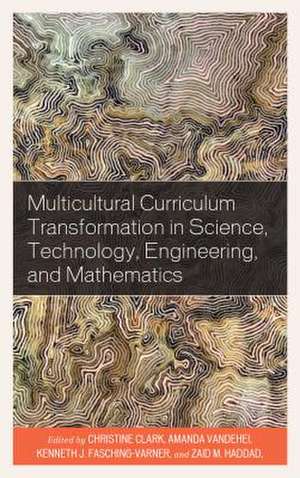
Multicultural Curriculum Transformation in Science, Technology, Engineering, and Mathematics: Foundations of Multicultural Education
Editat de Christine Clark, Amanda VandeHei-Carter, Kenneth J. Fasching-Varner, Zaid M. Haddad Contribuţii de Sandra Candel, Lauren Bell, Mónica Hernández-Johnson, Cindy Bezard, Tracy Arnold, Yolanda De La Cruz, Javier Díez-Palomar, Eshani Gandhi, Lori Griswold, Marna Hauk, Mary Hoelscher, Bettibel Kreye, Antoinette Linton, Sandra Lucia Osorio, Laura Luna, Carlos A. LópezLeiva, Twanelle Majors, Adam Masaki Joy, Allison Mattheis, Jennifer Meadows, Schetema Nealy, Dixon Perey, Sarah Roberts, Jeff Sapp, Janessa Schilmoeller, Neal Strudler, Antoinette Linton Tilley-Lubbs, Brian Trinh, Jeremy Yoderen Limba Engleză Hardback – 27 iul 2018
The volume is designed to speak with PK-12 teachers as colleagues in the multicultural curriculum transformation work at focus in each subject area and at varied grade levels. Readers are exposed to "things to think about," but also given curricular examples to work with or from in going about the actual, concrete work of curriculum change. It bridges the gaps between preparing PK-12 teachers to be able to 1) independently multiculturally adapt existing curriculum, and, 2) create new multicultural curriculum differentiated for their content areas and grade levels, while also, 3) providing ample examples of what such adapted and new differentiated curricula looks like. In so doing, this volume also bridges the gaps between the theory and practice of multicultural curriculum transformation in higher and PK-12 educational contexts.
Preț: 642.28 lei
Preț vechi: 960.01 lei
-33%
Puncte Express: 963
Carte tipărită la comandă
Livrare economică 08-22 decembrie
Livrare prin curier în România Termenul estimat este afișat lângă disponibilitate.
Transport gratuit pentru acest produs Plată online sau ramburs, în funcție de opțiunile comenzii.
Retur gratuit în 14 zile Comandă securizată și suport în română.
Specificații
ISBN-13: 9781498580519
ISBN-10: 1498580513
Pagini: 292
Ilustrații: 25 b/w illustrations; 10 tables;
Dimensiuni: 161 x 236 x 23 mm
Greutate: 0.64 kg
Editura: Bloomsbury Publishing
Colecția Lexington Books
Seria Foundations of Multicultural Education
Locul publicării:New York, United States
ISBN-10: 1498580513
Pagini: 292
Ilustrații: 25 b/w illustrations; 10 tables;
Dimensiuni: 161 x 236 x 23 mm
Greutate: 0.64 kg
Editura: Bloomsbury Publishing
Colecția Lexington Books
Seria Foundations of Multicultural Education
Locul publicării:New York, United States
Cuprins
Preface
Acknowledgements
Introduction, Christine Clark, Amanda VandeHei, Kenneth J. Fasching-Varner, and Zaid M. Haddad
Mathematics
Chapter 1: Transforming Family "Math Night" with Latina/Latino Middle School Parents: Communicating about the Adoption of Common Core State Standards, Yolanda De La Cruz
Chapter 2: Using Iterative Visuals and Virtual Manipulatives to Support English Language Learners in Mathematics Education, Sarah A. Roberts
Chapter 3: Rethinking the Teaching and Learning of Latina/Latino Students to Promote a Multicultural Mathematics Education, Javier Díez-Palomar and Carlos A. LópezLeiva
Chapter 4: Students Who Speak English as a Second Language: Preparing Teachers for Changing Demographics-An Innovative and Collaborative Approach, Bettibel Kreye and Gresilda A. Tilley-Lubbs
Science
Chapter 5: Teaching Biology in the Age of the Next Generation Science Standards: Methodology for Teaching in High Needs Schools, Antoinette Linton
Chapter 6: LGBT-Inclusion Across the Life Science Curriculum, Mary HoelscherChapter 7: Earth Shaking Dragons and Orphan Tsunamis: Transforming Middle School Earth Science and STEM through Studying Ancient Science Inquiry and Multicultural Collaborations in Earthquakes, Tsunamis, and Disaster Preparedness, Marna Hauk and Adam Masaki JoyChapter 8: Classroom Meteorologists: Transforming Science Content in a Dual Language Second Grade Classroom, Sandra Lucia OsorioMathematics and Science
Chapter 9: Rethinking Art in Mathematics and Science, Jeff Sapp
Engineering
Chapter 10: Effective Engineering Models for Multicultural Curriculum Transformation in STEM: Engineering for All, Laura Luna, Twanelle Walker Majors, and Jennifer Meadows
Technology
Chapter 11: Multicultural Technology Education: The Need to Teach Digital Technologies to All Students, Janessa Schilmoeller, Lori Griswold, and Neal Strudler
Mathematics, Science, Engineering, and Technology
Chapter 12: Coming Out of the Lab Closet: Queering STEM Education for Student Success and Well-Being, Allison Mattheis, Jeremy B. Yoder, and Dixon Perey
Chapter 13: Considering Women's Ways of Knowing in STEM, Tracy Arnold, Eshani Gandhi, Schetema Nealy, and Brian TrinhCoda, Christine Clark, Amanda VandeHei, Kenneth J. Fasching-Varner, and Zaid M. Haddad
Resources
About the Editors and Authors
Index
Acknowledgements
Introduction, Christine Clark, Amanda VandeHei, Kenneth J. Fasching-Varner, and Zaid M. Haddad
Mathematics
Chapter 1: Transforming Family "Math Night" with Latina/Latino Middle School Parents: Communicating about the Adoption of Common Core State Standards, Yolanda De La Cruz
Chapter 2: Using Iterative Visuals and Virtual Manipulatives to Support English Language Learners in Mathematics Education, Sarah A. Roberts
Chapter 3: Rethinking the Teaching and Learning of Latina/Latino Students to Promote a Multicultural Mathematics Education, Javier Díez-Palomar and Carlos A. LópezLeiva
Chapter 4: Students Who Speak English as a Second Language: Preparing Teachers for Changing Demographics-An Innovative and Collaborative Approach, Bettibel Kreye and Gresilda A. Tilley-Lubbs
Science
Chapter 5: Teaching Biology in the Age of the Next Generation Science Standards: Methodology for Teaching in High Needs Schools, Antoinette Linton
Chapter 6: LGBT-Inclusion Across the Life Science Curriculum, Mary HoelscherChapter 7: Earth Shaking Dragons and Orphan Tsunamis: Transforming Middle School Earth Science and STEM through Studying Ancient Science Inquiry and Multicultural Collaborations in Earthquakes, Tsunamis, and Disaster Preparedness, Marna Hauk and Adam Masaki JoyChapter 8: Classroom Meteorologists: Transforming Science Content in a Dual Language Second Grade Classroom, Sandra Lucia OsorioMathematics and Science
Chapter 9: Rethinking Art in Mathematics and Science, Jeff Sapp
Engineering
Chapter 10: Effective Engineering Models for Multicultural Curriculum Transformation in STEM: Engineering for All, Laura Luna, Twanelle Walker Majors, and Jennifer Meadows
Technology
Chapter 11: Multicultural Technology Education: The Need to Teach Digital Technologies to All Students, Janessa Schilmoeller, Lori Griswold, and Neal Strudler
Mathematics, Science, Engineering, and Technology
Chapter 12: Coming Out of the Lab Closet: Queering STEM Education for Student Success and Well-Being, Allison Mattheis, Jeremy B. Yoder, and Dixon Perey
Chapter 13: Considering Women's Ways of Knowing in STEM, Tracy Arnold, Eshani Gandhi, Schetema Nealy, and Brian TrinhCoda, Christine Clark, Amanda VandeHei, Kenneth J. Fasching-Varner, and Zaid M. Haddad
Resources
About the Editors and Authors
Index
Recenzii
It can easily be argued that curriculum-the 'what' we want students to know-is foundational in the education of any nation's young people. Because knowledge is constructed, we also know that it's contested. It is highly impacted by the political, social, and cultural context of education. Curriculum, then, is often at the cross-roads of intensive debates between those who wish to defend the traditional "canon" and those who wish to pursue a transformative curriculum that is rooted in principles of diversity, equity, and inclusion. The latter asks for a curriculum rooted in the lives of students, reflective of their social and cultural experiences, and responsive to the hopes and visions of families and communities of what it means to be educated.
A significant critique of this vision of a critical multicultural curriculum is the disconnection between theoretical and conceptual understandings with actual classroom activity. Many teachers have not experienced nor been prepared to teach for diversity, equity, and inclusion. This volume provides a framework for understanding what a transformative multicultural education curriculum entails, connects it to specific content areas, and supports and encourages teachers in enacting that curriculum.
This volume is especially critical at a time of often intense debates about what our nation's students should learn. It offers a much welcomed, hopeful, visionary, and actionable curriculum for any teacher who wishes to pursue schooling for social justice.
Enlightening teachers, families and communities about the intersection of Multicultural Education and Science, Technology, Engineering and Mathematics (STEM) has become increasingly important in today's technology driven society. Given the fact that our societies are becoming more diverse culturally and racially, and technological, this volume provides relevant knowledge and current practices involving the successful implementation of multicultural STEM PK-12 curriculum transformations. The authors emphasize practical and theoretical approaches on transforming mainstream and Eurocentric STEM curriculum to multicultural curriculum. This volume provides perspectives that are clearly missing in PK-12 STEM literature.
The timely, innovative and important contributions by the authors answer fundamental questions about what is happening in PK-12 education on transforming STEM content that is more inclusive and representative of multicultural STEM curriculum so that all students benefit, and not just a few.
Many students in our nation's schools have inadequate grounding in science, technology, engineering, and math (STEM) compared to global nations. In addition, children of color, low income, females, and ability challenged students fall below other groups within our society. Understanding these shortcomings, this volume does an excellent job in sharing multicultural curricular strategies for STEM P-12 schooling. The resources presented in this volume reflect transformative approaches and flexibility that are also standards-based and teacher friendly. Furthermore, parent involvement is a critical element within the eight organizing tools of this volume and approaches such as, transforming family math night with Latinx middle school parents is one of the delightful highlights. These approaches provide greater opportunity in the STEM fields for social and cultural integration. Children are more successful in all subject areas when they are able to identify and embrace who they are and where they come from, across a wide spectrum of specific cultural characteristics.
A significant critique of this vision of a critical multicultural curriculum is the disconnection between theoretical and conceptual understandings with actual classroom activity. Many teachers have not experienced nor been prepared to teach for diversity, equity, and inclusion. This volume provides a framework for understanding what a transformative multicultural education curriculum entails, connects it to specific content areas, and supports and encourages teachers in enacting that curriculum.
This volume is especially critical at a time of often intense debates about what our nation's students should learn. It offers a much welcomed, hopeful, visionary, and actionable curriculum for any teacher who wishes to pursue schooling for social justice.
Enlightening teachers, families and communities about the intersection of Multicultural Education and Science, Technology, Engineering and Mathematics (STEM) has become increasingly important in today's technology driven society. Given the fact that our societies are becoming more diverse culturally and racially, and technological, this volume provides relevant knowledge and current practices involving the successful implementation of multicultural STEM PK-12 curriculum transformations. The authors emphasize practical and theoretical approaches on transforming mainstream and Eurocentric STEM curriculum to multicultural curriculum. This volume provides perspectives that are clearly missing in PK-12 STEM literature.
The timely, innovative and important contributions by the authors answer fundamental questions about what is happening in PK-12 education on transforming STEM content that is more inclusive and representative of multicultural STEM curriculum so that all students benefit, and not just a few.
Many students in our nation's schools have inadequate grounding in science, technology, engineering, and math (STEM) compared to global nations. In addition, children of color, low income, females, and ability challenged students fall below other groups within our society. Understanding these shortcomings, this volume does an excellent job in sharing multicultural curricular strategies for STEM P-12 schooling. The resources presented in this volume reflect transformative approaches and flexibility that are also standards-based and teacher friendly. Furthermore, parent involvement is a critical element within the eight organizing tools of this volume and approaches such as, transforming family math night with Latinx middle school parents is one of the delightful highlights. These approaches provide greater opportunity in the STEM fields for social and cultural integration. Children are more successful in all subject areas when they are able to identify and embrace who they are and where they come from, across a wide spectrum of specific cultural characteristics.