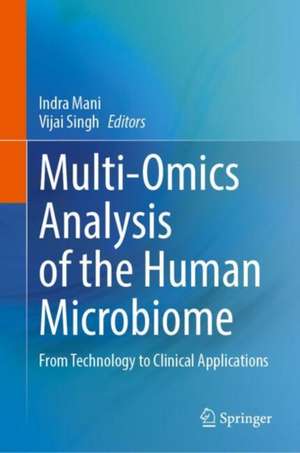
Multi-Omics Analysis of the Human Microbiome: From Technology to Clinical Applications
Editat de Indra Mani, Vijai Singhen Limba Engleză Hardback – 30 mai 2024
În literatura academică actuală, deși există numeroase resurse despre metagenomică, se resimte o lacună în ceea ce privește integrarea holistică a diverselor straturi de date biologice. Remarcăm faptul că volumul Multi-Omics Analysis of the Human Microbiome vine să completeze exact acest gol, oferind un cadru metodologic care unifică genomica, transcriptomica, proteomica și metabolomica. Putem afirma că lucrarea reprezintă un salt necesar de la simpla catalogare a speciilor microbiene către înțelegerea funcțională a interacțiunilor acestora în gazda umană.
Extinzând cadrul propus de Understanding Host-Microbiome Interactions - An Omics Approach cu date noi din perioada 2023-2024, această ediție pune un accent deosebit pe instrumentele computaționale. Merită menționat modul în care autorii integrează inteligența artificială ca pilon central în procesarea volumelor masive de date generate de tehnologiile de înaltă performanță. Structura cărții este riguros organizată în 16 capitole, debutând cu fundamentele tehnologice și progresând logic spre analize specifice pe nișe ecologice umane, precum microbiomul cutanat sau cel oral, finalizând cu potențialul clinic în medicina personalizată.
În contextul operei editorilor, acest titlu continuă direcția de cercetare începută în Microbial Genomic Islands in Adaptation and Pathogenicity, unde accentul era pus pe stabilitatea genomului. Aici, perspectiva se lărgește considerabil, trecând de la insulele genomice la întregul ecosistem microbian văzut prin prisma „omicii” integrate. Față de The Metagenomics Revolution, care se concentrează pe diagnostic, volumul de față explorează mai profund dimensiunea biotehnologică și fluxul metabolic (fluxomics), oferind o imagine mult mai granulară a dinamicii microbiene.
Preț: 1181.26 lei
Preț vechi: 1440.57 lei
-18%
Carte disponibilă
Livrare economică 19 mai-02 iunie
Specificații
ISBN-10: 9819718430
Pagini: 354
Ilustrații: XIV, 354 p. 40 illus., 36 illus. in color.
Dimensiuni: 155 x 235 mm
Greutate: 0.77 kg
Ediția:2024
Editura: Springer Nature Singapore
Colecția Springer
Locul publicării:Singapore, Singapore
De ce să citești această carte
Recomandăm această lucrare cercetătorilor și studenților la medicină sau bioinformatică care doresc să stăpânească instrumentele de analiză integrativă. Cartea oferă un avantaj competitiv prin explicarea algoritmilor de machine learning aplicați microbiomului, transformând datele brute în perspective clinice. Este o resursă esențială pentru înțelegerea modului în care biomarkerii microbieni vor modela viitorul diagnosticelor și al terapiilor personalizate.
Despre autor
Indra Mani și Vijai Singh sunt cercetători cu o vastă experiență în biologia moleculară și bioinformatică, fiind recunoscuți pentru contribuțiile lor în studiul mecanismelor celulare și microbiene. Portofoliul lor editorial la Springer include lucrări de referință despre epigenetică și semnalizarea neuroreceptorilor, demonstrând o expertiză multidisciplinară. În acest volum, aceștia își folosesc experiența acumulată în proiecte anterioare despre insulele genomice microbiene pentru a coordona o sinteză actualizată a tehnologiilor multi-omice aplicate sănătății umane.
Descriere scurtă
Cuprins
Notă biografică
Dr. Vijai Singh is a Professor and Head of the Department of Biosciences, School of Science at Indrashil University, Rajpur, Mehsana, India. He served as Associate Professor in the Department of Biosciences, School of Science at Indrashil University, Rajpur, Mehsana, India. He was an Assistant Professor in the Department of Biological Sciences and Biotechnology at the Institute of Advanced Research, Gandhinagar, India and also an Assistant Professor in the Department of Biotechnology at the Invertis University, Bareilly, India. Prior to that, he was a Postdoctoral Fellow in the Synthetic Biology Group at the Institute of Systems and Synthetic Biology, Paris, France and School of Energy & Chemical Engineeringat the Ulsan National Institute of Science and Technology, Ulsan, South Korea. He received his Ph.D. in Biotechnology (2009) from the National Bureau of Fish Genetic Resources, Uttar Pradesh Technical University, Lucknow, India with a research focus on the development of molecular and immunoassays for diagnosis of Aeromonas hydrophila. His research interests are focused on building novel biosynthetic pathways for production of medically and industrially important biomolecules. Additionally, his laboratory is working on CRISPR-Cas9 tools for genome editing. He has more than 12 years of research and teaching experience in synthetic biology, metabolic engineering, bioinformatics, microbiology, and industrial microbiology. He has published 100 articles, 70 chapters, 25 books and 3 patents. He serves as an associate editor, editorial board member, and reviewer of several peer-reviewed journals. He is also a member of the Board of Study and Academic Council of Indrashil University and is the Member Secretary of the Institutional Biosafety Committee (IBSC) at the same University.