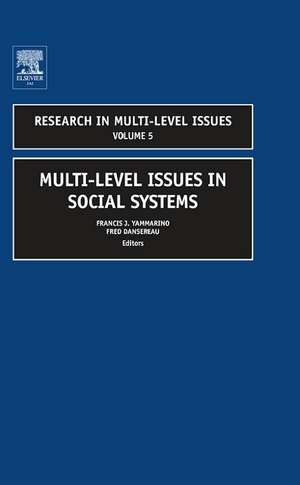
Multi–Level Issues in Social Systems: Research in Multi Level Issues
Autor Francis J. Yammarino, Fred Dansereauen Limba Engleză Hardback – 14 iun 2006
Preț: 833.78 lei
Preț vechi: 1082.83 lei
-23%
Puncte Express: 1251
Carte tipărită la comandă
Livrare economică 08-22 decembrie
Livrare prin curier în România Termenul estimat este afișat lângă disponibilitate.
Transport gratuit pentru acest produs Plată online sau ramburs, în funcție de opțiunile comenzii.
Retur gratuit în 14 zile Comandă securizată și suport în română.
Specificații
ISBN-13: 9780762313341
ISBN-10: 076231334X
Pagini: 496
Dimensiuni: 155 x 234 x 660 mm
Greutate: 0.82 kg
Editura: Emerald Publishing
Seria Research in Multi Level Issues
ISBN-10: 076231334X
Pagini: 496
Dimensiuni: 155 x 234 x 660 mm
Greutate: 0.82 kg
Editura: Emerald Publishing
Seria Research in Multi Level Issues
V-ar putea interesa
-
 -18%Preț: 202.28 lei245.71 lei
 -
 A Manager's Guide to LeadershipMike Pedler-26%Preț: 384.28 lei518.88 lei
 -
 TrustGuido Mollering-23%Preț: 793.19 lei1030.12 lei
 -
 How to Get to the TopJeffrey J. FoxPreț: 114.31 lei
 -
 How To Become A Great BossJeffrey J. Fox-29%Preț: 85.26 lei119.79 lei
 -
 -20%Preț: 495.08 lei619.85 lei
 -
 Preț: 214.52 lei
 -
 Developing Global LeadersB. JohnsonPreț: 321.49 lei
 -
 Leadership and Global JusticeD. Hicks-15%Preț: 698.67 lei821.96 lei
 -
 DriveDaniel PinkPreț: 116.14 lei
 -
 -18%Preț: 100.78 lei123.09 lei
Public țintă
Established scholars in multi-level issues, scholars and researchers new to the field of multi-level studies, and doctoral students in the various disciplines where multi-level issues are being pursued.Cuprins
Overview: Multi-level Issues in Social Systems (F. Dansereau and F. J. Yammarino).
Part I: Human Resources Management: Multi-level Fit. An Integrative Framework for Understanding Human Resources Management Practices in Cross-cultural contexts (K. A. Aumann and C. Ostroff); An organizational perspective on multi-level cultural integration: Human Resource Management Practices in Cross-cultural Contexts (X. Chen and A. Tsui); Integrating HRM Practices into a Multi-level Model of Culture: Culture’s Values, Depth and Strength.(M. Erez); Multi-level Fit: Complexity, Values and Climate (K. A. Umann and C. Ostroff). Part II: Continuous Learning: Continuous Learning in Organizations: A Living Systems Analysis of Individual, Group, and Organization Learning (M. London and V.I. Sessa); Continuous Learning: Why is it Still an Issue? (D. V. Day and B.W. Tate); A Multi-level Inquiry and Elaboration: Continuous Learning Within and Across Organizations, Groups, and Individuals. (S. E. Markham, R. L. Groesbeck, and B.R. Swan); Continuous Learning About Continuous Learning: Clarifying and Expanding a Multi-level, Living Systems Analysis (V.I. Sessa and M. London). Part III: Divorce and Family: The Importance of the Common Family Background for the Similarity of Divorce Risks of Siblings: A Multi-level Event History Analysis (J. Dronkers and J. Hox); Sibling Effects on Divorce: Common Family Background, Common Genetic Heritage, or Continuining Interaction Among Adult Siblings (M.P. Farrell); Multi-level Event History Analysis for a Sibling Design: The Choice of Predictor Variables (T.A.B. Snijders); Additional Thoughts About the Importance of Common Family Background for the Similarity of Divorce Risks of Siblings (J. Dronkers and J. Hox); Part IV: Industry-University Dynamics: Industry-University Intellectual Property Dynamics as a Multi-level Phenomenon (M. Jelinek); Industry-University Relationships and the Context of Intellectual Property Dynamics: the Case of IBM (M.L. Baba); Industry-University Technololgy Transfer: Moving the Research Agenda Forward (M. Feldman); Industry-University Intellectual Property in Context: Framing the Deal and Dealing with the Frame(s) (M. Jelinek). Part V: Organizational Leadership: The Lampe Theory of Organizational Leadership (K. D. Mackenzie);"Breaking the Frame" Even Farther: Complexity Science and Lampe Theory (M. Uhl-bien and R. Marion). Some Ideas about Testing Processual Theories (K.D. Mackenzie). Part VI: About the Authors.
Part I: Human Resources Management: Multi-level Fit. An Integrative Framework for Understanding Human Resources Management Practices in Cross-cultural contexts (K. A. Aumann and C. Ostroff); An organizational perspective on multi-level cultural integration: Human Resource Management Practices in Cross-cultural Contexts (X. Chen and A. Tsui); Integrating HRM Practices into a Multi-level Model of Culture: Culture’s Values, Depth and Strength.(M. Erez); Multi-level Fit: Complexity, Values and Climate (K. A. Umann and C. Ostroff). Part II: Continuous Learning: Continuous Learning in Organizations: A Living Systems Analysis of Individual, Group, and Organization Learning (M. London and V.I. Sessa); Continuous Learning: Why is it Still an Issue? (D. V. Day and B.W. Tate); A Multi-level Inquiry and Elaboration: Continuous Learning Within and Across Organizations, Groups, and Individuals. (S. E. Markham, R. L. Groesbeck, and B.R. Swan); Continuous Learning About Continuous Learning: Clarifying and Expanding a Multi-level, Living Systems Analysis (V.I. Sessa and M. London). Part III: Divorce and Family: The Importance of the Common Family Background for the Similarity of Divorce Risks of Siblings: A Multi-level Event History Analysis (J. Dronkers and J. Hox); Sibling Effects on Divorce: Common Family Background, Common Genetic Heritage, or Continuining Interaction Among Adult Siblings (M.P. Farrell); Multi-level Event History Analysis for a Sibling Design: The Choice of Predictor Variables (T.A.B. Snijders); Additional Thoughts About the Importance of Common Family Background for the Similarity of Divorce Risks of Siblings (J. Dronkers and J. Hox); Part IV: Industry-University Dynamics: Industry-University Intellectual Property Dynamics as a Multi-level Phenomenon (M. Jelinek); Industry-University Relationships and the Context of Intellectual Property Dynamics: the Case of IBM (M.L. Baba); Industry-University Technololgy Transfer: Moving the Research Agenda Forward (M. Feldman); Industry-University Intellectual Property in Context: Framing the Deal and Dealing with the Frame(s) (M. Jelinek). Part V: Organizational Leadership: The Lampe Theory of Organizational Leadership (K. D. Mackenzie);"Breaking the Frame" Even Farther: Complexity Science and Lampe Theory (M. Uhl-bien and R. Marion). Some Ideas about Testing Processual Theories (K.D. Mackenzie). Part VI: About the Authors.