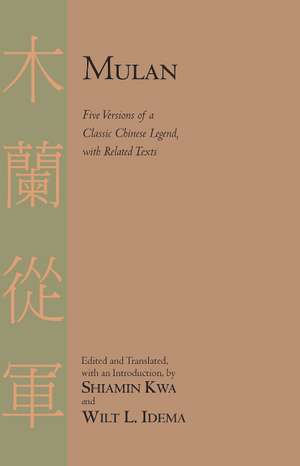
Mulan: Five Versions of a Classic Chinese Legend, with Related Texts
Traducere de Shiamin Kwa, Wilt L. Idemaen Limba Engleză Paperback – 14 sep 2010
The legend of Mulan--the daughter who disguises herself as a man, dons her father's armor, and heads off to war in his place--remains one of the most popular Chinese folktales despite (or because of) its lack of supernatural demonstrations or interventions.
This volume offers lively translations of the earliest recorded version of the legend and several later iterations of the tale (including the screenplay of the hugely successful 1939 Chinese film Mulan Joins the Army), illustrating the many ways that reinterpretations of this basic story reflect centuries of changes in Chinese cultural, political, and sexual attitudes.
An Introduction traces the evolution of the Mulan legend and its significance in the history of Chinese popular culture. Annotation explaining terms and references unfamiliar to Western readers, a glossary, and a comprehensive bibliography further enhance the value of this volume for both scholars and students.
This volume offers lively translations of the earliest recorded version of the legend and several later iterations of the tale (including the screenplay of the hugely successful 1939 Chinese film Mulan Joins the Army), illustrating the many ways that reinterpretations of this basic story reflect centuries of changes in Chinese cultural, political, and sexual attitudes.
An Introduction traces the evolution of the Mulan legend and its significance in the history of Chinese popular culture. Annotation explaining terms and references unfamiliar to Western readers, a glossary, and a comprehensive bibliography further enhance the value of this volume for both scholars and students.
Preț: 125.19 lei
Preț vechi: 153.14 lei
-18%
Puncte Express: 188
Carte disponibilă
Livrare economică 11-25 noiembrie
Livrare express 27-31 octombrie pentru 47.78 lei
Livrare prin curier în România Termenul estimat este afișat lângă disponibilitate.
Transport gratuit de la 400.00 lei Plată online sau ramburs, în funcție de opțiunile comenzii.
Retur gratuit în 14 zile Comandă securizată și suport în română.
Specificații
ISBN-13: 9781603841962
ISBN-10: 1603841962
Pagini: 176
Ilustrații: 6 halftones throughout
Dimensiuni: 140 x 216 x 139 mm
Greutate: 0.21 kg
Editura: Hackett Publishing Company,Inc
Colecția Hackett Publishing Company, Inc.
Locul publicării:United States
ISBN-10: 1603841962
Pagini: 176
Ilustrații: 6 halftones throughout
Dimensiuni: 140 x 216 x 139 mm
Greutate: 0.21 kg
Editura: Hackett Publishing Company,Inc
Colecția Hackett Publishing Company, Inc.
Locul publicării:United States
V-ar putea interesa
-
 Escape from Blood Pond HellBeata GrantPreț: 265.70 lei
 -
 Between Kant and Hegel: Texts in the Development of Post-Kantian IdealismGeorge di Giovanni-21%Preț: 174.40 lei221.50 lei
 -
 Kleist: Selected WritingsHeinrich Von Kleist-16%Preț: 132.91 lei157.76 lei
 -
 -15%Preț: 135.08 lei159.06 lei
 -
 -22%Preț: 198.61 lei254.16 lei
 -
 Medieval DramaDavid Bevington-24%Preț: 420.47 lei550.54 lei
 -
 -9%Preț: 741.08 lei814.37 lei
 -
 PASSION, POVERTY AND TRAVELIdema Wilt LPreț: 281.30 lei
 -
 Preț: 143.23 lei
 -
 Doux Pays. 189 Dessins (Éd.1897)Jean-Louis ForainPreț: 135.52 lei
 -
 Du sang, de la volupté et de la mort (Éd.1894)Maurice BarrèsPreț: 182.84 lei
 -
 Éloge de Voltaire, Suivi de Poésies Diverses (Éd.1783)Michel de Cubières-PalmézeauxPreț: 97.35 lei
 -
 Éloge Du Sein Des Femmes: Ouvrage Curieux (4e Éd) (1873)Claude-François Mercier de CompiègnePreț: 120.47 lei
 -
 Essai sur les écrits politiques de Christine de Pisan (Éd.1838)Raymond ThomassyPreț: 134.90 lei
 -
 Preț: 105.44 lei
 -
 Étude Biographique Sur François Villon (Éd.1877)Auguste LongnonPreț: 142.45 lei
 -
 Etude Et Récits Sur Alfred de Musset (Éd.1891)Alix de Choiseul-GouffierPreț: 167.25 lei
 -
 Etude Généalogique Sur Les Bourdaloue, (Éd.1900)J -B -Emile TausseratPreț: 112.19 lei
 -
 Preț: 183.07 lei
 -
 Etudes Historiques: La Maison de Rabaine (Éd.1891)Charles DangibeaudPreț: 134.90 lei
 -
 Preț: 223.57 lei
 -
 Études Sur l'Histoire de Prusse (4e Tirage) (Éd.1896)Ernest LavissePreț: 190.55 lei
 -
 Études Sur Molière: Le Tartuffe (Éd.1877)Louis Lacour de la PijardièrePreț: 112.58 lei
 -
 JUDGE BAO AND THE RULE OF LAWIdema Wilt LPreț: 249.14 lei
 -
 GENERALS OF THE YANG FAMILY, THEIdema Wilt L-15%Preț: 585.28 lei688.57 lei
Recenzii
Idema's scholarship . . . [and his] ability to translate popular texts into comparably idiomatic English are outstanding achievements.--Hugh R. Clark, Ursinus College
The plots and the elaborations of the Mulan narratives reproduced (and summarized) here demonstrate the many ways in which the Mulan figure has spoken to succeeding generations with differing heroic characteristics and in the idiom that each audience understood; they offer excellent texts for a deep background for any consideration of Mulan in contemporary culture. For scholars of European fairy tales, the narratives offer striking points of comparison with European crossdressing heroines of the sixteenth, seventeenth, and eighteenth centuries.--Ruth B. Bottigheimer, Stony Brook University