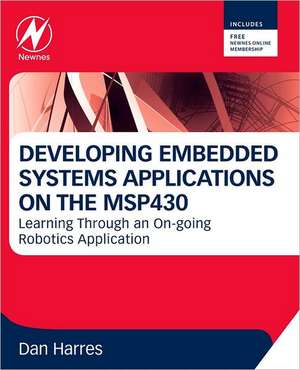
MSP430-based Robot Applications: A Guide to Developing Embedded Systems
Autor Dan Harresen Limba Engleză Paperback – 24 apr 2013
Pe linia practică a lucrării Introduction to Embedded Systems de Manuel Jiménez, dar cu un focus aplicat strict pe familia de microcontrolere TI MSP430, volumul semnat de Dan Harres propune o metodologie de tip „learn-by-doing”. Apreciem în mod deosebit pragmatismul structurii: în loc să rămână în sfera teoretică a sistemelor încorporate, autorul ghidează cititorul prin procesul de modificare a unei mașini teleghidate obișnuite pentru a crea un robot autonom complex. Găsim în această carte un echilibru tehnic rar, care pornește de la bazele electronicii și logicii digitale, ajungând până la detalii fine de achiziție de date și controlul întreruperilor.
Spre deosebire de Programmable Microcontrollers with Applications, care se concentrează pe platformele LaunchPad, MSP430-based Robot Applications pune accent pe construcția hardware-ului de la zero. Structura celor 21 de capitole indică o progresie logică: primele secțiuni sunt dedicate componentelor robotice și aritmeticii computerizate, urmate de o analiză aprofundată a arhitecturii MSP430. Un element distinctiv este tratarea programării atât în limbaj de asamblare (Assembler), cât și în C, oferind cititorului o înțelegere intimă a modului în care codul interacționează cu registrele procesorului. Capitolele finale despre evitarea coliziunilor, utilizarea tahometrelor și depanare transformă volumul într-un manual complet de inginerie. Ne-a atras atenția și includerea unor soluții economice pentru simularea și prototiparea circuitelor, un aspect esențial pentru studenți sau inginerii aflați la început de drum.
Preț: 301.70 lei
Preț vechi: 388.74 lei
-22%
Carte tipărită la comandă
Livrare economică 01-15 decembrie
Specificații
ISBN-10: 0123970121
Pagini: 416
Ilustrații: Illustrations
Dimensiuni: 191 x 235 x 25 mm
Greutate: 0.66 kg
Editura: ELSEVIER SCIENCE
V-ar putea interesa
-
 Principles of Computer HardwareAlan Clements-28%Preț: 623.58 lei861.14 lei
 -
 -40%Preț: 458.81 lei768.90 lei
 -
 -30%Preț: 445.71 lei639.30 lei
 -
 Electronics For Dummies, UK EditionCathleen ShamiehPreț: 145.47 lei
 -
 -11%Preț: 494.15 lei555.22 lei
 -
 The Big Book of RobotsCampbell BooksPreț: 84.16 lei
 -
 -26%Preț: 277.16 lei373.40 lei
 -
 -31%Preț: 176.73 lei257.72 lei
 -
 -28%Preț: 89.21 lei123.50 lei
 -
 MechatronicsW. Bolton-11%Preț: 667.57 lei750.07 lei
 -
 Making Embedded SystemsElecia White-38%Preț: 200.48 lei324.68 lei
 -
 Make: Arduino Bots and GadgetsTero KarvinenPreț: 210.49 lei
 -
 The LEGO MINDSTORMS EV3 Discovery BookLaurens Valk-18%Preț: 216.13 lei264.86 lei
 -
 The LEGO MINDSTORMS EV3 LaboratoryDaniele Benedettelli-19%Preț: 215.56 lei264.52 lei
 -
 Learn Robotics with Raspberry PiMatt Timmons-Brown-34%Preț: 116.63 lei177.71 lei
 -
 Introduction to Computer Organization: ARM EditionRobert G. Plantz-35%Preț: 303.72 lei468.10 lei
 -
 The Art of ARM Assembly Volume 1Randall Hyde-34%Preț: 438.12 lei665.69 lei
 -
 -34%Preț: 245.07 lei372.06 lei
 -
 Embedded Systems Design using the MSP430FR2355 LaunchPad(TM)Brock J. Lameres-20%Preț: 375.56 lei469.44 lei
 -
 MSP430 Microcontroller EssentialsMiroslav CinaPreț: 282.96 lei
Public țintă
Professional electronics engineers, embedded designers and programmers; students taking a course using microcontrollers. Individuals with an electronics background who may (or may not) have previous experience with microcontrollers, but who are just getting started with the TI MSP430 microcontroller.De ce să citești această carte
Recomandăm această carte inginerilor și studenților care doresc să treacă de la teorie la construcția efectivă de sisteme încorporate. Cititorul câștigă competențe solide în programarea MSP430 și proiectarea de senzori, utilizând un proiect concret — transformarea unei mașini RC în robot — ca platformă de învățare. Este resursa ideală pentru a înțelege cum interacționează software-ul cu hardware-ul în robotică, fără a necesita cunoștințe avansate de mecanică.
Descriere scurtă
Key features include:
- Thorough treatment of the MSP430’s architecture and functionality along with detailed application-specific guidance
- Programming and the use of sensor technology to build an embedded system
- A learn-by-doing experience
- The basic theory for electronics design
- Digital logic
- Computer arithmetic
- Microcontroller programming
- How to design and build a working robot
- Assembly language and C programming
- How to develop your own high-performance embedded systems application using an on-going robotics application
- Teaches how to develop your own high-performance embedded systems application using an on-going robotics application
- Thorough treatment of the MSP430’s architecture and functionality along with detailed application-specific guidance
- Focuses on electronics, programming and the use of sensor technology to build an embedded system
- Covers assembly language and C programming
Cuprins
Recenzii
"The Texas Instruments MSP430 is a small, low power consumption microcontroller with a wide range of uses in embedded devices. In this book, Harres provides a guide to using them in robotics projects. The book emphasizes a hands-on approach where the reader will learn about robotics by constructing actual robots. The reader is not assumed to have any advanced technical background beyond algebra, trigonometry, basic programming knowledge, soldering skills, and high school level knowledge of electromagnetic physics." --Reference & Research Book News, December 2013