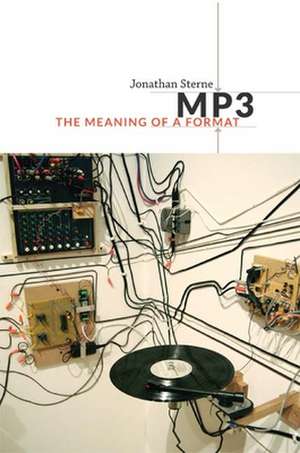
MP3
Autor Jonathan Sterneen Limba Engleză Paperback – 17 iul 2012
Ceea ce diferențiază MP3 de documentația tehnică standard este abordarea sa genealogică profundă, care refuză să trateze acest format doar ca pe un algoritm software modern. Jonathan Sterne demonstrează că MP3-ul nu este o invenție spontană a anilor '90, ci punctul culminant al unei cercetări de un secol asupra audiției umane, începută în laboratoarele industriei telefonice în 1910. Observăm cum autorul descompune mecanismul compresiei—procesul prin care sunetele considerate redundante sunt eliminate pentru a economisi spațiu—și cum această logică a eficienței a modelat întreaga cultură sonoră contemporană.
Analiza este susținută de 31 de fotografii și 5 tabele, oferind o perspectivă tehnică asupra codării perceptuale. Credem că valoarea acestui volum rezidă în capacitatea de a explica modul în care standardele și infrastructurile invizibile dictează forma conținutului media. Complementar lucrării Compression Mode de Stephen Kennedy, care explorează compresia ca fenomen politic și economic, volumul lui Sterne se concentrează pe evoluția tehnologică și pe relația dintre sunet, tăcere și zgomot în contextul istoriei comunicațiilor. Dacă Audio Technology, Music, and Media oferă o privire generală asupra fizicii sunetului și a înregistrării multicanal, MP3 sapă în detaliile specifice ale algoritmilor care au făcut posibilă portabilitatea muzicii la scară globală, provocând ideea că progresul media înseamnă întotdeauna o fidelitate mai mare.
Preț: 285.03 lei
Carte tipărită la comandă
Livrare economică 27 august-10 septembrie
Specificații
ISBN-10: 0822352877
Pagini: 360
Ilustrații: 31 photographs, 5 tables
Dimensiuni: 152 x 229 x 20 mm
Greutate: 0.52 kg
Editura: Duke University Press
V-ar putea interesa
-
 Electric ShockPeter Doggett-18%Preț: 86.07 lei105.38 lei
 -
 How Music Got FreeStephen Witt-20%Preț: 73.07 lei91.64 lei
 -
 The Logic of Filtering: How Noise Shapes the Sound of Recorded MusicMelle Jan Kromhout-18%Preț: 210.32 lei256.14 lei
 -
 The Oxford Handbook of Radio and PodcastingMichele Hilmes-33%Preț: 905.75 lei1351.20 lei
 -
 Format Friction: Perspectives on the Shellac DiscGavin WilliamsPreț: 206.74 lei
 -
 Preț: 178.17 lei
 -
 Preț: 194.47 lei
 -
 Why Sound MattersDamon KrukowskiPreț: 131.80 lei
 -
 Encyclopedia of New MediaSteve Jones-9%Preț: 1028.24 lei1129.94 lei
 -
 Songs In The Key of MP3: The New Icons of the Internet AgeLiam Inscoe-Jones-27%Preț: 104.33 lei142.22 lei
 -
 Compact DiscRobert Barry-33%Preț: 50.44 lei75.19 lei
 -
 Compression Mode: The Edge of SensibilityStephen Kennedy-30%Preț: 540.76 lei773.77 lei
 -
 The Medium Is Still the MessageGrant N. HaversPreț: 230.41 lei
 -
 A Social History of the MediaAsa BriggsPreț: 170.05 lei
 -
 Sound TracksGraeme LawsonPreț: 92.75 lei
 -
 Perfecting Sound ForeverGreg MilnerPreț: 92.54 lei
 -
 MiddlelandRory StewartPreț: 157.41 lei
 -
 -21%Preț: 83.90 lei105.59 lei
 -
 -26%Preț: 193.23 lei259.62 lei
De ce să citești această carte
Recomandăm această carte inginerilor de sunet, istoricilor tehnologiei și profesioniștilor din comunicații care doresc să înțeleagă fundamentul tehnic al celui mai utilizat format audio. Cititorul va câștiga o perspectivă rară asupra modului în care limitările biologice ale auzului uman au fost codificate în software, transformând sunetul într-o marfă digitală globală.
Descriere scurtă
Recenzii
"MP3: The Meaning of a Format is based on a genealogy that meticulously traces various technological strands that led to the MP3 being codified in 1992. Sterne's method allows for unexpected insights that break with well-ingrained presumptions about technological progress...As Sterne shows, digital technologies need to be understood in a broad sense, and perhaps the difference between analogue and digital is not so very great after all. Instead, this study shows the importance of continuities and the cross-referencing of media formats, offering a fresh entry point in the histories of sound and communications as well as of digital technologies." - Hillegonda C. Rietveld, Times Higher Education, August 9th 2012 "Jonathan Sterne's book unravels the paradigms and ideas that underpin the MP3, including theories of audio masking and coding which date all the way back to Bell Laboratories/AT & T's attempts to wring maximum bandwidth from telephone lines back in the early 20th century... Ultimately the MP3 itself fades into the background of the book (as it was designed to do in practice), and becomes an elegant lens through which to view the collision of communication, commerce, data and sound in the 21st century." - Derek Walmsley, The Wire, September 2012 "Jonathan Sterne argues in MP3: The Meaning of a Format, the dreams associated with MP3s, iPods, and the digital revolution in music distribution are actually "old dreams." Rigorous and quietly philosophical, MP3 situates this world-conquering format in a broader context than the familiar stories of college kids downloading wild and the death of the recording industry... Sterne's MP3 is an important work in various academic fields, but his probing questions about the future of digital culture have consequences beyond the specialized reader. The MP3 is a format, just as vinyl records, compact discs, and cassettes were formats. There is music, which will continue to send us into the throes of euphoria or depression, and there is its container, whether it is a minute file inside your computer or a lustrous vinyl record. The nostalgia we feel isn't for a more thoroughgoing relationship to music so much as it is nostalgia for these things and our relationships to them, scarcity-in-retrospect, the quaint simplicity and innocence of our own past." - Hua Hsu, Slate.com, August 2012 "As we continue to inhabit the digital universe created by the invention of the computer, Jonathan Sterne provides us with an important cultural history and theory of the pervasive MP3 audio format. His insights go deep into our basic ideas of hearing and listening as well as our ideas of information, showing how these ideas are tied to 20th century media." - Pauline Oliveros, Composer/Improviser, Deep Listening Institute, Rensselaer Polytechnic Institute "In this authoritative and fascinating book, Jonathan Sterne, a leading scholar of sound studies, traces the MP3 technology back to its roots in telephone research. His book is about not only how musical experience became equated with one format but also how subjectivity itself is formatted. Sterne decompresses history to weave a wonderful tale of the many surprising links and twists embedded in those tiny files." - Trevor Pinch, author of Analog Days: The History and Impact of the Moog Synthesizer "Jonathan Sterne's MP3 traces the sonic genealogy of the much-maligned format from its roots in AT<>T's drive to maximise profits by squeezing as many calls as possible into a given phone line, eking out the implications of each stage along the way. A sequel of sorts to 2003's The Audible Past, which offered a history of listening between the stethoscope and the gramophone; MP3 brings the story up to the present day, taking in information theory, architectural acoustics, and the vocoder along the way, before finally settling down to the development of the MPEG standard itself and some of the more philosophical implications thrown up by it." Robert Barry, Review 31
"As we continue to inhabit the digital universe created by the invention of the computer, Jonathan Sterne provides us with an important cultural history and theory of the pervasive MP3 audio format. His insights go deep into our basic ideas of hearing and listening as well as our ideas of information, showing how these ideas are tied to 20th century media." Pauline Oliveros, Composer/Improviser, Deep Listening Institute, Rensselaer Polytechnic Institute "In this authoritative and fascinating book, Jonathan Sterne, a leading scholar of sound studies, traces the MP3 technology back to its roots in telephone research. His book is about not only how musical experience became equated with one format but also how subjectivity itself is formatted. Sterne decompresses history to weave a wonderful tale of the many surprising links and twists embedded in those tiny files." Trevor Pinch, author of Analog Days: The History and Impact of the Moog Synthesizer
"MP3: The Meaning of a Format is based on a genealogy that meticulously traces various technological strands that led to the MP3 being codified in 1992. Sterne's method allows for unexpected insights that break with well-ingrained presumptions about technological progress...As Sterne shows, digital technologies need to be understood in a broad sense, and perhaps the difference between analogue and digital is not so very great after all. Instead, this study shows the importance of continuities and the cross-referencing of media formats, offering a fresh entry point in the histories of sound and communications as well as of digital technologies." Hillegonda C. Rietveld, Times Higher Education, August 9th 2012 "Jonathan Sterne argues in MP3: The Meaning of a Format, the dreams associated with MP3s, iPods, and the digital revolution in music distribution are actually "old dreams." Rigorous and quietly philosophical, MP3 situates this world-conquering format in a broader context than the familiar stories of college kids downloading wild and the death of the recording industry... Sterne's MP3 is an important work in various academic fields, but his probing questions about the future of digital culture have consequences beyond the specialized reader. The MP3 is a format, just as vinyl records, compact discs, and cassettes were formats. There is music, which will continue to send us into the throes of euphoria or depression, and there is its container, whether it is a minute file inside your computer or a lustrous vinyl record. The nostalgia we feel isn't for a more thoroughgoing relationship to music so much as it is nostalgia for these things and our relationships to them, scarcity-in-retrospect, the quaint simplicity and innocence of our own past." Hua Hsu, Slate.com, August 2012 "As we continue to inhabit the digital universe created by the invention of the computer, Jonathan Sterne provides us with an important cultural history and theory of the pervasive MP3 audio format. His insights go deep into our basic ideas of hearing and listening as well as our ideas of information, showing how these ideas are tied to 20th century media." Pauline Oliveros, Composer/Improviser, Deep Listening Institute, Rensselaer Polytechnic Institute "In this authoritative and fascinating book, Jonathan Sterne, a leading scholar of sound studies, traces the MP3 technology back to its roots in telephone research. His book is about not only how musical experience became equated with one format but also how subjectivity itself is formatted. Sterne decompresses history to weave a wonderful tale of the many surprising links and twists embedded in those tiny files." Trevor Pinch, author of Analog Days: The History and Impact of the Moog Synthesizer