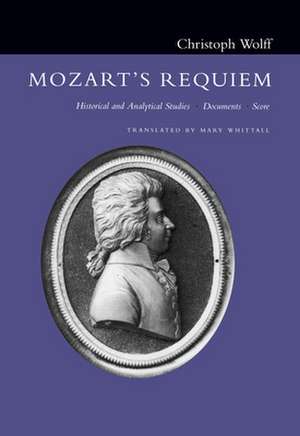
Mozart's Requiem: Historical and Analytical Studies, Documents, Score
Autor Christoph Wolff Traducere de Mary Whittallen Limba Engleză Paperback – 31 mai 1998
Observăm de la prima atingere că acest volum în format paperback, deși compact, este un ghid portabil dens, care reușește să sintetizeze secole de controverse muzicologice în doar 190 de pagini. Credem că valoarea acestui titlu rezidă în echilibrul rar dintre rigoarea academică și accesibilitatea documentară, oferind cititorului o experiență senzorială completă prin includerea partiturii fragmentare a Requiemului. Suntem de părere că procesul de parcurgere a celor trei secțiuni — istorică, analitică și documentară — transformă lectura dintr-o simplă acumulare de date într-o investigație cvasi-detectivistică asupra uneia dintre cele mai enigmatice compoziții din istoria muzicii.
Analiza lui Christoph Wolff nu se limitează la mitul romantic al compozitorului care își scrie propria moarte, ci ancorează lucrarea în realitatea tehnică a manuscrisului. Colecționarii care au apreciat Requiem, K.626 de Wolfgang Amadeus Mozart vor găsi aici aceeași calitate de reproducere a materialului muzical, dar îmbogățită de un aparat critic care explică tranziția de la schițele lui Mozart la completările lui Sussmayr. În contextul operei sale, acest volum completează viziunea autorului din Mozart at the Gateway to His Fortune: Serving the Emperor, 1788-1791, unde Wolff explora ascensiunea socială a compozitorului; aici, el analizează apogeul creativ și moștenirea postumă, menținând standardul de excelență stabilit în biografia sa fundamentală Johann Sebastian Bach. Este o resursă esențială pentru cei care doresc să înțeleagă nu doar ce a scris Mozart, ci și cum a fost receptată muzica sa în primele decenii după 1791.
Preț: 267.53 lei
Carte tipărită la comandă
Livrare economică 08-22 iunie
Specificații
ISBN-10: 0520213890
Pagini: 190
Dimensiuni: 179 x 250 x 17 mm
Greutate: 0.49 kg
Ediția:Reprint
Editura: University of California Press
V-ar putea interesa
-
 All Cheeses Great and SmallAlex JamesPreț: 75.56 lei
 -
 Ludwig van Beethoven: Approaches to his MusicCarl Dahlhaus-37%Preț: 644.54 lei1027.21 lei
 -
 Johann Sebastian Bach: The Learned MusicianChristoph Wolff-18%Preț: 186.99 lei228.40 lei
 -
 Taraborrelli, J: SinatraJ. Randy Taraborrelli-30%Preț: 45.42 lei64.95 lei
 -
 Preț: 182.72 lei
 -
 Bach – Essays on his Life & Music (Paper)Christopher WolffPreț: 408.96 lei
 -
 -20%Preț: 71.50 lei89.32 lei
 -
 MarillionJon CollinsPreț: 137.03 lei
 -
 Britten: Centenary EditionDavid Matthews-19%Preț: 55.80 lei69.20 lei
 -
 Just Getting StartedJustin BieberPreț: 91.31 lei
De ce să citești această carte
Recomandăm această lucrare oricărui meloman sau student la conservator care dorește să depășească miturile din jurul „Requiemului”. Cititorul câștigă o înțelegere profundă a structurii muzicale și acces direct la documente istorice rare și la partitura originală. Este o oportunitate unică de a studia manuscrisul fragmentar alături de una dintre cele mai avizate voci ale muzicologiei contemporane, Christoph Wolff.
Despre autor
Christoph Wolff, finalist al Premiului Pulitzer, este profesor la Universitatea Harvard și este considerat unul dintre cei mai importanți experți mondiali în viețile și operele lui Bach și Mozart. Renumit pentru capacitatea sa de a îmbina analiza tehnică a partiturilor cu contextul istoric bogat, Wolff a publicat numeroase studii fundamentale care au redefinit înțelegerea muzicii baroce și clasice. Locuiește în Cambridge, Massachusetts, continuând să fie o autoritate centrală în cercetarea muzicologică internațională, fiind apreciat pentru rigoarea cu care tratează sursele primare și manuscrisele autografe.
Descriere scurtă
Christoph Wolff provides a critical introduction to the Requiem in its many facets. Part I of his study focuses on the tangled genesis and completion of the work and its fascinating early reception history until Constanze's death. Wolff summarizes the current state of research on the subject, provides new perspectives on Mozart's conception of the whole work, and surveys his contributions to the movements composed posthumously by his assistant, Sssmayr. Part II provides a musical analysis of Mozart's composition, including contextual, structural, and interpretive aspects. Part III consists of an annotated collection of the principal literary documents (1791-1839) that illuminate the fascinating early history of the Requiem.
The book concludes with a complete edition of the work that is at the center of Wolff's study, the authentic score of the Requiem--Mozart's fragment--supplemented by crucial excerpts from Sssmayr's 1792 Requiem completion. Mozart's unfinished Requiem has long been shrouded in mystery. Mozart undertook the commission for an Austrian nobleman, little knowing that he was to write a requiem for himself. Inevitably, the secrecy surrounding the anonymous commission, the circumstances of Mozart's death, the unfinished state of the work, and its completion under the direction of Mozart's widow, Constanze, have precipitated two centuries of romantic speculation and scholarly controversy.
Christoph Wolff provides a critical introduction to the Requiem in its many facets. Part I of his study focuses on the tangled genesis and completion of the work and its fascinating early reception history until Constanze's death. Wolff summarizes the current state of research on the subject, provides new perspectives on Mozart's conception of the whole work, and surveys his contributions to the movements composed posthumously by his assistant, Sssmayr. Part II provides a musical analysis of Mozart's composition, including contextual, structural, and interpretive aspects. Part III consists of an annotated collection of the principal literary documents (1791-1839) that illuminate the fascinating early history of the Requiem.
The book concludes with a complete edition of the work that is at the center of Wolff's study, the authentic score of the Requiem--Mozart's fragment--supplemented by crucial excerpts from Sssmayr's 1792 Requiem completion.