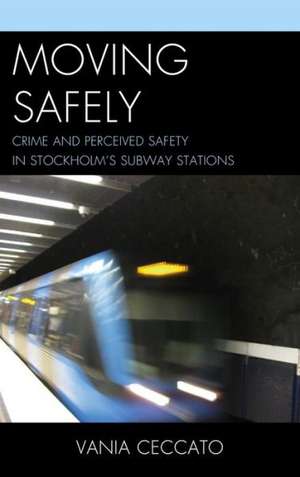
Moving Safely: Crime and Perceived Safety in Stockholm's Subway Stations
Autor Vania Ceccatoen Limba Engleză Hardback – 12 sep 2013
Preț: 500.82 lei
Preț vechi: 790.99 lei
-37%
Puncte Express: 751
Carte tipărită la comandă
Livrare economică 27 noiembrie-11 decembrie
Livrare prin curier în România Termenul estimat este afișat lângă disponibilitate.
Transport gratuit pentru acest produs Plată online sau ramburs, în funcție de opțiunile comenzii.
Retur gratuit în 14 zile Comandă securizată și suport în română.
Specificații
ISBN-13: 9780739177600
ISBN-10: 0739177605
Pagini: 218
Dimensiuni: 158 x 237 x 19 mm
Greutate: 0.48 kg
Ediția:New.
Editura: Bloomsbury Publishing
Colecția Lexington Books
Locul publicării:New York, United States
ISBN-10: 0739177605
Pagini: 218
Dimensiuni: 158 x 237 x 19 mm
Greutate: 0.48 kg
Ediția:New.
Editura: Bloomsbury Publishing
Colecția Lexington Books
Locul publicării:New York, United States
Cuprins
Chapter 1: Introduction
Chapter 2: Mobility and safety
Chapter 3: Transportation nodes and the city
Chapter 4: The emergence in criminology of safety in transportation nodes
Chapter 5: A conceptual framework for safety in subway stations
Chapter 6: The Stockholm's subway stations
Chapter 7: Crime and the environment in Stockholm's subway stations
Chapter 8: Patterns of perceived safety in Stockholm's subway stations
Chapter 9: The rhythms of crime at Stockholm's subway stations
Chapter 10: Lessons from Stockholm's subway stations
Chapter 11: Making transportation nodes safer
Chapter 12: A research agenda for safety at transportation nodes
References
Definitions
Appendices
Index
About the author
Chapter 2: Mobility and safety
Chapter 3: Transportation nodes and the city
Chapter 4: The emergence in criminology of safety in transportation nodes
Chapter 5: A conceptual framework for safety in subway stations
Chapter 6: The Stockholm's subway stations
Chapter 7: Crime and the environment in Stockholm's subway stations
Chapter 8: Patterns of perceived safety in Stockholm's subway stations
Chapter 9: The rhythms of crime at Stockholm's subway stations
Chapter 10: Lessons from Stockholm's subway stations
Chapter 11: Making transportation nodes safer
Chapter 12: A research agenda for safety at transportation nodes
References
Definitions
Appendices
Index
About the author
Recenzii
Moving Safely: Crime and Perceived Safety In Stockholm's Subway Stations provides important and additional support for the introduction of measures designed to reduce crime and disorder and make people feel safer using transit. As safety is likely the primary factor in the decision of a non-transit dependent person to take or not to take transit, knowledge of crime and how to prevent it is essential for transit professionals.
This is a book of substance and depth, pushing beyond the current literature to help us understand transit crime and local crime in general. Ceccato covers and links multiple literatures and helps us relate crime to the flows of daily life. These principles apply beyond any one city or country.
Focusing on Stockholm subway system, this comprehensive and thought-provoking book explores almost every aspect of safety at transport nodes-the very places where people enter and exit the underground network. Being safe and feeling safe is affected not only by the physical characteristics of the stations themselves but also by what surrounds them and where they are located in the city. As well as presenting an evidence-based analysis of safety on a subway system, this book also suggests how practical measures can alter crime risks and perceptions of safety to improve the quality of the passenger experience. Although Stockholm-centered, the book clearly has relevance to subway systems in large metropolitan areas, particularly in North America and Europe. It is essential reading for criminologists, architects, transport planners, and geographers but most importantly, passengers, for whom subways should offer a chance to move freely around the city and to go about their daily lives in safety, comfort, and with peace of mind.
A welcome addition to the literature on safety and security in public spaces, Ceccato draws on her intensive field-based research into the Stockholm subway system to craft a book that will appeal to academics for its conceptual robustness and to planners for the practical insights it offers.
This is a book of substance and depth, pushing beyond the current literature to help us understand transit crime and local crime in general. Ceccato covers and links multiple literatures and helps us relate crime to the flows of daily life. These principles apply beyond any one city or country.
Focusing on Stockholm subway system, this comprehensive and thought-provoking book explores almost every aspect of safety at transport nodes-the very places where people enter and exit the underground network. Being safe and feeling safe is affected not only by the physical characteristics of the stations themselves but also by what surrounds them and where they are located in the city. As well as presenting an evidence-based analysis of safety on a subway system, this book also suggests how practical measures can alter crime risks and perceptions of safety to improve the quality of the passenger experience. Although Stockholm-centered, the book clearly has relevance to subway systems in large metropolitan areas, particularly in North America and Europe. It is essential reading for criminologists, architects, transport planners, and geographers but most importantly, passengers, for whom subways should offer a chance to move freely around the city and to go about their daily lives in safety, comfort, and with peace of mind.
A welcome addition to the literature on safety and security in public spaces, Ceccato draws on her intensive field-based research into the Stockholm subway system to craft a book that will appeal to academics for its conceptual robustness and to planners for the practical insights it offers.