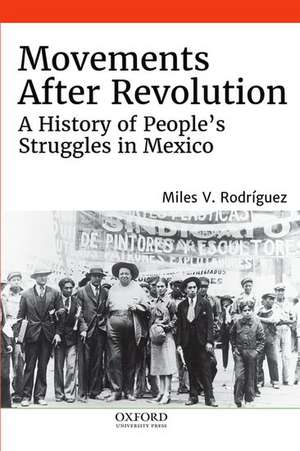
Movements After Revolution: A History of People's Struggles in Mexico
Autor Miles V. Rodríguezen Limba Engleză Hardback – 12 oct 2022
Autorul Miles V. Rodríguez, profesor și cercetător cu o expertiză solidă în istoria Americii Latine, fundamentează această lucrare pe o documentare riguroasă a arhivelor sindicale și politice din Mexic. Ne-a atras atenția modul în care volumul Movements After Revolution deconstruiește mitul conform căruia stabilirea republicii constituționale a adus pacea socială. Din contră, decada 1920-1930 a fost marcată de o efervescență organizațională fără precedent, în care muncitorii industriali și țăranii au căutat forme diverse de justiție socială. Subliniem perspectiva inedită a lui Rodríguez asupra rolului comuniștilor, care au încercat să transforme nemulțumirile locale într-o mișcare unitară împotriva statului post-revoluționar și a capitalismului. Credem că valoarea academică a cărții rezidă în analiza detaliată a fragmentării acestor mișcări; autorul explică cum tensiunile interne între radicali și reformiști au permis statului să intervină decisiv, ducând la colapsul coalițiilor în pragul Marii Depresiuni. Lucrarea acoperă aceeași arie tematică precum Communism in Mexico de Karl M. Schmitt, dar cu o abordare mult mai ancorată în mișcările de la firul ierbii și în dinamica de clasă, spre deosebire de analiza lui Schmitt axată pe geopolitică și securitate. De asemenea, spre deosebire de Workers, Neighbors, and Citizens de John Lear, care se concentrează pe mobilizarea urbană din Mexico City, Rodríguez extinde analiza la nivel național, realizând o sinteză între mișcarea agrară și cea industrială.
Preț: 376.63 lei
Preț vechi: 475.41 lei
-21%
Carte disponibilă
Livrare economică 02-07 octombrie
Specificații
ISBN-10: 0197558100
Pagini: 240
Dimensiuni: 237 x 162 x 21 mm
Greutate: 0.5 kg
Editura: Oxford University Press
Colecția OUP USA
Locul publicării:New York, United States
De ce să citești această carte
Recomandăm această carte studenților la istorie și științe politice care doresc să înțeleagă limitele Revoluției Mexicane. Cititorul câștigă o perspectivă clară asupra modului în care un stat centralizat poate neutraliza opoziția prin fragmentare și cooptare. Este o lectură esențială pentru a înțelege de ce alternativele socialiste nu au reușit să se consolideze în Mexicul post-1920, oferind lecții valoroase despre reziliența și eșecul mișcărilor sociale în fața puterii de stat.
Despre autor
Miles V. Rodríguez este un istoric specializat în mișcările sociale și politice din America Latină, cu un accent deosebit pe relația dintre clasa muncitoare și formarea statului în Mexic. Lucrările sale sunt recunoscute pentru utilizarea unor surse primare adesea ignorate, aducând la lumină contribuțiile activiștilor de la baza societății. În contextul volumului Movements After Revolution, experiența sa academică este vizibilă în rigoarea cu care analizează eșecul coalițiilor revoluționare și impactul ideologiilor de stânga asupra structurii sociale mexicane în perioada interbelică.
Descriere
Recenzii
Rodríguez closely examines the relatively unknown and unexamined histories of specific parts of the labor and agrarian movements that began to align with one another in Mexico, demonstrating a clear understanding of the influences and limits of the Mexican Revolution in people's movements. He argues that the possibilities of strategic organizations and the parts of the agrarian and labor movements that forged alliances failed to unite in a common struggle because of state intervention and subsequent co-option....Rodríguez makes an important distinction between 'people's movements' and 'popular movements,' emphasizing that 'people's movements' represent people, making them much more than just popular. This distinction, Rodríguez further opines, is also meant to facilitate global and international comparisons relevant to revolutions and post-revolutionary processes and situations throughout the 20th-century world.
A must-read for anyone trying to understand why the Mexican Revolution did not lead to the revolutionary Mexico portrayed in Rivera's and Siqueiros's murals and became instead a capitalist country ruled by a single party. This book masterfully explains how the possibility of a socialist Mexico vanished by the end of the 1920s as labor and agrarian movements, briefly allied under Communist leadership, failed to remain united and independent from an increasingly strong state.
A provocative analysis of popular movements in 1920s Mexico. Rodríguez traces the important yet ultimately unsuccessful efforts to unite labor and agrarian movements in an anti-capitalist front under Communist leadership and thus challenges prevailing narratives about the Mexican Revolution.
Miles Rodríguez illuminates the complexities of post-revolutionary Mexico and the fragmentation of agrarian and industrial unions and movements. Forced to choose between the Mexican Community Party or the Mexican state, some of the strongest independent labor unions and agrarian organizations ultimately had their power reduced by state leaders, and despite a brief resurgence in the 1930s, many remained under state control for decades. Movements after Revolution is an important part of the story about why it took the Mexican left so long to consolidate a national electoral victory after the Mexican Revolution.
Movements after Revolution uncovers new research about a forgotten chapter of the Mexican Revolution—how authentic labor and agrarian groups struggled in the decade after 1920 to unite under Communist leadership and pose an alternative path to the state-dominated Mexican Revolution. Rodríguez's passion for the topic is evident and brings this important story to light, emphasizing that, despite the difficulties faced by these movements in the face of emerging state power, their influence would be felt in the evolution of the revolution's official labor and agrarian organizations. This study is a must-read for anyone interested in the history of revolution in twentieth-century Latin America.