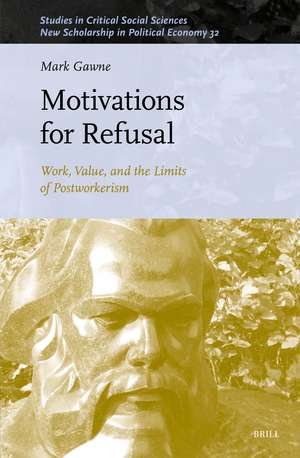
Motivations for Refusal: Work, Value, and the Limits of Postworkerism: Studies in Critical Social Sciences / New Scholarship in Political Economy, cartea 315-32
Autor Mark Gawneen Limba Engleză Hardback – 24 apr 2025
| Toate formatele și edițiile | Preț | Express |
|---|---|---|
| Paperback (1) | 167.22 lei Precomandă | |
| Haymarket Books – iul 2026 | 167.22 lei Precomandă | |
| Hardback (1) | 656.22 lei 23-29 zile | |
| Brill – 24 apr 2025 | 656.22 lei 23-29 zile |







Preț: 656.22 lei
Preț vechi: 800.27 lei
-18%
Puncte Express: 984
Preț estimativ în valută:
116.18€ • 135.28$ • 100.92£
116.18€ • 135.28$ • 100.92£
Carte disponibilă
Livrare economică 05-11 februarie
Preluare comenzi: 021 569.72.76
Specificații
ISBN-13: 9789004678934
ISBN-10: 900467893X
Pagini: 264
Dimensiuni: 155 x 235 x 20 mm
Greutate: 0.57 kg
Editura: Brill
Colecția Brill
Seria Studies in Critical Social Sciences / New Scholarship in Political Economy
ISBN-10: 900467893X
Pagini: 264
Dimensiuni: 155 x 235 x 20 mm
Greutate: 0.57 kg
Editura: Brill
Colecția Brill
Seria Studies in Critical Social Sciences / New Scholarship in Political Economy
Notă biografică
Mark Gawne, Ph.D. (2015), University of Sydney, is Lecturer in Social and Political Sciences at the University of Technology Sydney. He has taught widely in critical sociologies of labour and political economy, and writes on themes of work, class composition, and deindustrialisation, including “Love Is a Battlefield: on the Affective Politics of Crisis”, in The Love Collective (eds.), Love: Art, Ideas, Music, Politics (Kembla Books, 2020).
Cuprins
Contents
Acknowledgements
1 Introduction
1 Crisis, Work, Motivation
2 Why Work? What Life?
3 Preliminary Comments on Postworkerism, Affective Labour, and Immaterial Production
4 Motivation, Refusal, and the Affective Compositions of Capital and Class
2 Lineages of Value, Theories of Labour
1 Introduction
2 Marx on Value: Variations and Ambivalences
3 Value-Form
4 Tracing the Lineages of Theories of Value
5 Foundations of a New Substantialism: the Trinity of Labour-Value-Affect
6 Notation: against a Productivist Foundation of Politics
7 Conclusion
3 Class Composition and the Prehistory of Immaterial Production
1 Introduction
2 Value and Antagonism
3 Class Composition Analysis as Method and Perspective
4 Workerist-Feminist Critiques, Wages for and against Housework
5 The Emergence of Postworkerism and the Composition of Class
6 Conclusion
4 Affective Ontology, Cooperation, and the Crisis of Value
1 Introduction
2 The Crisis of Value
3 Cooperation, Autonomous Production, and Measure
4 From Class Composition to the Foundational Threshold of Political Ontology
5 The Character of Labour in the Becoming-Rent of Profit
6 Fragmentation and the Persistence of Mediation
7 Conclusion
5 The Affective Sciences and Managerial Practice
1 Introduction
2 Critical Management Studies and the Problem of Affect
3 Affective Capitalism and the Theorisation of Labour and Capital
4 The Affective Sciences and Management
5 Affect as Material of Service Labour and Management
6 Conclusion: Affective Management and the Technical Composition of Class
6 Affective Capital, Labour, and Emotion Recognition Technology in the Workplace
1 Introduction
2 Affect and Emotion
3 Affective Machines and Problems of Composition
4 Human-Computer Interaction and Affective Capital
5 Technologically Fixed Affects, or the ReInversion of the General Intellect
6 Affective Augmentation, Productivity, and Surplus Value
7 Conclusion: Technological Determinism or Technical Ambivalence?
7 Ambivalence and the Affective Compositions of Capital and Class
1 Introduction
2 Class Compositions: Technical, Political, Social, Affective
3 Affective Politics and the Affective Composition of Labour: Motivation and Refusal
4 Affective Sciences and the Technical Composition of Class
5 On Ambivalence
6 Ambivalent Affects
7 Conclusion
8 Conclusion
Bibliography
Index
Acknowledgements
1 Introduction
1 Crisis, Work, Motivation
2 Why Work? What Life?
3 Preliminary Comments on Postworkerism, Affective Labour, and Immaterial Production
4 Motivation, Refusal, and the Affective Compositions of Capital and Class
Part 1: Labour, Value, Affect
2 Lineages of Value, Theories of Labour
1 Introduction
2 Marx on Value: Variations and Ambivalences
3 Value-Form
4 Tracing the Lineages of Theories of Value
5 Foundations of a New Substantialism: the Trinity of Labour-Value-Affect
6 Notation: against a Productivist Foundation of Politics
7 Conclusion
3 Class Composition and the Prehistory of Immaterial Production
1 Introduction
2 Value and Antagonism
3 Class Composition Analysis as Method and Perspective
4 Workerist-Feminist Critiques, Wages for and against Housework
5 The Emergence of Postworkerism and the Composition of Class
6 Conclusion
4 Affective Ontology, Cooperation, and the Crisis of Value
1 Introduction
2 The Crisis of Value
3 Cooperation, Autonomous Production, and Measure
4 From Class Composition to the Foundational Threshold of Political Ontology
5 The Character of Labour in the Becoming-Rent of Profit
6 Fragmentation and the Persistence of Mediation
7 Conclusion
Part 2: Contested Terrains of Affect
5 The Affective Sciences and Managerial Practice
1 Introduction
2 Critical Management Studies and the Problem of Affect
3 Affective Capitalism and the Theorisation of Labour and Capital
4 The Affective Sciences and Management
5 Affect as Material of Service Labour and Management
6 Conclusion: Affective Management and the Technical Composition of Class
6 Affective Capital, Labour, and Emotion Recognition Technology in the Workplace
1 Introduction
2 Affect and Emotion
3 Affective Machines and Problems of Composition
4 Human-Computer Interaction and Affective Capital
5 Technologically Fixed Affects, or the ReInversion of the General Intellect
6 Affective Augmentation, Productivity, and Surplus Value
7 Conclusion: Technological Determinism or Technical Ambivalence?
7 Ambivalence and the Affective Compositions of Capital and Class
1 Introduction
2 Class Compositions: Technical, Political, Social, Affective
3 Affective Politics and the Affective Composition of Labour: Motivation and Refusal
4 Affective Sciences and the Technical Composition of Class
5 On Ambivalence
6 Ambivalent Affects
7 Conclusion
8 Conclusion
Bibliography
Index