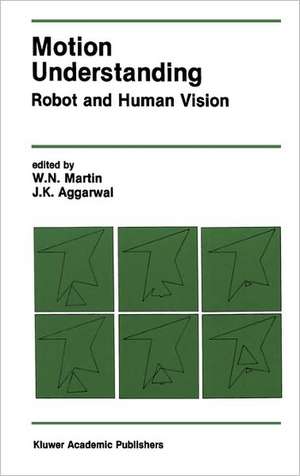
Motion Understanding
Editat de W. Bach, J K Aggarwalen Limba Engleză Hardback – 29 feb 1988
Preț: 1238.76 lei
Preț vechi: 1510.69 lei
-18%
Puncte Express: 1858
Carte tipărită la comandă
Livrare economică 03-17 decembrie
Livrare prin curier în România Termenul estimat este afișat lângă disponibilitate.
Transport gratuit pentru acest produs Plată online sau ramburs, în funcție de opțiunile comenzii.
Retur gratuit în 14 zile Comandă securizată și suport în română.
Specificații
ISBN-13: 9780898382587
ISBN-10: 0898382580
Pagini: 432
Ilustrații: XXIV, 432 p.
Dimensiuni: 156 x 234 x 25 mm
Greutate: 0.82 kg
Ediția:1988 edition
Editura: Springer Us
Locul publicării:New York, NY, United States
ISBN-10: 0898382580
Pagini: 432
Ilustrații: XXIV, 432 p.
Dimensiuni: 156 x 234 x 25 mm
Greutate: 0.82 kg
Ediția:1988 edition
Editura: Springer Us
Locul publicării:New York, NY, United States
V-ar putea interesa
-
 PhysicsAristotle-17%Preț: 60.12 lei72.86 lei
 -
 Seven Brief Lessons on Physics. Anniversary EditionCarlo RovelliPreț: 92.41 lei
 -
 SpeedVaclav SmilPreț: 137.51 lei
 -
 The Human Figure in MotionEadweard Muybridge-17%Preț: 332.70 lei400.11 lei
 -
 MeditationsMarcus AureliusPreț: 34.00 lei
 -
 -24%Preț: 146.90 lei192.22 lei
 -
 -20%Preț: 119.79 lei149.23 lei
 -
 The ScoreC. Thi NguyenPreț: 194.17 lei
 -
 Preț: 384.83 leiRecomandat
 -
 The Legend of Zelda and PhilosophyLuke CuddyPreț: 104.85 lei
 -
 Move First, Align FastDeepika Chopra-20%Preț: 177.71 lei222.14 lei
 -
 The Physics Book: From the Big Bang to Quantum ResurrectionClifford Pickover A-30%Preț: 149.98 lei215.25 lei
 -
 What Next?Anna FranklinPreț: 44.47 lei
 -
 The Human ShutterRobert L. BowenPreț: 282.85 lei
 -
 Biological Motion - A History of LifeJanina WellmannPreț: 216.76 lei
 -
 The Time MachineH. G. WellsPreț: 33.23 lei
 -
 Resolving Aristotle's Aporia on TimeJan H. NylundPreț: 271.52 lei
 -
 Intelligent Analysis of Optical ImagesZhengjun Liu-18%Preț: 931.50 lei1135.97 lei
 -
 High-Orders Motion AnalysisYan Sun-20%Preț: 1018.75 lei1273.44 lei
Public țintă
ResearchCuprins
1 Bounding Constraint Propagation for Optical Flow Estimation.- 1.1 Introduction.- 1.2 The Gradient Constraint Equation.- 1.3 Gradient-Based Algorithms.- 1.4 Coping with Smoothness Violations.- 1.5 Results.- 1.6 Discussion.- 2 Image Flow: Fundamentals and Algorithms.- 2.1 Introduction.- 2.2 Simple Image Flows.- 2.3 Discontinuous Image Flow.- 2.4 Analysis of Discontinuous Image Flows.- 2.5 Algorithms for Discontinuous Image Flows.- 2.6 Smoothing Discontinuous Image Flows.- 2.7 Summary and Conclusions.- 3 A Computational Approach to the Fusion of Stereopsis and Kineopsis.- 3.1 Introduction.- 3.2 Integrating Optical Flow to Stereopsis for Motion.- 3.3 Perception of Rigid Objects in Motion.- 3.4 Examples.- 3.5 Summary.- 4 The Empirical Study of Structure from Motion.- 4.1 Introduction.- 4.2 Viewer-Centered vs. Object-Centered Depth.- 4.3 The Correspondence Problem.- 4.4 Rigidity.- 4.5 Perception of Self Motion.- 4.6 A Theory of Observers.- 4.7 An Empirical Test of Constraints.- 4.8 Summary and Conclusions.- 5 Motion Estimation Using More Than Two Images.- 5.1 Introduction.- 5.2 General Description of the Method.- 5.3 Results.- 5.4 Comparison with Other Methods.- 5.5 Conclusions.- 6 An Experimental Investigation of Estimation Approaches for Optical Flow Fields.- 6.1 Introduction.- 6.2 Feature Based Estimation.- 6.3 Analytical Approach for the Estimation of Optical Flow Vector Fields.- 6.4 Discussion.- 7 The Incremental Rigidity Scheme and Long-Range Motion Correspondence.- 7.1 The Rigidity-Based Recovery of Structure from Motion.- 7.2 The Incremental Rigidity Scheme.- 7.3 Experimental Results.- 7.4 Additional Properties of the Incremental Rigidity Scheme.- 7.5 Possible Implications to the Long-Range Motion Correspondence Process.- 7.6 Summary.- 8 Some Problems with Correspondence.- 8.1 Introduction.- 8.2 Determining Correspondence.- 8.3 Correspondence in Computer Vision.- 8.4 An Experiment on Correspondence.- 8.5 Conclusions.- 9 Recovering Connectivity from Moving Point-Light Displays.- 9.1 Introduction.- 9.2 Motion Information is a Minimal Stimulus Condition for the Perception of Form.- 9.3 Processing Models for Recovering Form from Motion.- 9.4 Do Fixed-Axis Models Predict Human Performance?.- 9.5 Human Implementation of Additional Processing Constraints.- 9.6 Incompatibilities Between Human Performance and Models Seeking Local Rigidity.- 9.7 Conclusion.- 10 Algorithms for Motion Estimation Based on Three-Dimensional Correspondences.- 10.1 Introduction.- 10.2 Direct Linear Method.- 10.3 Method Based on Translation Invariants.- 10.4 Axis-Angle Method.- 10.5 The Screw Decomposition Method.- 10.6 Improved Motion Estimation Algorithms.- 10.7 Comparing the Linear and Nonlinear Methods.- 10.8 Simulation Results for Three-Point Methods.- 10.9 Some Recent Related Results.- 11 Towards a Theory of Motion Understanding in Man and Machine.- 11.1 Introduction.- 11.2 The Time Complexity of Visual Perception.- 11.3 Measurement and Hierarchical Representations in Early Vision.- 11.4 Biological Research.- 11.5 Machine Research.- Author Index.