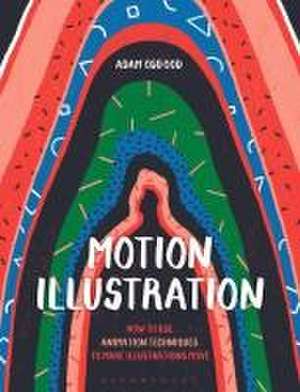
Motion Illustration: How to Use Animation Techniques to Make Illustrations Move
Autor Adam Osgooden Limba Engleză Paperback – 8 aug 2024
Bridging together illustration and animation disciplines in a new way, Adam Osgood shows that producing motion illustrations is achievable for anyone. Whether you're generating content for social media, designing GIFs, or creating fully animated videos, this book contains the tools and information you need to take your illustrated work to the next level and reach your audience in a new way.
With tons of contemporary examples, sample exercises, and supporting online resources, this is perfect for illustrators wanting to make the jump to moving image.
- How motion illustration fits in the context of animation and motion graphics, and how movement can help bring your images to life
- Which tools and software are best to use depending on your desired outcomes
- How illustrators animate with color, texture, composition, and effects to support narratives and ideas
- Conversations with international professionals working across all media forms and with a wide variety of clients and subjects
Preț: 202.00 lei
Preț vechi: 230.91 lei
-13%
Puncte Express: 303
Preț estimativ în valută:
35.76€ • 41.64$ • 31.07£
35.76€ • 41.64$ • 31.07£
Carte disponibilă
Livrare economică 02-16 februarie
Livrare express 16-22 ianuarie pentru 68.36 lei
Preluare comenzi: 021 569.72.76
Specificații
ISBN-13: 9781350323148
ISBN-10: 1350323144
Pagini: 216
Ilustrații: 247 colour illus
Dimensiuni: 188 x 246 x 10 mm
Greutate: 0.62 kg
Editura: Bloomsbury Publishing
Colecția Bloomsbury Visual Arts
Locul publicării:London, United Kingdom
ISBN-10: 1350323144
Pagini: 216
Ilustrații: 247 colour illus
Dimensiuni: 188 x 246 x 10 mm
Greutate: 0.62 kg
Editura: Bloomsbury Publishing
Colecția Bloomsbury Visual Arts
Locul publicării:London, United Kingdom
Cuprins
List of Figures
Acknowledgments
Introduction
1: Heritage of Motion Illustration
2: What makes an engaging Motion Illustration?
3: Common Themes and Motifs
4: Contemporary Practice
5: Technical Considerations
6: Exercises & Projects
Appendix
Glossary
Resources
Bibliography
Index
Acknowledgments
Introduction
1: Heritage of Motion Illustration
2: What makes an engaging Motion Illustration?
3: Common Themes and Motifs
4: Contemporary Practice
5: Technical Considerations
6: Exercises & Projects
Appendix
Glossary
Resources
Bibliography
Index
Recenzii
This singular text looks at motion illustration as a one-stop shop covering a diversity of aspects on this subject for anyone interested in and wanting to get into illustration and motion design. The more you look at the text, the more engaging and fascinating it becomes.
This book presents a comprehensive celebration of the contemporary, motion-illustrator, drawing from an eclectic field, with a wealth of animated examples and useful insights from creators around the world.
Motion Illustration is a great source of inspiration for anyone who works or has an interest in the field of illustration and animation. Adam Osgood reflects on the fact that for more than a decade creatives have tested and applied moving image techniques to blur and merge boundaries of visual actualities in their own illustration practice to great effect. Emphasis lies on an overview of contemporary developments referencing individual approaches and processes of practice. This is a highly valuable, engaging and greatly enjoyable source of knowledge, a vibrant pool of information. Osgood explores rich areas of original innovative work and invites the reader to expand their own practice through use of simple exercises introducing key principles of two disciplines, still moving.
This book presents a comprehensive celebration of the contemporary, motion-illustrator, drawing from an eclectic field, with a wealth of animated examples and useful insights from creators around the world.
Motion Illustration is a great source of inspiration for anyone who works or has an interest in the field of illustration and animation. Adam Osgood reflects on the fact that for more than a decade creatives have tested and applied moving image techniques to blur and merge boundaries of visual actualities in their own illustration practice to great effect. Emphasis lies on an overview of contemporary developments referencing individual approaches and processes of practice. This is a highly valuable, engaging and greatly enjoyable source of knowledge, a vibrant pool of information. Osgood explores rich areas of original innovative work and invites the reader to expand their own practice through use of simple exercises introducing key principles of two disciplines, still moving.