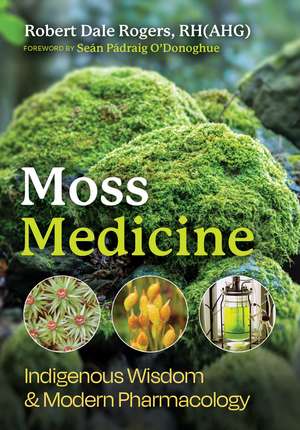
Moss Medicine: Indigenous Wisdom and Modern Pharmacology
Autor Robert Dale Rogers Cuvânt înainte de Seán Pádraig O'Donoghueen Limba Engleză Paperback – 23 apr 2026
• Explores more than 600 species of the bryophyte family of plants—mosses, liverworts, and hornworts—in text and full-color photos
• Shows the ways that indigenous peoples around the world have traditionally used mosses and other bryophytes for food preservation, clothing, and medicine
• Details scientific research on the potency of bryophyte compounds and terpenoids as well as their antiviral, antimicrobial, antifungal, and anti-cancer properties
In this comprehensive book, master herbalist Robert Dale Rogers reveals the unique healing benefits of bryophytes—the family of plants that includes mosses, liverworts, and hornworts. These plants are some of the oldest on our planet, and recently they have been recognized by science for their antiviral, antimicrobial, and anti-cancer properties.
Bryophytes have no vascular tissue and no roots. Found on all continents in a wide range of climates, they survive—and thrive—by extracting moisture and nutrients directly from the air. Using full-color photographic examples, Rogers presents more than 600 species of bryophytes through the lenses of ethnobotany, folklore, chemistry, and pharmacology, and he shares their healing applications in homeopathy and aromatherapy.
Rogers explains how Indigenous people all over the world have used bryophytes for millennia for food preservation, clothing, insulation, and medicine. He then compares the three types of bryophytes with scientific research on the medicinal effects of their chemical compounds, showing that mosses, liverworts, and hornworts can be used in herbal preparations, homeopathic remedies, and essential oils for common ailments.
He also explains that bryophytes have environmental benefits, such as in the sequestration of carbon and the phyto-remediation of our increasingly polluted planet, revealing how these ancient plants have supported humanity for eons—and, fortunately for us, continue to do so.
Preț: 140.22 lei
Nou
Puncte Express: 210
Carte disponibilă
Livrare economică 22 mai-03 iunie
Specificații
ISBN-13: 9798888500996
Pagini: 416
Ilustrații: Full-color throughout
Dimensiuni: 168 x 241 x 20 mm
Greutate: 0.92 kg
Editura: Inner Traditions/Bear & Company
Colecția Healing Arts Press
Pagini: 416
Ilustrații: Full-color throughout
Dimensiuni: 168 x 241 x 20 mm
Greutate: 0.92 kg
Editura: Inner Traditions/Bear & Company
Colecția Healing Arts Press
Notă biografică
Robert Dale Rogers, RH (AHG), an herbalist with more than 50 years of experience, is the author of more than 60 books, a professional member of the American Herbalists Guild, and on the editorial board of the International Journal of Medicinal Mushrooms. A former clinical professor in family medicine, he lives in Camrose, Alberta, Canada.
Extras
INTRODUCTION
Evolving from the Ancients
This is the forest primeval.
The murmuring pines and the hemlocks,
Bearded with moss, and in garments green.
Henry Wadsworth Longfellow
Bryophytes, which include mosses, liverworts, and hornworts, are the second largest group of land plants after angiosperms, and among the oldest. Worldwide, there are some 14,000 species of leaf mosses (Bryophyta), more than 6,000 species of liverworts or liver mosses (Marchantiophyta), and 300 species of hornworts or foliage mosses (Anthocerotophyta) (Chandra et al. 2017). Note that wort is from the Middle English wyrt, for “root,” “herb,” “plant.” A checklist by Soderstrom et al. (2016) suggests the total of both liverworts (Marchantiophyta) and hornworts (Anthocerotophyta) includes 7,486 species in 398 genera and 92 families. This number is decidedly low, as other authors suggest closer to 24,000 species worldwide.
The word bryophyte is derived from the Greek bruon, meaning “tree moss,” and phuton, meaning “plant.” The common name moss can be misleading. Spanish moss (Tillandsia usneoides), for example, belongs to the Bromeliaceae family, while reindeer moss is a lichen, spike moss a Selaginella spp., clubmoss a lycophyte, and Irish moss a seaweed.
There is controversy on the use of the plural moss versus mosses. The former is widely used by myself and the general population, but the scientific community deems only mosses as acceptable. The use of moss as a mass noun is to indicate a singular instance of its uniform nature (e.g. the moss blankets the rock) whereas mosses as a plural count noun is used to indicate various species/types of mosses. Both usages are grammatically correct, but it would make sense that mosses is used more often by the scientific community because they would be more inclined to identify and classify the little beings. Consider moose, which is used in both singular and plural senses. But the plural of mouse is mice. Oh well, such is the English language.
Bryophytes are distinguished by having no vascular tissue and no roots. They derive moisture from the air like a paper towel, absorbed from a leaf surface the thickness of which is only one cell, and they also extract nutrients from the air.
Hornwort is derived from the hornlike shape of the hornwort sporophyte, which is the multicellular diploid phase (Frangedakis et al. 2022). They are found on all continents in a wide range of climates, ranging from deserts to polar regions. Access to moisture is a limiting factor to growth.
Most bryophytes remain hidden from humans simply because of their less noticeable domains. That may be a good thing, as where they grow does influence their flavonoid content. In one 2017 study (Wang, Cao et al.), it was shown that the flavonoid concentration in ninety samples of bryophytes varied from 1.8 mg/g to 22.3 mg/g. The study also showed that the flavonoid content in liverworts was generally higher than in mosses, with acrocarpous mosses (mosses with an upright growth pattern) higher in flavonoids than pleurocarpous species (mosses with a prostrate growth pattern). Bryophytes growing at low light levels exhibit the highest levels of flavonoids, and those of aquatic species the lowest. Also, the flavonoid content of low-latitude species was higher than those growing at higher latitudes.
The term ethnobryology was first coined by botanist Seville Flowers (1957) in a paper on their use by the Gosiute of Utah. Bryophytes, which have strong antimicrobial activity, have been widely used in traditional medicine for thousands of years for a variety of health conditions, including treatment of the liver, skin, and cardiovascular system. A study by Harris (2008) suggests the medicinal use of bryophytes has been explored mostly by Indigenous peoples of North America (28% of all species) as well as by Traditional Chinese Medicine (27% of all species). In China, for example, 40 species of bryophytes are used for medicine, while in India 22 species (but only those growing in Himalayan regions) are used. Oddly, there is no record of bryophyte use in Ayurvedic medicine.
Celtic traditional medicine, as recorded in the antique 1861 Welsh (Cymry) book The Physicians of Myddfai: Meddygon Myddfai, mentions using the river startip liverwort, Scapania undulata (Wagner et al. 2020). In a promising study by the National Cancer Institute, the antitumor properties of 123 mosses, 13 liverworts, and 1 hornwort was assessed (Spjut 1986). The research continues.
And yet, by and large, byrophytes are largely ignored by the medical community despite growing evidence of their ability to alleviate a number of chronic conditions. Perhaps this is partly because bryophytes do not produce flowers or seeds, drawing little attention from most botanists.
As a retired clinical herbalist, my interests lie in their medicinal potential for restoring human and animal health, as well as their potential to assist in the survival and well-being of our planet. The study of bryophytes is over a century old, but it’s only been in the last 40 years that we have seen a tremendous accumulation of information on their chemistry and potential medicinal uses.
As with lichens, there has been a decline in bryophyte cover and richness, which is an indicator of our changing environment, in particular the heavy metal content in air pollution. Many people have heard of Oetzi, the Neolithic Tyrolean Iceman. His frozen body was uncovered in 1991 when retreating glaciers exposed him to hikers in the Austrian-Italian Alps. Along with his body was the discovery of 75 or more subfrozen bryophyte fossil species, including ten liverworts. Today, only 21 of these bryophytes grow in the same area (Dickson et al. 2019). At present, bryophytes are mainly used more prosaically as material for seed beds, fuel, food, pesticides, nitrogen fixation, gardening, construction, clothing, furnishing, packing, and soil conditioning.
THE PEATLAND PURIFIER
Mosses sequester carbon, one of their many gifts. Sphagnum spp. mosses, for example, soak up massive amounts of carbon dioxide, far exceeding the rate of sequestration by all the rainforests in the world combined according to bryophyte expert Annie Martin (2015). Peatlands contain as much carbon as is present in Earth’s entire atmosphere, sequestering between 198 and 502 billion tons of carbon. Peat moss, especially sphagnum mosses, covers 85% of the province of Quebec, some 11.6 million hectares. One half square meter of moss sequesters one kilogram of carbon dioxide. Put another way: mosses sequester 6.43 billion tons of carbon annually from the atmosphere, or six times the carbon from altered lands (cultivated, agricultural lands) (Eldridge et al. 2023). And consider that mosses cover 9.4 million square kilometers of Earth’s surface!
As one example of the great potential of bryophytes, Green City Solutions, a German company, utilizes the dust-cleansing properties of mosses to purify urban air. They have developed several products, including something called City Tree, which cleanses air for 100,000 people every hour, removing 82% of fine dust and cooling the returned air by up to 4.5° F / 2.5° C. Their larger units, City Breeze and Wall Breeze, are currently in development.
Sphagnum moss communities host numerous microorganisms, including microbial polyesterases. Work by Muller et al. (2017) identified six novel esterases, which were isolated, cloned, and heterologously expressed in Escherichia coli. The enzymes hydrolyzed not only common esterase substrates, but also polybutylene adipate terephthalate, or PBAT, a common material used in biodegradable plastics. The widespread use of synthetic polyesters requires the development of new sustainable technology solutions to enable recycling.
There is currently a fear that peat bogs are contributing to the rise in methane, but this has been debunked by recent findings (Wilson et al. 2016). Peat moss regenerates quickly, is easily harvested, has a low sulphur content, and its heating value is superior to wood. Moreover, peatlands, when drained and neutralized of acidity, are prolific producers of leaf and root vegetables. Over 100,000 acres throughout Canada are currently under agricultural use, supplying a large amount of produce for Toronto and Montreal. In Germany, sphagnum farming is replacing drainage-based peatland agriculture to help tackle downstream pollution and climate change (Vroom et al. 2020).
On the other hand, the destruction of peatlands, bogs, and fens by the petroleum industry has created a unique ecological and environmental challenge. The re-creation of wetlands after their destruction by Athabasca oil sands companies in northeastern Alberta, Canada, will require the rapid cultivation of mosses, including fast-growing Sphagnum species. Fortunately, clonal in vitro cultivation of various species, including blunt-leaved bogmoss, Sphagnum palustre, is greatly increased some ten- to thirtyfold with the additions of sucrose and ammonium nitrate (Beike et al. 2015). These kinds of advances in biotechnology can help prevent the exploitation of wilderness mosses while also advancing the production of unique compounds for natural health and pharmaceutical benefit.
Evolving from the Ancients
This is the forest primeval.
The murmuring pines and the hemlocks,
Bearded with moss, and in garments green.
Henry Wadsworth Longfellow
Bryophytes, which include mosses, liverworts, and hornworts, are the second largest group of land plants after angiosperms, and among the oldest. Worldwide, there are some 14,000 species of leaf mosses (Bryophyta), more than 6,000 species of liverworts or liver mosses (Marchantiophyta), and 300 species of hornworts or foliage mosses (Anthocerotophyta) (Chandra et al. 2017). Note that wort is from the Middle English wyrt, for “root,” “herb,” “plant.” A checklist by Soderstrom et al. (2016) suggests the total of both liverworts (Marchantiophyta) and hornworts (Anthocerotophyta) includes 7,486 species in 398 genera and 92 families. This number is decidedly low, as other authors suggest closer to 24,000 species worldwide.
The word bryophyte is derived from the Greek bruon, meaning “tree moss,” and phuton, meaning “plant.” The common name moss can be misleading. Spanish moss (Tillandsia usneoides), for example, belongs to the Bromeliaceae family, while reindeer moss is a lichen, spike moss a Selaginella spp., clubmoss a lycophyte, and Irish moss a seaweed.
There is controversy on the use of the plural moss versus mosses. The former is widely used by myself and the general population, but the scientific community deems only mosses as acceptable. The use of moss as a mass noun is to indicate a singular instance of its uniform nature (e.g. the moss blankets the rock) whereas mosses as a plural count noun is used to indicate various species/types of mosses. Both usages are grammatically correct, but it would make sense that mosses is used more often by the scientific community because they would be more inclined to identify and classify the little beings. Consider moose, which is used in both singular and plural senses. But the plural of mouse is mice. Oh well, such is the English language.
Bryophytes are distinguished by having no vascular tissue and no roots. They derive moisture from the air like a paper towel, absorbed from a leaf surface the thickness of which is only one cell, and they also extract nutrients from the air.
Hornwort is derived from the hornlike shape of the hornwort sporophyte, which is the multicellular diploid phase (Frangedakis et al. 2022). They are found on all continents in a wide range of climates, ranging from deserts to polar regions. Access to moisture is a limiting factor to growth.
Most bryophytes remain hidden from humans simply because of their less noticeable domains. That may be a good thing, as where they grow does influence their flavonoid content. In one 2017 study (Wang, Cao et al.), it was shown that the flavonoid concentration in ninety samples of bryophytes varied from 1.8 mg/g to 22.3 mg/g. The study also showed that the flavonoid content in liverworts was generally higher than in mosses, with acrocarpous mosses (mosses with an upright growth pattern) higher in flavonoids than pleurocarpous species (mosses with a prostrate growth pattern). Bryophytes growing at low light levels exhibit the highest levels of flavonoids, and those of aquatic species the lowest. Also, the flavonoid content of low-latitude species was higher than those growing at higher latitudes.
The term ethnobryology was first coined by botanist Seville Flowers (1957) in a paper on their use by the Gosiute of Utah. Bryophytes, which have strong antimicrobial activity, have been widely used in traditional medicine for thousands of years for a variety of health conditions, including treatment of the liver, skin, and cardiovascular system. A study by Harris (2008) suggests the medicinal use of bryophytes has been explored mostly by Indigenous peoples of North America (28% of all species) as well as by Traditional Chinese Medicine (27% of all species). In China, for example, 40 species of bryophytes are used for medicine, while in India 22 species (but only those growing in Himalayan regions) are used. Oddly, there is no record of bryophyte use in Ayurvedic medicine.
Celtic traditional medicine, as recorded in the antique 1861 Welsh (Cymry) book The Physicians of Myddfai: Meddygon Myddfai, mentions using the river startip liverwort, Scapania undulata (Wagner et al. 2020). In a promising study by the National Cancer Institute, the antitumor properties of 123 mosses, 13 liverworts, and 1 hornwort was assessed (Spjut 1986). The research continues.
And yet, by and large, byrophytes are largely ignored by the medical community despite growing evidence of their ability to alleviate a number of chronic conditions. Perhaps this is partly because bryophytes do not produce flowers or seeds, drawing little attention from most botanists.
As a retired clinical herbalist, my interests lie in their medicinal potential for restoring human and animal health, as well as their potential to assist in the survival and well-being of our planet. The study of bryophytes is over a century old, but it’s only been in the last 40 years that we have seen a tremendous accumulation of information on their chemistry and potential medicinal uses.
As with lichens, there has been a decline in bryophyte cover and richness, which is an indicator of our changing environment, in particular the heavy metal content in air pollution. Many people have heard of Oetzi, the Neolithic Tyrolean Iceman. His frozen body was uncovered in 1991 when retreating glaciers exposed him to hikers in the Austrian-Italian Alps. Along with his body was the discovery of 75 or more subfrozen bryophyte fossil species, including ten liverworts. Today, only 21 of these bryophytes grow in the same area (Dickson et al. 2019). At present, bryophytes are mainly used more prosaically as material for seed beds, fuel, food, pesticides, nitrogen fixation, gardening, construction, clothing, furnishing, packing, and soil conditioning.
THE PEATLAND PURIFIER
Mosses sequester carbon, one of their many gifts. Sphagnum spp. mosses, for example, soak up massive amounts of carbon dioxide, far exceeding the rate of sequestration by all the rainforests in the world combined according to bryophyte expert Annie Martin (2015). Peatlands contain as much carbon as is present in Earth’s entire atmosphere, sequestering between 198 and 502 billion tons of carbon. Peat moss, especially sphagnum mosses, covers 85% of the province of Quebec, some 11.6 million hectares. One half square meter of moss sequesters one kilogram of carbon dioxide. Put another way: mosses sequester 6.43 billion tons of carbon annually from the atmosphere, or six times the carbon from altered lands (cultivated, agricultural lands) (Eldridge et al. 2023). And consider that mosses cover 9.4 million square kilometers of Earth’s surface!
As one example of the great potential of bryophytes, Green City Solutions, a German company, utilizes the dust-cleansing properties of mosses to purify urban air. They have developed several products, including something called City Tree, which cleanses air for 100,000 people every hour, removing 82% of fine dust and cooling the returned air by up to 4.5° F / 2.5° C. Their larger units, City Breeze and Wall Breeze, are currently in development.
Sphagnum moss communities host numerous microorganisms, including microbial polyesterases. Work by Muller et al. (2017) identified six novel esterases, which were isolated, cloned, and heterologously expressed in Escherichia coli. The enzymes hydrolyzed not only common esterase substrates, but also polybutylene adipate terephthalate, or PBAT, a common material used in biodegradable plastics. The widespread use of synthetic polyesters requires the development of new sustainable technology solutions to enable recycling.
There is currently a fear that peat bogs are contributing to the rise in methane, but this has been debunked by recent findings (Wilson et al. 2016). Peat moss regenerates quickly, is easily harvested, has a low sulphur content, and its heating value is superior to wood. Moreover, peatlands, when drained and neutralized of acidity, are prolific producers of leaf and root vegetables. Over 100,000 acres throughout Canada are currently under agricultural use, supplying a large amount of produce for Toronto and Montreal. In Germany, sphagnum farming is replacing drainage-based peatland agriculture to help tackle downstream pollution and climate change (Vroom et al. 2020).
On the other hand, the destruction of peatlands, bogs, and fens by the petroleum industry has created a unique ecological and environmental challenge. The re-creation of wetlands after their destruction by Athabasca oil sands companies in northeastern Alberta, Canada, will require the rapid cultivation of mosses, including fast-growing Sphagnum species. Fortunately, clonal in vitro cultivation of various species, including blunt-leaved bogmoss, Sphagnum palustre, is greatly increased some ten- to thirtyfold with the additions of sucrose and ammonium nitrate (Beike et al. 2015). These kinds of advances in biotechnology can help prevent the exploitation of wilderness mosses while also advancing the production of unique compounds for natural health and pharmaceutical benefit.
Cuprins
Foreword by Seán Pádraig O’Donoghue
Acknowledgments
Introduction
Evolving from the Ancients
The Bryophytes
Mosses, Liverworts, and Hornworts
1. Mosses
Bryophyta
2. Liverworts
Marchantiophyta
3. Hornworts
Anthocerotophyta
Bryophytes by Common Name
Resources
References
Index of Bryophytes and
Medicinal Applications
Acknowledgments
Introduction
Evolving from the Ancients
The Bryophytes
Mosses, Liverworts, and Hornworts
1. Mosses
Bryophyta
2. Liverworts
Marchantiophyta
3. Hornworts
Anthocerotophyta
Bryophytes by Common Name
Resources
References
Index of Bryophytes and
Medicinal Applications
Recenzii
“I have known Robert Rogers for more than 30 years. During the early years, he took on the project of researching the medicinal properties of the plants of the boreal forest. The books that have come from this project have included trees, herbaceous plants, fungi, and now bryophytes. In this book, you will find information on practical uses and contraindications, along with scientific and medically useful information. The genetic pathways involved may hold the key to survival in the fields of medicine, agriculture, biodiversity, and space exploration.”
“This richly informed and deeply researched book opened my eyes to clinical possibilities from a source I wasn’t previously aware of. Reading it inspired recognition of the huge number of moss species, which offer hope for novel medical treatments. This book discusses the research supporting new solutions for medical conditions, with particularly strong support for potential in dealing with both cancer and infectious diseases. I really enjoyed the fascinating chemical, medical, historical, and cultural insights that underlie the different uses of moss. I cannot recommend this book highly enough for those interested in nature-based therapeutics or traditional medicines and looking for inspiration.”
“I am both inspired by and grateful for Robert’s focus on medicinal mosses. As a practicing herbalist, I am deeply intrigued by their history, medicinal potential, and the immense role they play in the sacred web of life on our planet.”
“As a medical doctor and ecology enthusiast, I loved this book, especially the wonderful introductory chapter that offers a wise perspective. I appreciate a book written by a holistic systems thinker that compiles an exhaustive reference that appeals to those concerned with a planetary, or one-health, approach to living.”
“This richly informed and deeply researched book opened my eyes to clinical possibilities from a source I wasn’t previously aware of. Reading it inspired recognition of the huge number of moss species, which offer hope for novel medical treatments. This book discusses the research supporting new solutions for medical conditions, with particularly strong support for potential in dealing with both cancer and infectious diseases. I really enjoyed the fascinating chemical, medical, historical, and cultural insights that underlie the different uses of moss. I cannot recommend this book highly enough for those interested in nature-based therapeutics or traditional medicines and looking for inspiration.”
“I am both inspired by and grateful for Robert’s focus on medicinal mosses. As a practicing herbalist, I am deeply intrigued by their history, medicinal potential, and the immense role they play in the sacred web of life on our planet.”
“As a medical doctor and ecology enthusiast, I loved this book, especially the wonderful introductory chapter that offers a wise perspective. I appreciate a book written by a holistic systems thinker that compiles an exhaustive reference that appeals to those concerned with a planetary, or one-health, approach to living.”