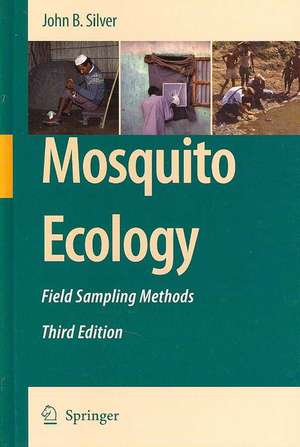
Mosquito Ecology
Autor John B Silveren Limba Engleză Hardback – 27 aug 2008
În cadrul programelor avansate de cercetare în entomologie medicală și ecologie vectorială, Mosquito Ecology reprezintă standardul de referință pentru metodologiile de teren. Această a treia ediție, revizuită de John B Silver și publicată de Springer, extinde cadrul metodologic propus în lucrări precum The Ecology of Malaria Vectors de Jacques Derek Charlwood, oferind o acoperire mult mai vastă a tuturor stadiilor de dezvoltare ale insectei, nu doar a vectorilor malariei. Observăm o tranziție necesară de la simpla colectare la o abordare sistemică a ecologiei populațiilor de țânțari. Structura volumului urmărește o progresie logică, debutând cu fundamentele proiectării unui program de eșantionare și continuând cu secțiuni tehnice riguroase dedicate fiecărui stadiu biologic: ouă, larve și adulți. Suntem de părere că relevanța acestei ediții rezidă în detalierea tehnologiilor moderne de captare — de la capcanele cu dioxid de carbon și cele cu atracție vizuală, până la metodele de estimare a mortalității și supraviețuirii. Spre deosebire de Mosquitoes and Their Control, care pune accent pe bionomică și sistematică, volumul de față se concentrează pe rigoarea statistică a colectării datelor și pe analiza ecologică. Textul este unul dens, de peste 1400 de pagini, fiind conceput ca un manual de teren pentru specialiștii în controlul vectorilor. Deși focalizat pe țânțari, observăm că multe dintre tehnicile de eșantionare și analiză a datelor sunt direct transferabile către studiul altor diptere de importanță medicală, precum Simuliidae sau Phlebotominae, ceea ce îi conferă o valoare adăugată în studiul biodiversității artropodelor.
Preț: 2245.20 lei
Preț vechi: 2738.05 lei
-18%
Carte disponibilă
Livrare economică 18 noiembrie-02 decembrie
Specificații
ISBN-10: 1402066651
Pagini: 1477
Ilustrații: XLII, 1477 p. In 2 volumes, not available separately.
Dimensiuni: 169 x 245 x 66 mm
Greutate: 2.62 kg
Ediția:3rd edition
Editura: Springer
Locul publicării:Dordrecht, Netherlands
V-ar putea interesa
-
 Insect Molecular Biology and BiochemistryLawrence I. Gilbert-22%Preț: 514.35 lei658.53 lei
 -
 -23%Preț: 886.31 lei1151.06 lei
 -
 Honey Bees: Estimating the Environmental Impact of ChemicalsJames Devillers-18%Preț: 1697.94 lei2070.66 lei
 -
 Conservation BiologyAndrew S. Pullin-19%Preț: 506.65 lei625.49 lei
 -
 Principles of Population Dynamics and Their ApplicationAlan A. Berryman-15%Preț: 612.10 lei720.11 lei
 -
 Insects of Hawaii, Volume 1Elwood C ZimmermanPreț: 277.43 lei
 -
 Stink Bugs of Economic Importance in America North of MexicoJ. E. McPherson-18%Preț: 1119.70 lei1365.49 lei
 -
 Heteroptera of Economic ImportanceCarl W. Schaefer-18%Preț: 1730.38 lei2110.22 lei
 -
 Biotic Stress and Yield LossRobert K.D. Peterson-18%Preț: 1596.59 lei1947.06 lei
 -
 SkepsF. AlstonPreț: 120.26 lei
 -
 The Hunting WaspsJean-Henri FabrePreț: 144.98 lei
 -
 Biological and Biotechnological Control of Insect PestsJack E. Rechcigl-18%Preț: 1373.46 lei1674.95 lei
 -
 FliesStephen A. Marshall-15%Preț: 579.53 lei681.80 lei
 -
 Triatominae - The Biology of Chagas Disease VectorsAlessandra Guarneri-18%Preț: 1358.74 lei1657.00 lei
 -
 The Auchenorrhyncha (Homoptera) of Fennoscandia and DenmarkF. Ossiannilsson-23%Preț: 861.26 lei1118.52 lei
 -
 -23%Preț: 869.19 lei1128.81 lei
 -
 A Closer Look at SilkwormsPratheep Thangaraj-25%Preț: 475.90 lei633.95 lei
Public țintă
ResearchDe ce să citești această carte
Recomandăm această ediție cercetătorilor și entomologilor care au nevoie de un protocol riguros pentru studiile de teren. Cititorul câștigă acces la cele mai avansate metode de monitorizare a vectorilor de boli, esențiale pentru sănătatea publică. Este o investiție în precizia datelor colectate, oferind soluții concrete pentru eșantionarea tuturor stadiilor de viață, completate de tehnici moderne de analiză a supraviețuirii și dispersiei populațiilor.
Despre autor
John B Silver este un cercetător consacrat care a preluat sarcina revizuirii și actualizării operei fundamentale a profesorului M W Service. Expertiza sa în entomologie se reflectă în modul în care a integrat noile tehnologii de captare și metodele statistice contemporane în structura clasică a lucrării. Prin această a treia ediție a Mosquito Ecology, Silver asigură continuitatea unei resurse vitale pentru comunitatea științifică, adaptând cunoștințele acumulate în decenii de cercetare la cerințele actuale ale ecologiei vectoriale și controlului bolilor infecțioase transmise prin insecte.
Descriere scurtă
Cuprins
Recenzii
"To have a new, updated edition is more than had been hoped for, and a real credit to John Silver … who took on the necessary revision and produced such an excellent book. … Mosquito Ecology is an essential purchase for any readers of the Annals who have an interest in vector-borne disease, and will be a welcome arrival for those researchers who have tried unsuccessfully to obtain the second edition. Hopefully, this third edition will remain available for a lot longer than the second." (P. J. McCall, Annals of Tropical Medicine and Parasitology, Vol. 102 (7), 2008)
"Mosquito Ecology: Field Sampling Methods … provide a resource for field officers wanting to more effectively sample adult and larval mosquito populations. … the text is well illustrated, providing simple line drawings of many of the traps described … . it is a resource that any mosquito worker, entomologist, wetland scientist or public health officer can use to find effective methods to sample mosquito populations to better understand the role these insects play in disease outbreaks as well as local ecosystems." (Cameron E Webb, Australian Journal of Entomology, Vol. 47, 2008)