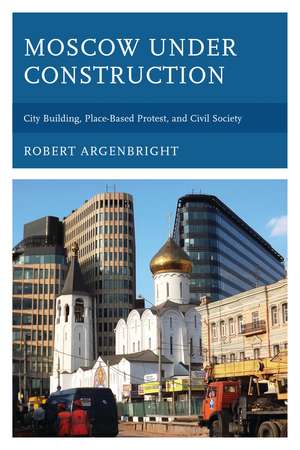
Moscow under Construction: City Building, Place-Based Protest, and Civil Society
Autor Robert Argenbrighten Limba Engleză Hardback – 26 iul 2016
Preț: 545.37 lei
Preț vechi: 816.67 lei
-33%
Puncte Express: 818
Carte tipărită la comandă
Livrare economică 30 noiembrie-14 decembrie
Livrare prin curier în România Termenul estimat este afișat lângă disponibilitate.
Transport gratuit pentru acest produs Plată online sau ramburs, în funcție de opțiunile comenzii.
Retur gratuit în 14 zile Comandă securizată și suport în română.
Specificații
ISBN-13: 9781498522021
ISBN-10: 1498522025
Pagini: 236
Ilustrații: 13 b/w photos; 2 maps
Dimensiuni: 160 x 230 x 20 mm
Greutate: 0.52 kg
Editura: Bloomsbury Publishing
Colecția Lexington Books
Locul publicării:New York, United States
ISBN-10: 1498522025
Pagini: 236
Ilustrații: 13 b/w photos; 2 maps
Dimensiuni: 160 x 230 x 20 mm
Greutate: 0.52 kg
Editura: Bloomsbury Publishing
Colecția Lexington Books
Locul publicării:New York, United States
Cuprins
Chapter 1: City-Making
Chapter 2: Two Transitions
Chapter 3: Malyi Kozikhinskii Case Study
Chapter 4: City Defenders vs. Luzhkov's Machine
Chapter 5: City-Builders vs. City-Defenders in the First Decade of the New Century
Chapter 6: Accommodation of Purposes
Chapter 7: "Leave Us in Peace!"
Conclusion: Moscow Citizens in a Changing Context
Chapter 2: Two Transitions
Chapter 3: Malyi Kozikhinskii Case Study
Chapter 4: City Defenders vs. Luzhkov's Machine
Chapter 5: City-Builders vs. City-Defenders in the First Decade of the New Century
Chapter 6: Accommodation of Purposes
Chapter 7: "Leave Us in Peace!"
Conclusion: Moscow Citizens in a Changing Context
Recenzii
There are some books that one knows, almost from the very first page, one will enjoy. For the present writer this is such a book. Its value is in the refreshing light it throws on the Russia that has emerged since 1991. In contrast to the picture which is painted by so many journalists, politicians, and Cold War publicists of Russia as a dreary, monolithic and authoritarian land verging on totalitarianism, a perspective based essentially on Kremlinology, this book looks at Russia from "below," from the perspective of ordinary people (or at least ordinary Muscovites). What emerges is a picture which is much more interesting, colorful and, in a way, more optimistic than the mass media and its informants will commonly allow.... There is much to ponder in this excellent book.
By integrating battles over home, neighborhood, and monuments in Moscow into the broader theoretical literature on place, Argenbright redefines how we need to think about Russian politics. Despite Russia's indisputable authoritarian turn under Putin, urbanites continue to struggle with authorities and developers over their immediate environment-often winning a battle here and there and, as this book brilliantly reveals, forcing officials to behave differently. The result, he concludes, is that post-Soviet Moscow 'has been a big mess in transition toward an unknown future.' By looking at what was happening on city streets, Argenbright provides a lively and important look at how Russia has been transformed beneath the cover of its own national politics.
The great merit of Robert Argenbright's book is its willingness to challenge prevailing opinions about the strongly autocratic governance regime in Moscow and its impotent civil society in order to better understand the complexities of city life. Moscow under Construction is an excellent book which provides detailed, pragmatic, well-balanced, and unprejudiced analysis that enables the reader (even Russian ones) to attain a deeper understanding of social transformations in Moscow.
The book carefully scrutinizes the recent and deep transformation of Moscow into a 'new world city.' Argenbright analyzes how widespread redevelopment practices in the interests of political and business elites has resulted in cardinal changes in the city's urban landscape, particularly in its historic center. He describes the actions of 'city-defenders' to protect their homes, neighborhoods, heritage buildings, and historic districts, and emphasizes the role of such protests in the productive growth and development of civil society, resulting in both conflict and cooperation between grassroots social movements and local authorities. The book is based on the Argenbright's more than twenty years of annual field research and numerous interviews and sociological and statistical data, and is a valuable resource for both researchers and students of social and urban geography.
This engaging book investigates the largest post-socialist metropolis as a stage for the emergence of civil society. Dr. Argenbright examines two decades of struggles by urban residents to protect their neighborhoods from aggressive infill development and the 'creative destruction' of historic downtown areas by the city administration, well-connected private real estate developers, new transportation infrastructure projects, and even the Russian Orthodox Church. In the process, Muscovites formed place-based coalitions that included people of all ages, classes, and occupations-from grandmothers to young activists and celebrities. Urban residents fought-often successfully-for their 'right to the city' in the face of the authoritarian post-Soviet regimes. Dr. Argenbright convincingly shows that Russian civil society has grown from, among other things, activism around place-making.
By integrating battles over home, neighborhood, and monuments in Moscow into the broader theoretical literature on place, Argenbright redefines how we need to think about Russian politics. Despite Russia's indisputable authoritarian turn under Putin, urbanites continue to struggle with authorities and developers over their immediate environment-often winning a battle here and there and, as this book brilliantly reveals, forcing officials to behave differently. The result, he concludes, is that post-Soviet Moscow 'has been a big mess in transition toward an unknown future.' By looking at what was happening on city streets, Argenbright provides a lively and important look at how Russia has been transformed beneath the cover of its own national politics.
The great merit of Robert Argenbright's book is its willingness to challenge prevailing opinions about the strongly autocratic governance regime in Moscow and its impotent civil society in order to better understand the complexities of city life. Moscow under Construction is an excellent book which provides detailed, pragmatic, well-balanced, and unprejudiced analysis that enables the reader (even Russian ones) to attain a deeper understanding of social transformations in Moscow.
The book carefully scrutinizes the recent and deep transformation of Moscow into a 'new world city.' Argenbright analyzes how widespread redevelopment practices in the interests of political and business elites has resulted in cardinal changes in the city's urban landscape, particularly in its historic center. He describes the actions of 'city-defenders' to protect their homes, neighborhoods, heritage buildings, and historic districts, and emphasizes the role of such protests in the productive growth and development of civil society, resulting in both conflict and cooperation between grassroots social movements and local authorities. The book is based on the Argenbright's more than twenty years of annual field research and numerous interviews and sociological and statistical data, and is a valuable resource for both researchers and students of social and urban geography.
This engaging book investigates the largest post-socialist metropolis as a stage for the emergence of civil society. Dr. Argenbright examines two decades of struggles by urban residents to protect their neighborhoods from aggressive infill development and the 'creative destruction' of historic downtown areas by the city administration, well-connected private real estate developers, new transportation infrastructure projects, and even the Russian Orthodox Church. In the process, Muscovites formed place-based coalitions that included people of all ages, classes, and occupations-from grandmothers to young activists and celebrities. Urban residents fought-often successfully-for their 'right to the city' in the face of the authoritarian post-Soviet regimes. Dr. Argenbright convincingly shows that Russian civil society has grown from, among other things, activism around place-making.