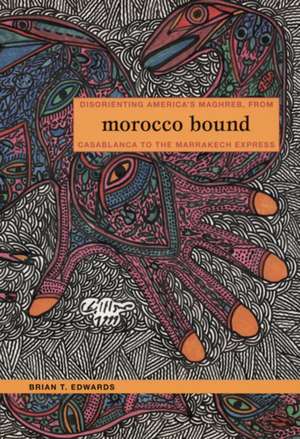
Morocco Bound
Autor Brian T. Edwardsen Limba Engleză Paperback – 28 oct 2005
Diferența majoră pe care o aduce această lucrare în peisajul studiilor culturale este refuzul de a privi Magrebul doar ca pe un decor pasiv pentru fanteziile occidentale. Considerăm că Morocco Bound – Disorienting America′s Maghreb, from Casablanca to the Marrakech Express reușește o performanță rară: deconstruiește mitul „orientalismului” american prin punerea în dialog direct a producțiilor culturale din SUA cu răspunsurile locale din Maroc, Algeria și Tunisia. Abordarea amintește de Writing Tangier in the Postcolonial Transition prin concentrarea asupra comunităților de expați și a figurilor literare iconice precum William Burroughs sau Paul Bowles, dar adaugă o dimensiune politică și istorică mult mai vastă, extinzând analiza de la campaniile militare din al Doilea Război Mondial până la mișcările hippie din anii '70. Subliniem rigoarea cu care Brian Edwards analizează modul în care Statele Unite au utilizat Nordul Africii pentru a-și defini propria identitate imperială într-o perioadă de ascensiune globală. De la marketingul filmului „Casablanca” în 1942, până la scrierile antropologice ale lui Clifford Geertz, autorul demonstrează cum tensiunile rasiale din America au fost adesea proiectate asupra acestui spațiu geografic. Această lucrare se distinge în cadrul operei sale prin profunzimea analizei postcoloniale, spre deosebire de alte scrieri precum Edinburgh - The Making of a Capital City care se concentrează pe evoluția urbană, sau Rough Guide to Sustainability, axată pe aspecte tehnice de sustenabilitate. Tonul este unul academic, dar extrem de viu, fiind susținut de cele 27 de ilustrații care punctează momentele cheie ale acestei întâlniri culturale complexe.
Preț: 290.94 lei
Carte tipărită la comandă
Livrare economică 27 noiembrie-11 decembrie
Specificații
ISBN-10: 0822336448
Pagini: 384
Ilustrații: 27 illustrations
Dimensiuni: 156 x 235 x 21 mm
Greutate: 0.59 kg
Editura: Duke University Press
V-ar putea interesa
-
 -18%Preț: 719.98 lei878.02 lei
 -
 -18%Preț: 1114.85 lei1359.57 lei
 -
 -18%Preț: 1119.36 lei1365.07 lei
 -
 Preț: 421.49 lei
 -
 Preț: 477.29 lei
 -
 Archaeology in Africa and in MuseumsDavid W. PhillipsonPreț: 159.23 lei
 -
 A New Euro-Mediterranean Cultural IdentityStefania Panebianco-18%Preț: 1253.42 lei1528.56 lei
 -
 -23%Preț: 322.16 lei416.97 lei
 -
 -22%Preț: 327.05 lei419.54 lei
 -
 The American Founding and the Social CompactRonald J. Pestritto-23%Preț: 322.67 lei417.25 lei
 -
 Governance in ChinaJude Howell-23%Preț: 354.68 lei463.21 lei
 -
 Dissolution: Sovereignty and the Breakup of the Soviet UnionEdward W. Walker-23%Preț: 276.66 lei361.13 lei
 -
 -36%Preț: 159.64 lei249.75 lei
 -
 -26%Preț: 542.20 lei732.20 lei
 -
 Colombia: Current Issues & Historical BackgroundNina M Serafino-25%Preț: 493.83 lei657.30 lei
 -
 -31%Preț: 162.48 lei234.17 lei
 -
 Sports and Education: A Reference HandbookAnna Marie Frank-52%Preț: 219.76 lei459.16 lei
De ce să citești această carte
Pentru cititorul pasionat de istorie culturală și geopolitică, această carte oferă o perspectivă fascinantă asupra modului în care cultura pop și literatura modelează viziunea noastră despre lume. Veți câștiga o înțelegere profundă a relației dintre SUA și Magreb, descoperind cum „Marrakech Express” sau filmele lui Hitchcock au fost mai mult decât divertisment, devenind instrumente de definire a puterii americane într-un spațiu aflat la intersecția dintre tradiție și modernitate.
Despre autor
Brian Edwards este un cercetător și autor a cărui operă traversează discipline diverse, de la studii literare și culturale la urbanism și sustenabilitate. Cu o capacitate remarcabilă de a analiza transformările spațiului construit și ale identităților naționale, Edwards a explorat în scrierile sale atât evoluția istorică a unor capitale europene în Edinburgh - The Making of a Capital City, cât și experiențe personale în contexte politice diverse, inclusiv în România comunistă. În Morocco Bound, el își folosește expertiza pentru a investiga intersecția dintre politica externă americană și reprezentările culturale ale lumii arabe, oferind o analiză critică esențială pentru înțelegerea secolului XX.
Descriere scurtă
Recenzii
"As literary studies in the United States founder between America globalizing and the globe Americanizing, Brian T. Edwards's brilliant analysis of how America becomes worldly for others is a model for future work. Here language-based close readings bring literary criticism and the study of cultural politics together as the author guides us with a sure hand from cold war ideology, through 'hippie orientalism,' postcoloniality--onto the threshold of the consequences of globalization seen in a new perspective."--Gayatri Chakravorty Spivak, Columbia University "Morocco Bound announces a radical departure from contemporary debates on orientalism through an interesting deployment of the concept of circulation in its study of the U.S. encounter with North Africa and through an astute consideration of the ways that American texts translate the North African Arab and Berber other. With this book, postcolonialism, cultural studies, African studies, and American studies will be refreshed and can begin some of the most exciting debates anew."--Taieb Belghazi, Mohammed V University, Rabat, Morocco "By his achieved commitment to working across languages, treating several disciplines and diverse cultural levels (official, mass, avant-garde), and by his disruptive practice of reading Arabic voices together with Anglophones, Brian T. Edwards has produced an exemplary performance of what American studies must become in the twenty-first century."--Jonathan Arac, author of The Emergence of American Literary Narrative, 1820-1860 "Morocco Bound is a powerful meditation on the question of why the circulation of cultural representations matters... Given its important critical interventions, Morocco Bound should be a required text for a broad range of readers and scholars in the fields of American studies, postcolonialism, comparative literature, and Middle Eastern Studies."--Ali Behdad, Comparative Literature "Brian T. Edwards has penned a fundamental book, one that takes an in-depth look at how America--via both popular culture and the State Department--"discovered" Morocco, starting with Paul Bowles, moving through Casablanca, and ending with hippies, hashish, and 'happenings.'"--Rebecca Romani, Al Jadid "Brian T. Edwards applies the lesson's of Edward Said's Orientalism...to an arena whose time has come...It is easy to endorse his collaborative spirit and to join in lamenting what he calls the American heritage of indifference toward the political travails of Moroccans." --Diana Wylie , American Historical Review