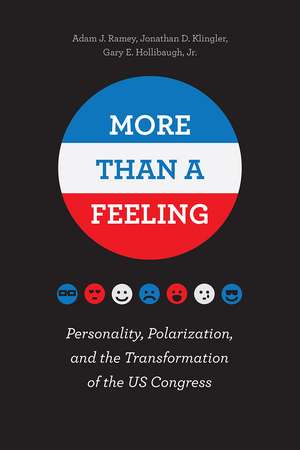
More Than a Feeling: Personality, Polarization, and the Transformation of the US Congress
Autor Adam J. Ramey, Jonathan D. Klingler, Gary E. Hollibaugh Jr.en Limba Engleză Paperback – 27 apr 2017
Whatever you think about the widening divide between Democrats and Republicans, ideological differences do not explain why politicians from the same parties, who share the same goals and policy preferences, often argue fiercely about how best to attain them. This perplexing misalignment suggests that we are missing an important piece of the puzzle. Political scientists have increasingly drawn on the relationship between voters’ personalities and political orientation, but there has been little empirically grounded research looking at how legislators’ personalities influence their performance on Capitol Hill.
With More Than a Feeling, Adam J. Ramey, Jonathan D. Klingler, and Gary E. Hollibaugh, Jr. have developed an innovative framework incorporating what are known as the Big Five dimensions of personality—openness to experience, conscientiousness, extraversion, agreeableness, and neuroticism—to improve our understanding of political behavior among members of Congress. To determine how strongly individuals display these traits, the authors identified correlates across a wealth of data, including speeches, campaign contributions and expenditures, committee involvement, willingness to filibuster, and even Twitter feeds. They then show how we might expect to see the influence of these traits across all aspects of Congress members’ political behavior—from the type and quantity of legislation they sponsor and their style of communication to whether they decide to run again or seek a higher office. They also argue convincingly that the types of personalities that have come to dominate Capitol Hill in recent years may be contributing to a lot of the gridlock and frustration plaguing the American political system.
With More Than a Feeling, Adam J. Ramey, Jonathan D. Klingler, and Gary E. Hollibaugh, Jr. have developed an innovative framework incorporating what are known as the Big Five dimensions of personality—openness to experience, conscientiousness, extraversion, agreeableness, and neuroticism—to improve our understanding of political behavior among members of Congress. To determine how strongly individuals display these traits, the authors identified correlates across a wealth of data, including speeches, campaign contributions and expenditures, committee involvement, willingness to filibuster, and even Twitter feeds. They then show how we might expect to see the influence of these traits across all aspects of Congress members’ political behavior—from the type and quantity of legislation they sponsor and their style of communication to whether they decide to run again or seek a higher office. They also argue convincingly that the types of personalities that have come to dominate Capitol Hill in recent years may be contributing to a lot of the gridlock and frustration plaguing the American political system.
Preț: 156.60 lei
Preț vechi: 200.32 lei
-22%
Puncte Express: 235
Carte indisponibilă temporar
Doresc să fiu notificat când acest titlu va fi disponibil:
Se trimite...
Specificații
ISBN-13: 9780226455983
ISBN-10: 022645598X
Pagini: 256
Ilustrații: 24 halftones, 23 tables
Dimensiuni: 152 x 229 x 23 mm
Greutate: 0.4 kg
Ediția:1
Editura: University of Chicago Press
Colecția University of Chicago Press
ISBN-10: 022645598X
Pagini: 256
Ilustrații: 24 halftones, 23 tables
Dimensiuni: 152 x 229 x 23 mm
Greutate: 0.4 kg
Ediția:1
Editura: University of Chicago Press
Colecția University of Chicago Press
Notă biografică
Adam J. Ramey is assistant professor of political science at New York University Abu Dhabi. Jonathan D. Klingler is an IAST Research Fellow at the Institute for Advanced Study in Toulouse. Gary E. Hollibaugh, Jr., is assistant professor of political science and a faculty affiliate at the Rooney Center for the Study of American Democracy at the University of Notre Dame.
Cuprins
List of Figures
List of Tables
Acknowledgments
PART I. Foundations
Chapter 1. Introduction
1.1 A Tale of Two Senators: Chuck and Roy Disagree on the Shutdown
1.2 Traits and Elite Behavior in Institutions
Chapter 2. Modeling Individual Differences: Translating Personality Traits into Mathematical Parameters
2.1 The Five-Factor Model
2.3 Personality and Political Science
2.4 Modeling Personality
2.7 Considerations for Strategic Interactions
2.8 Modeling Individual Differences: Conclusion
Chapter 3. Read My Lips: Measuring Personality Through Legislative Speech
3.1 Limitations of Existing Approaches for Elected Officials
3.2 Using Text to Measure Personality Traits
3.3 Measuring Personality: From Speeches to Scores
3.4 Validity of the Estimates
3.6 Appendix
PART II. Revisiting the Textbook Congress
Chapter 4. Securing Reelection: Deterrence and Disbursements
4.1 Who Attracts Quality Challengers?
4.2 Who Spends?
4.3 Individual Differences and Seeking Reelection: Conclusion
Chapter 5. Committee Assignments
5.1 Congressional Committees and Core Cognitive Constraints
5.2 Plum Assignments
5.3 Becoming Chair
5.4 Committee Assignments: Conclusion
Chapter 6. Proposing and Passing Legislation
6.1 Personality, Proposals, and Passage
6.2 Putting Bills on the Agenda
6.3 Workhorses and Show Horses
6.4 Predicting Legislative Success
6.5 Proposing and Passing Legislation: Conclusion
Chapter 7. Cooperation, Obstruction, and Party Discipline: Shifting Norms in the US Congress
7.1 Rebellion, Obstruction, and Polarization
7.2 Party Brands, Loyalty, and the Big Five
7.3 Bucking the Party: Working Across Party Lines
7.4 Holding the Floor: Filibustering and Obstruction
7.5 Norms and the Shattering Thereof: Conclusion
Chapter 8. Media Presence and Home Style
8.1 Who Tweets?
8.2 Press Releases
8.3 Media Usage: Conclusion
Chapter 9. Moving On
9.1 Moving On or Moving Out?
9.2 Lame Ducks and the Shadow of Irrelevance
9.3 Moving On: Conclusion
9.4 Appendix: A Model of Legislative Voting
PART III. Bringing It All Together
Chapter 10. More than a Conclusion: Personality, Politics, and Polarization
10.1 Personality and the Congressional Life Cycle
10.2 Personality and Congress as an Institution
10.3 Personality and the Future Study of Elites and Institutions
Bibliography
Author Index
Subject Index
List of Tables
Acknowledgments
PART I. Foundations
Chapter 1. Introduction
1.1 A Tale of Two Senators: Chuck and Roy Disagree on the Shutdown
1.2 Traits and Elite Behavior in Institutions
1.2.1 Translating Individual Differences into the Language of Institutions
1.3 The Elite Behavior in Institutions Agenda and Plan of the BookChapter 2. Modeling Individual Differences: Translating Personality Traits into Mathematical Parameters
2.1 The Five-Factor Model
2.1.1 The Lexical and Questionnaire Schools of Thought
2.1.2 Causal Foundations and Stability in the Big Five
2.2 Challenges to the Five-Factor Model2.1.2 Causal Foundations and Stability in the Big Five
2.3 Personality and Political Science
2.4 Modeling Personality
2.4.1 Defending Models of Personality
2.4.2 Parameterizing Core Cognitive Constraints
2.4.3 Measuring Personality-Based Cognitive Constraints
2.5 The Big Five Traits2.4.2 Parameterizing Core Cognitive Constraints
2.4.3 Measuring Personality-Based Cognitive Constraints
2.5.1 Openness (to Experience)
2.5.2 Conscientiousness
2.5.3 Extraversion
2.5.4 Agreeableness
2.5.5 Neuroticism
2.6 A Framework for Political Choice2.5.2 Conscientiousness
2.5.3 Extraversion
2.5.4 Agreeableness
2.5.5 Neuroticism
2.7 Considerations for Strategic Interactions
2.8 Modeling Individual Differences: Conclusion
Chapter 3. Read My Lips: Measuring Personality Through Legislative Speech
3.1 Limitations of Existing Approaches for Elected Officials
3.2 Using Text to Measure Personality Traits
3.3 Measuring Personality: From Speeches to Scores
3.4 Validity of the Estimates
3.4.1 Strategic Misrepresentation and Authorship Concerns
3.4.2 Face Validity
3.5 Read My Lips: Conclusion3.4.2 Face Validity
3.6 Appendix
PART II. Revisiting the Textbook Congress
Chapter 4. Securing Reelection: Deterrence and Disbursements
4.1 Who Attracts Quality Challengers?
4.2 Who Spends?
4.3 Individual Differences and Seeking Reelection: Conclusion
Chapter 5. Committee Assignments
5.1 Congressional Committees and Core Cognitive Constraints
5.2 Plum Assignments
5.3 Becoming Chair
5.4 Committee Assignments: Conclusion
Chapter 6. Proposing and Passing Legislation
6.1 Personality, Proposals, and Passage
6.2 Putting Bills on the Agenda
6.3 Workhorses and Show Horses
6.4 Predicting Legislative Success
6.5 Proposing and Passing Legislation: Conclusion
Chapter 7. Cooperation, Obstruction, and Party Discipline: Shifting Norms in the US Congress
7.1 Rebellion, Obstruction, and Polarization
7.2 Party Brands, Loyalty, and the Big Five
7.3 Bucking the Party: Working Across Party Lines
7.4 Holding the Floor: Filibustering and Obstruction
7.5 Norms and the Shattering Thereof: Conclusion
Chapter 8. Media Presence and Home Style
8.1 Who Tweets?
8.2 Press Releases
8.3 Media Usage: Conclusion
Chapter 9. Moving On
9.1 Moving On or Moving Out?
9.2 Lame Ducks and the Shadow of Irrelevance
9.3 Moving On: Conclusion
9.4 Appendix: A Model of Legislative Voting
PART III. Bringing It All Together
Chapter 10. More than a Conclusion: Personality, Politics, and Polarization
10.1 Personality and the Congressional Life Cycle
10.2 Personality and Congress as an Institution
10.3 Personality and the Future Study of Elites and Institutions
Bibliography
Author Index
Subject Index
Recenzii
"With More Than a Feeling, Ramey, Klingler, and Hollibaugh make the compelling case that variation in personality matters for many of the behaviors studied by congressional scholars. Creatively researched and thoroughly grounded in the relevant psychological literature, the book makes an enormous contribution to the conversation about individual differences and elite behavior.”
“A fascinating statistical study of Congressional personalities and the way those traits systematically affect the outcomes of our institutions of government. Using cutting edge data science measurement techniques applied to hundreds of thousands of modern legislative speeches, the authors demonstrate that psychological proclivities vary widely across actors, and that these have real effects on behavior. This book will be of interest to anyone who wants to understand how we got to the modern ills of Congressional polarization, deadlock, and dysfunction, why we seem stuck there, and how we might escape.”
“Even in an era of resurgent partisanship in government, recent events make clear that the workings of Congress continue to reflect the particular mix of personalities within its ranks. . . . More Than a Feeling provides an ambitious quantitative examination of the relationship between the personality characteristics of members and various aspects of congressional behavior.”
"In the end, the reader cannot but agree with the authors when they write in the conclusion that 'personality matters both theoretically and empirically' . . . They provide keen insight into what makes the individual members of Congress tick."