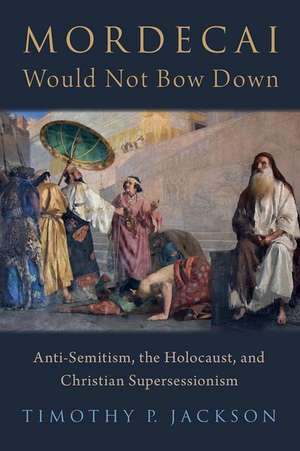
Mordecai Would Not Bow Down: Anti-Semitism, the Holocaust, and Christian Supersessionism
Autor Timothy P. Jacksonen Limba Engleză Hardback – 30 sep 2021
Preț: 529.54 lei
Preț vechi: 752.89 lei
-30%
Puncte Express: 794
Carte disponibilă
Livrare economică 05-11 noiembrie
Livrare prin curier în România Termenul estimat este afișat lângă disponibilitate.
Transport gratuit pentru acest produs Plată online sau ramburs, în funcție de opțiunile comenzii.
Retur gratuit în 14 zile Comandă securizată și suport în română.
Specificații
ISBN-13: 9780197538050
ISBN-10: 0197538053
Pagini: 288
Ilustrații: 25
Dimensiuni: 239 x 152 x 33 mm
Greutate: 0.74 kg
Editura: Oxford University Press
Colecția OUP USA
Locul publicării:New York, United States
ISBN-10: 0197538053
Pagini: 288
Ilustrații: 25
Dimensiuni: 239 x 152 x 33 mm
Greutate: 0.74 kg
Editura: Oxford University Press
Colecția OUP USA
Locul publicării:New York, United States
Recenzii
contributes much to the ongoing discussion of the supersessionist/Holocaust issues
A worthy addition to the growing literature on the Holocaust, anti-Semitism, and Christianity.
As a Gentile Christian, Jackson has taken a certain risk in writing about the Jews, the Shoah, and anti-Semitism. He does so, however, with nuance, sensitivity, courage, and moral clarity.
Among the most thoughtful and committed scholar theologians active today, Jackson knows that Israel, the Jewish people, are the suffering servant, called by God's word and steeled by God's covenant to their role as a blessing to the earth's nations. Jews have immeasurably enriched civilization spiritually, morally, and intellectually. Yet Jews are persecuted. In this unique and important book, Jackson argues that Jews have been persecuted through the ages because Jewish ideals are antithetical to the power-lust that masquerades as worldly wisdom. Jewish loyalty is to a higher standard calling all who listen to seek goodness, truth, and beauty for their intrinsic preciousness and no lesser good.
Although I do not share some of the author's theological premises, I am pleased to recommend this book. Why? Because it is elegantly written, philosophically profound and provocative, and the fruit of reading so wide one can only envy it. I know of nothing quite like it, and any reader of it will profit in countless ways.
Many books have been written about anti-Semitism. This one is different. Without for a moment averting his eyes from the particular horrors of the long history of Christian anti-Semitism, or of its culmination in the Holocaust, Jackson invites us to go deeper. Jackson finds in anti-Semitism fundamentally an effort to escape our humanity before God, a form of idolatry that lashes out in hatred of God and of the frail and vulnerable, whom God loves. He summons each of us recognize our own inner Nazi, intent on denigrating others in order to elevate ourselves, resistant to a moral monotheism that demands universal love and suffering service to the world. A proper engagement with these matters, he insists, must be radically self-involving, not detached or merely analytic. Mordecai Would Not Bow Down is a profound, lyrical, forceful book that will not let you go.
A worthy addition to the growing literature on the Holocaust, anti-Semitism, and Christianity.
As a Gentile Christian, Jackson has taken a certain risk in writing about the Jews, the Shoah, and anti-Semitism. He does so, however, with nuance, sensitivity, courage, and moral clarity.
Among the most thoughtful and committed scholar theologians active today, Jackson knows that Israel, the Jewish people, are the suffering servant, called by God's word and steeled by God's covenant to their role as a blessing to the earth's nations. Jews have immeasurably enriched civilization spiritually, morally, and intellectually. Yet Jews are persecuted. In this unique and important book, Jackson argues that Jews have been persecuted through the ages because Jewish ideals are antithetical to the power-lust that masquerades as worldly wisdom. Jewish loyalty is to a higher standard calling all who listen to seek goodness, truth, and beauty for their intrinsic preciousness and no lesser good.
Although I do not share some of the author's theological premises, I am pleased to recommend this book. Why? Because it is elegantly written, philosophically profound and provocative, and the fruit of reading so wide one can only envy it. I know of nothing quite like it, and any reader of it will profit in countless ways.
Many books have been written about anti-Semitism. This one is different. Without for a moment averting his eyes from the particular horrors of the long history of Christian anti-Semitism, or of its culmination in the Holocaust, Jackson invites us to go deeper. Jackson finds in anti-Semitism fundamentally an effort to escape our humanity before God, a form of idolatry that lashes out in hatred of God and of the frail and vulnerable, whom God loves. He summons each of us recognize our own inner Nazi, intent on denigrating others in order to elevate ourselves, resistant to a moral monotheism that demands universal love and suffering service to the world. A proper engagement with these matters, he insists, must be radically self-involving, not detached or merely analytic. Mordecai Would Not Bow Down is a profound, lyrical, forceful book that will not let you go.
Notă biografică
Timothy P. Jackson is Professor of Christian Ethics at The Candler School of Theology at Emory University. He is the author of Political Agape: Christian Love and Liberal Democracy and The Priority of Love: Christian Charity and Social Justice, among other works.
Cuprins
- Introduction: Judaic Holiness and a Holistic Approach to Anti-Semitism and the Holocaust .
- Chapter 1: Legitimating a Topic as Old as Esther
- Chapter 2: The Perennial Either/Or
- Chapter 3: Nazism and the Western Conscience
- Chapter 4: The Evils of Supersessionism
- Chapter 5: Jesus and the Jews: Two Suffering Servants Incarnate
- Chapter 6: Naming Good and Evil: Hitler's Insidious Genius
- Chapter 7: A Closer Look at Schadenfreude and the Prophetic
- Conclusion: Guilt, Innocence, and Anne Frank
- Bibliography
- Index