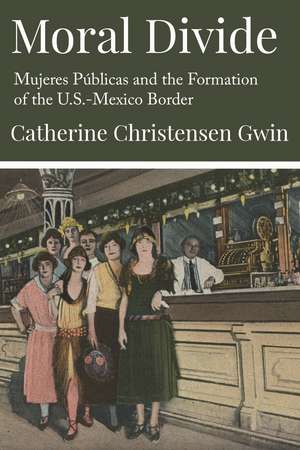
Moral Divide: Mujeres Públicas and the Formation of the U.S.-Mexico Border
Autor Catherine Christensen Gwinen Limba Engleză Hardback – sep 2026
In Moral Divide Catherine Christensen Gwin sheds new light on a largely forgotten chapter in the history of the U.S.-Mexico border, when it was a place of agency among Euro-American clubwomen reformers and sex workers. White women in California’s Progressive movement sowed panic over prostitution, pushing American sex workers into the vice districts of Mexico, where American pleasure seekers followed. In response, clubwomen initiated a crusade to control U.S. citizens and their pursuit of illicit leisure in Mexico. These ideals of morality were used to enforce border restrictions and developed stereotypes of Mexicans as rapists and traffickers. Christensen Gwin brings the Mexican perspective on vice tourism to the fore, showing how Mexican officials responded to the sex trade, while also discussing the invention and juxtaposition of the white human trafficking victim and the criminal drug trafficking woman. The “moral divide” that resulted from these gendered and racialized politics of national purification set the stage for the exclusionary border regime we live with today.
Preț: 427.18 lei
Preț vechi: 527.38 lei
-19% Nou
Puncte Express: 641
Carte disponibilă
Livrare economică 10-24 noiembrie
Livrare express 24-30 octombrie pentru 37.42 lei
Livrare prin curier în România Termenul estimat este afișat lângă disponibilitate.
Transport gratuit pentru acest produs Plată online sau ramburs, în funcție de opțiunile comenzii.
Retur gratuit în 14 zile Comandă securizată și suport în română.
Specificații
ISBN-13: 9781496244826
ISBN-10: 1496244826
Pagini: 296
Ilustrații: 22 photos, index
Dimensiuni: 152 x 229 mm
Greutate: 0.57 kg
Editura: Nebraska
Colecția University of Nebraska Press
Locul publicării:United States
ISBN-10: 1496244826
Pagini: 296
Ilustrații: 22 photos, index
Dimensiuni: 152 x 229 mm
Greutate: 0.57 kg
Editura: Nebraska
Colecția University of Nebraska Press
Locul publicării:United States
Notă biografică
Catherine Christensen Gwin is an associate professor of history at Palomar College.
Cuprins
List of Illustrations
Acknowledgments
Introduction
Chapter 1 Off-scouring Domestic Disorder: Anti-prostitution Activism and the Shuttering of California’s Red-Light Districts
Chapter 2 Regulating Bodies: Las Americanas in Baja California’s Vice Districts
Chapter 3 Trafficking Fictions of Victimhood: Tropes of White Womanhood in the “White Slavery” Panic
Chapter 4 Ordering International Relations: Clubwomen’s Transnational Political Activism and the Crusade for a Curfew
Chapter 5 Controlling the Border: Disgraced Daughters, National Honor, and the Boundaries of Patriarchal Protection
Conclusion
Notes
Bibliography
Index
Acknowledgments
Introduction
Chapter 1 Off-scouring Domestic Disorder: Anti-prostitution Activism and the Shuttering of California’s Red-Light Districts
Chapter 2 Regulating Bodies: Las Americanas in Baja California’s Vice Districts
Chapter 3 Trafficking Fictions of Victimhood: Tropes of White Womanhood in the “White Slavery” Panic
Chapter 4 Ordering International Relations: Clubwomen’s Transnational Political Activism and the Crusade for a Curfew
Chapter 5 Controlling the Border: Disgraced Daughters, National Honor, and the Boundaries of Patriarchal Protection
Conclusion
Notes
Bibliography
Index
Recenzii
“A brilliant new history of the U.S.-Mexico border rooted in the gender politics of the Progressive Era. Catherine Christensen Gwin details how white California clubwomen compelled the U.S. federal government to build border fences at Tijuana and Mexicali in the 1920s to halt the transmigration of white American sex workers and their white American patrons. Yet in their determination to police morality and eradicate urban vice districts, the clubwomen overlooked the agency of ‘public women’ who used Mexico’s proximity to build cross-border, cross-racial leisure cultures that sustained their livelihoods, fueled the Mexican economy, and satisfied male sexual desire. From the establishment of punitive reformatories for ‘wayward girls’ to the federal legislation for border walls, Moral Divide artfully traces both the clubwomen’s efforts and the sex workers’ ingenuity as they negotiated what it meant to be independent, activist women in twentieth-century North America.”—Laura K. Muñoz, author of Desert Dreams: Mexican Arizona and the Politics of Educational Equality
“Moral Divide is a significant study of the sexual politics that surrounded the creation of an enforceable border between the United States and Mexico in the Progressive Era. The triangulation of three sets of archival sources—organizational records of the clubwomen, the U.S. federal government, and fascinating records from Mexico—makes this book exciting. This study will be of interest to women’s historians, borderlands scholars, and historians of California.”—Jessica Pliley, author of Policing Sexuality: The Mann Act and the Making of the FBI
“Tremendously important given the U.S.-Mexico border’s social, political, and cultural significance in American history and our contemporary moment. Moral Divide offers compelling narratives of clubwomen’s persistence around border enforcement and sex workers’ defiance that generate new insights into the gendered and racial dynamics of border-making.”—Natalie Lira, author of Laboratory of Deficiency: Sterilization and Confinement in California, 1900–1950s
“Moral Divide is a significant study of the sexual politics that surrounded the creation of an enforceable border between the United States and Mexico in the Progressive Era. The triangulation of three sets of archival sources—organizational records of the clubwomen, the U.S. federal government, and fascinating records from Mexico—makes this book exciting. This study will be of interest to women’s historians, borderlands scholars, and historians of California.”—Jessica Pliley, author of Policing Sexuality: The Mann Act and the Making of the FBI
“Tremendously important given the U.S.-Mexico border’s social, political, and cultural significance in American history and our contemporary moment. Moral Divide offers compelling narratives of clubwomen’s persistence around border enforcement and sex workers’ defiance that generate new insights into the gendered and racial dynamics of border-making.”—Natalie Lira, author of Laboratory of Deficiency: Sterilization and Confinement in California, 1900–1950s
Descriere
Catherine Christensen Gwin sheds new light on the U.S.-Mexico border as a place of women’s agency amid the “moral divide” that resulted from gendered and racialized politics of national purification.