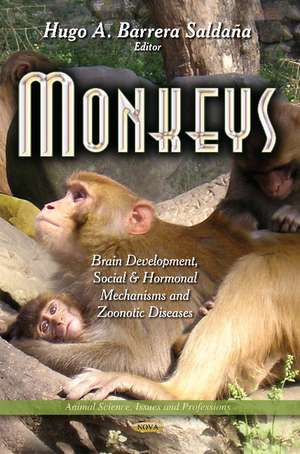
Monkeys: Brain Development, Social & Hormonal Mechanisms & Zoonotic Diseases
Editat de Hugo A Barrera Saldanaen Limba Engleză Hardback – iun 2014
Preț: 1332.71 lei
Preț vechi: 1814.36 lei
-27%
Puncte Express: 1999
Carte disponibilă
Livrare economică 22 octombrie-05 noiembrie
Livrare prin curier în România Termenul estimat este afișat lângă disponibilitate.
Transport gratuit pentru acest produs Plată online sau ramburs, în funcție de opțiunile comenzii.
Retur gratuit în 14 zile Comandă securizată și suport în română.
Specificații
ISBN-13: 9781631178511
ISBN-10: 1631178512
Pagini: 254
Dimensiuni: 180 x 260 x 20 mm
Greutate: 0.68 kg
Editura: Nova Science Publishers Inc
Colecția Nova Science Publishers, Inc (US)
Locul publicării:United States
ISBN-10: 1631178512
Pagini: 254
Dimensiuni: 180 x 260 x 20 mm
Greutate: 0.68 kg
Editura: Nova Science Publishers Inc
Colecția Nova Science Publishers, Inc (US)
Locul publicării:United States
V-ar putea interesa
-
 -32%Preț: 527.32 lei779.35 lei
 -
 -31%Preț: 830.16 lei1198.49 lei
 -
 Marmosets and Tamarins: Systematics, Behaviour, and EcologyAnthony B. Rylands-33%Preț: 998.53 lei1482.52 lei
 -
 -32%Preț: 736.65 lei1084.01 lei
 -
 The Evolution of Primate SocietiesJohn C. Mitani-23%Preț: 463.76 lei602.29 lei
 -
 Preț: 137.45 lei
 -
 Primate CommunicationKatja Liebal-11%Preț: 552.41 lei620.69 lei
 -
 The Cultured ChimpanzeeW C McGrew-9%Preț: 379.28 lei416.33 lei
 -
 Mahale ChimpanzeesMichio Nakamura-32%Preț: 1192.35 lei1744.10 lei
 -
 ChimpanzeeKevin D. HuntPreț: 476.59 lei
 -
 Spatial Analysis in Field PrimatologyFrancine L DolinsPreț: 418.66 lei
 -
 Studying PrimatesJoanna M. Setchell-11%Preț: 590.36 lei663.32 lei
 -
 Killing, Capture, Trade and Ape Conservation: Volume 4Arcus FoundationPreț: 328.37 lei
 -
 Primate Behavior and Human OriginsGlenn KingPreț: 496.80 lei
 -
 No He's Not a Monkey, He's an Ape and He's My SonHester MundisPreț: 95.33 lei
 -
 The Primate Family TreeIan RedmondPreț: 150.99 lei
 -
 Shadows in the WoodsDaniel S. GreenPreț: 246.22 lei
 -
 ORANG PENDEKRichard FreemanPreț: 154.65 lei
 -
 THE YOWIETony HealyPreț: 254.87 lei
Cuprins
Preface; Brainstem's Auditory Evoked Potentials and Intervals Values in Rhesus Monkeys; The Use of Non-Human Primates As Bio-Models for Aging Brain Studies: Interventional Role of Oxidative Stress in Demyelization Processes; Ontogeny of Somatosensory Evoked Potentials of Median and Tibial Nerves in Rhesus Monkeys (Macaca mulatta): Influence of Dissociative Anesthetic Mixtures under Captivity Conditions; How New World Monkeys See the Social World; Monkey Physical Cognition: A Comparative Review; Zoonoses and Anthroponoses in Non-Human Primates of Costa Rica; The Role of Natural Occurring Infections in Experimental Studies in Non-Human Primates; Growth Hormone and Prolactin in New World Monkeys; Revelations of the Primate Genome Projects: The Case of the Growth Hormone Locus; Nonhuman Primates Used for Research of Obesity and Related Metabolic Diseases: The Baboon As a Model; Index.