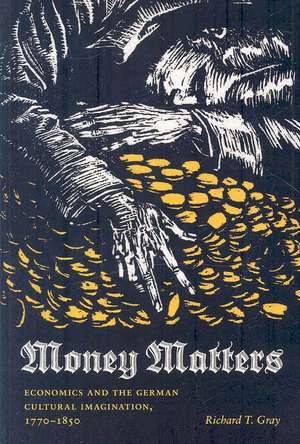
Money Matters
Autor Richard T. Grayen Limba Engleză Paperback – 12 noi 2008
În volumul Money Matters, observăm o analiză riguroasă a modului în care fundamentele economiei moderne nu au fost construite izolat, ci în strânsă legătură cu eferescența literară și filozofică germană dintre 1770 și 1850. Aplicabilitatea practică a acestui studiu rezidă în capacitatea de a descifra mecanismele prin care valorile culturale influențează paradigmele de schimb, oferind instrumente critice esențiale pentru înțelegerea tranziției de la economia de subzistență la capitalismul industrial. Subliniem faptul că autorul Richard T. Gray nu se limitează la o istorie a ideilor, ci investighează un „inconștient economic” prezent în operele unor figuri precum Kant, Goethe sau Marx, demonstrând cum trecerea de la moneda metalică la banii de hârtie a remodelat imaginația culturală. Această lucrare acoperă aceeași arie tematică precum volumul Culture and Money in the Nineteenth Century, însă Richard T. Gray propune o abordare mai specifică și mai profund ancorată în spațiul germanofon, spre deosebire de perspectiva globală, adesea victoriană, a altor cercetări din domeniu. Dacă The New Economic Criticism de Martha Woodmansee stabilește cadrul teoretic general al disciplinei, Money Matters aplică aceste concepte pe texte canonice, oferind o demonstrație aplicată a modului în care literatura participă la crearea modelelor economice. Credem că acest volum reprezintă o evoluție firească în opera autorului; dacă în About Face investiga disciplina empirică a fiziognomiei în iluminismul german, aici extinde analiza asupra structurilor de valoare și schimb, menținând același interes pentru intersecția dintre științele umane și sistemele de cunoaștere formalizate. Este o resursă academică densă, care recontextualizează romantismul și idealismul german prin prisma realităților materiale ale epocii.
Preț: 215.83 lei
Carte disponibilă
Livrare economică 11-25 mai
Livrare express 24-30 aprilie pentru 38.28 lei
Specificații
ISBN-10: 0295988371
Pagini: 464
Ilustrații: 16 illustrations
Dimensiuni: 154 x 228 x 33 mm
Greutate: 0.68 kg
Editura: University of Washington Press
V-ar putea interesa
-
 The Alice Behind WonderlandSimon Winchester-11%Preț: 79.08 lei89.31 lei
 -
 Oxford Student Texts: Songs of Innocence and ExperienceWilliam Blake-31%Preț: 82.03 lei118.03 lei
 -
 -37%Preț: 1162.28 lei1840.65 lei
 -
 Scottish and Irish RomanticismMurray Pittock-23%Preț: 362.10 lei467.32 lei
 -
 -9%Preț: 198.17 lei218.69 lei
 -
 Popular Medievalism in Romantic-Era BritainC. SimmonsPreț: 374.10 lei
 -
 Dante and Italy in British RomanticismF. BurwickPreț: 374.46 lei
 -
 The Masculine Middlebrow, 1880-1950K. MacdonaldPreț: 375.78 lei
 -
 Preț: 378.19 lei
 -
 Preț: 379.30 lei
 -
 Writing Women of the Fin de SiècleAdrienne E GavinPreț: 377.24 lei
 -
 Joseph Conrad's Letters to R. B. Cunninghame GrahamJoseph ConradPreț: 337.31 lei
 -
 The Background of Modern French Poetry: Essays and InterviewsP. Mansell JonesPreț: 269.65 lei
 -
 A. E. Housman: A SketchA. S. F. GowPreț: 285.01 lei
 -
 Slavery, Philosophy, and American Literature, 1830–1860Maurice S. LeePreț: 290.76 lei
 -
 Mark Twain: The Contemporary ReviewsLouis BuddPreț: 507.87 lei
 -
 The Romances of William MorrisAmanda HodgsonPreț: 318.97 lei
 -
 The Edinburgh Companion to Sir Walter ScottFiona Robertson-18%Preț: 164.66 lei201.20 lei
 -
 Chaplin, S: York Notes Companions Gothic LiteratureSusan ChaplinPreț: 89.84 lei
De ce să citești această carte
Recomandăm această carte cercetătorilor și studenților interesați de filozofie politică și istorie culturală. Cititorul câștigă o perspectivă interdisciplinară asupra modului în care literatura germană a prefigurat concepte economice moderne. Este o lectură esențială pentru a înțelege că banii și cultura nu sunt domenii separate, ci forțe care s-au modelat reciproc în perioada formării capitalismului european, oferind o bază teoretică solidă pentru critica economică literară contemporană.
Despre autor
Richard T. Gray este profesor de științe umaniste la University of Washington, deținând catedra Byron W. și Alice L. Lockwood. Expert în cultura și literatura germană, Gray s-a remarcat prin studii care explorează intersecțiile complexe dintre istoria ideilor, filozofie și contextul social. Printre lucrările sale de referință se numără About Face, o analiză a gândirii fiziognomice germane, și contribuțiile în seria Constructive Destruction (Studien zur deutschen Literatur). Abordarea sa metodologică integrează rigurozitatea istorică cu analizele textuale profunde, fiind unul dintre promotorii direcției New Economic Criticism în studiile literare germane.
Descriere scurtă
Recenzii
"Money Matters is both a manifesto for what Gray terms the 'New Economic Criticism' and a model of how it should be done. He argues against the notion that culture and economics have nothing to do with one another, insisting instead that German aesthetic theory and artistic practice are deeply implicated in a parallel discourse about the meaning of money at a time of sweeping political, cultural, and economic change. Money Matters is a landmark study that belongs to the very best work in German studies today." Todd Kontje, author of German Orientalisms "Who would have thought that books devoted to German literature and cultural history of past centuries could be so timely and strike so deep? Dealing with a geographically and historically remote subject matter--the economic imagination in eighteenth- and nineteenth-century German literature--Money Matters hit the market amidst the deep global recession of 2008. Suddenly, everything was a matter of money: we always had known that money mattered, but now we felt it. Yet most people understood little about the elusive, virtual nature that had come to define money in recent decades. With perhaps unintended, but nevertheless anticipatory foresight, Richard Gray's book enlightens us about the origins of money's problematic career and about the ways in which monetary matters have preoccupied fiction, the literary imagination, and--by implication--the narrative and dramatic fables of the modern Self." - Birgit Tautz (Bowdoin College), H-German