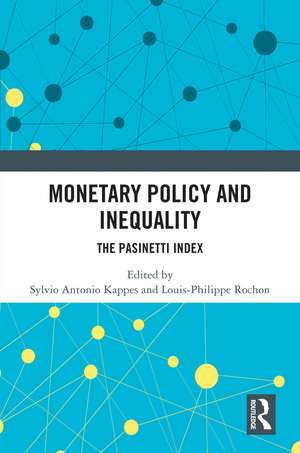
Monetary Policy and Inequality: The Pasinetti Index
Editat de Sylvio Antonio Kappes, Louis-Philippe Rochonen Limba Engleză Hardback – 3 noi 2025
Within contemporary heterodox economics, this topic gained renewed attention in the late 1980s through influential papers by prominent post-Keynesians who highlighted concerns about how interest rate changes affect functional income distribution. This perspective places social class dynamics and class conflict at the center of monetary policy debates, challenging mainstream approaches that often overlook distributional consequences.
This book is an invaluable read for economics researchers, graduate students, and policy analysts of monetary theory, macroeconomics, political economy, income inequality, financial economics, and heterodox economic approaches.
The chapters in this book were originally published in Review of Political Economy.
Preț: 1114.12 lei
Preț vechi: 1358.68 lei
-18%
Puncte Express: 1671
Carte tipărită la comandă
Livrare economică 20 noiembrie-04 decembrie
Livrare express 16-22 octombrie pentru 248.40 lei
Livrare prin curier în România Termenul estimat este afișat lângă disponibilitate.
Transport gratuit pentru acest produs Plată online sau ramburs, în funcție de opțiunile comenzii.
Retur gratuit în 14 zile Comandă securizată și suport în română.
Specificații
ISBN-13: 9781041173625
ISBN-10: 1041173628
Pagini: 184
Dimensiuni: 174 x 246 x 15 mm
Greutate: 0.5 kg
Ediția:1
Editura: Taylor & Francis
Colecția Routledge
Locul publicării:Oxford, United Kingdom
ISBN-10: 1041173628
Pagini: 184
Dimensiuni: 174 x 246 x 15 mm
Greutate: 0.5 kg
Ediția:1
Editura: Taylor & Francis
Colecția Routledge
Locul publicării:Oxford, United Kingdom
Public țintă
Postgraduate, Undergraduate Advanced, and Undergraduate CoreCuprins
Introduction - Monetary Policy and Income Distribution: The Pasinetti Index 1. Where do the Pasinetti Rule and the Pasinetti Index Come from? 2. Distributional Regimes in the US — The Pasinetti Index and the Monetary Policy Effects on Income Distribution 3. Monetary Policy and the Pasinetti Index: A Stock Flow Model for Latin American Economies 4. Revisiting the Pasinetti Index: Understanding Its Cyclical and Long-Term Features and Its Important Implications for Macroeconomic Policy 5. The Distributive Impact of Unconventional Monetary Policies: Old and New 6. The Pasinetti Index and the Rise of Inequality in the Age of Unconventional Monetary Policy in Japan 7. Monetary Policy and Income Distribution: Some Reflections on the Pasinetti Rule
Notă biografică
Sylvio Antonio Kappes is Assistant Professor of Macroeconomics at the Federal University of Alagoas, Brazil. He is the co-editor of the Elgar Series on Central Banking and Monetary Policy, together with Louis-Philippe Rochon and Guillaume Vallet. He is the co-editor of the Review of Political Economy. He also sits on the editorial boards of the Bulletin of Political Economy and Advances in Economics Education. He is the co-director of the Monetary Policy Institute.
Louis-Philippe Rochon is Full Professor of Economics at Laurentian University, Canada. He is the current editor-in-chief of the Review of Political Economy and the founder (now Editor Emeritus) of the Review of Keynesian Economics. He sits on the editorial board of 14 other journals. He has published widely in several journals on monetary policy and post-Keynesian economics. He has been Visiting Professor in over 10 countries. He is the co-director of the Monetary Policy Institute.
Louis-Philippe Rochon is Full Professor of Economics at Laurentian University, Canada. He is the current editor-in-chief of the Review of Political Economy and the founder (now Editor Emeritus) of the Review of Keynesian Economics. He sits on the editorial board of 14 other journals. He has published widely in several journals on monetary policy and post-Keynesian economics. He has been Visiting Professor in over 10 countries. He is the co-director of the Monetary Policy Institute.
Descriere
This book explores the relationship between monetary policy and income (and wealth) distribution, a growing area of research in post-Keynesian and heterodox economics today.