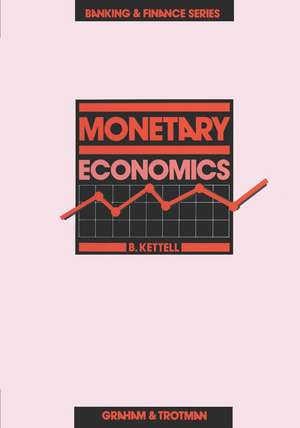
Monetary Economics: Banking and Finance Series, cartea 1
Autor B. Kettellen Limba Engleză Paperback – 31 aug 1985
Preț: 383.96 lei
Puncte Express: 576
Carte tipărită la comandă
Livrare economică 08-22 decembrie
Livrare prin curier în România Termenul estimat este afișat lângă disponibilitate.
Transport gratuit de la 400.00 lei Plată online sau ramburs, în funcție de opțiunile comenzii.
Retur gratuit în 14 zile Comandă securizată și suport în română.
Specificații
ISBN-13: 9780860105626
ISBN-10: 0860105628
Pagini: 372
Ilustrații: 372 p.
Dimensiuni: 178 x 254 x 21 mm
Greutate: 0.68 kg
Ediția:Softcover reprint of the original 1st ed. 1985
Editura: SPRINGER NETHERLANDS
Colecția Springer
Seria Banking and Finance Series
Locul publicării:Dordrecht, Netherlands
ISBN-10: 0860105628
Pagini: 372
Ilustrații: 372 p.
Dimensiuni: 178 x 254 x 21 mm
Greutate: 0.68 kg
Ediția:Softcover reprint of the original 1st ed. 1985
Editura: SPRINGER NETHERLANDS
Colecția Springer
Seria Banking and Finance Series
Locul publicării:Dordrecht, Netherlands
V-ar putea interesa
-
 The Cash NexusNiall Ferguson-18%Preț: 100.21 lei122.72 lei
 -
 -10%Preț: 350.29 lei388.00 lei
 -
 Monetary EconomicsMervyn K. Lewis-25%Preț: 583.80 lei775.61 lei
 -
 Fundamental Determinants of Exchange RatesJerome L. Stein-34%Preț: 591.37 lei892.11 lei
 -
 -27%Preț: 370.75 lei509.48 lei
 -
 -28%Preț: 387.18 lei541.05 lei
 -
 Solutions Manual for Financial EconomicsJürgen Eichberger-27%Preț: 345.84 lei474.75 lei
 -
 GSI Forex TradingMichael D ArcherPreț: 127.95 lei
 -
 Islamic Finance in a NutshellBrian KettellPreț: 199.60 lei
 -
 Why Most Things FailPaul OrmerodPreț: 93.16 lei
 -
 The Optimum Quantity of MoneyMilton Friedman-15%Preț: 447.31 lei526.24 lei
 -
 Making Sense of DollarMarc ChandlerPreț: 156.15 lei
 -
 The Failing Logic of MoneyDuane MullinPreț: 110.74 lei
 -
 Preț: 120.59 lei
 -
 Tychastic Measure of Viability RiskJean-Pierre AubinPreț: 399.14 lei
 -
 Cost-of-Capital in Managerial FinanceDennis Schlegel-15%Preț: 667.64 lei785.46 lei
Public țintă
ResearchCuprins
1 The Concept of Money.- Money — evolution and functions.- From paper money to bank deposits.- The cheque clearing system.- The characteristics of money.- Liquidity.- The quantity theory of money — the basis of monetarism.- The measurement of the money supply.- Domestic credit expansion.- A key issue in monetary theory.- Appendix 1.- 2 The United Kingdom Financial System.- The functions of a financial system.- The monetary sector.- The Bank of England.- Balance sheet management of the clearing banks.- Other financial institutions (OFIs).- The 1979 UK Banking Act — The background to the legislation.- The supervision and monitoring proposals — the post-banking Act position.- Appendix 1.- 3 Money Markets.- What is a money market?.- The London money market.- The discount market.- The parallel markets.- Money markets and the financial press.- Appendix 1.- 4 The Money Supply.- The bank credit multiplier.- Can the banks manufacture money indefinitely?.- The major influences on UK money supply changes.- The major controls influencing recent monetary growth.- Monetary control implications.- Can the authorities control the money supply?.- Appendix 1.- Appendix 2.- 5 Interest Rates.- Function of interest rates.- Determination of interest rates, demand and supply of funds.- International factors affecting interest rates.- The term structure of interest rates.- Default risk.- The role of inflation.- The determination of retail bank’s base rate.- Appendix 1.- 6 Aspects of Monetary Theory.- Monetarists and the quantity theory of money.- Keynes, money and inflation.- Macro-economic policy — is it necessary?.- The new classicists and the rational expectations school.- The Phillips curve and inflation.- The monetarists versus the Keynesian debate: its implications formonetary targets.- Fiscal policy.- The role of the exchange rate.- Monetarist and Keynesian views: some further considerations.- 7 Controlling Money Supply.- Criteria of efficiency in monetary control.- The goals of monetary policy.- The targets of monetary policy.- Exchange rate targets and monetary targets: the need for choice.- Intermediate indicators of monetary policy.- Instruments of monetary policy: market forces versus portfolio constraints.- Market operations: the techniques.- Portfolio constraints: the techniques.- The Public Sector Borrowing Requirement (PSBR).- Lags.- The efficiency of monetary control.- The medium-term financial strategy.- 8 International Trade and the Balance of Payments.- Why do countries trade?.- How has world trade evolved?.- What is the balance of payments and why is it important?.- The changing nature of UK trade and payments.- The adjustment problem.- Are import controls desirable?.- Appendix 1.- Appendix 2.- Appendix 3.- 9 The Foreign Exchange Market.- Exchange rate regimes.- The breakdown of the Bretton Woods system.- The impact of OPEC on the international economy.- Floating exchange rates and the new role of the IMF.- The European monetary system — the intervention systems.- Has the EMS been a success?.- Should Britain join the EMS.- Fixed versus flexible exchange rates.- Overshooting — an argument for fixed exchange rates.- Forecasting exchange rates.- Forecasting exchange rates by using one single variable.- 10 International Liquidity.- The International Monetary Fund.- Foreign exchange.- Central Bank gold holdings.- Special drawing rights.- How have international reserves grown over time?.- What characteristics should areserve asset possess.- The “privatisation” of the creation of new international liquidity.- 11 TheEuro-Currency Markets.- What are Eurocurrencies?.- Why do Eurocurrency markets exist?.- Structure of Eurocurrency interest rates.- The relationship between Eurocurrency interest rates and domestic interest rates.- The effects of controls on capital flows.- The relationship between Euromarkets and the foreign exchange market — the forward exchange market.- The Eurodollar credit multiplier.- Should the Eurocurrency markets be controlled?.- Appendix 1.- Appendix 2.- Further Reading.