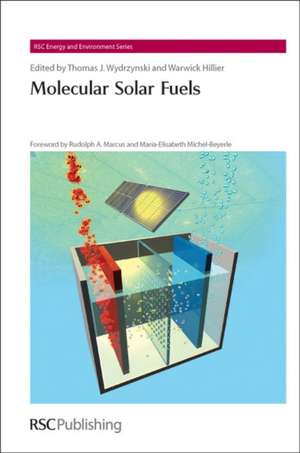
Molecular Solar Fuels
Editat de Thomas J. Wydrzynski, Warwick Hillieren Limba Engleză Hardback – 19 dec 2011
Adresat în egală măsură studenților la masterat sau doctorat, cercetătorilor în chimia materialelor și practicienilor din domeniul energiilor regenerabile, Molecular Solar Fuels oferă un cadru teoretic și aplicat esențial pentru înțelegerea producerii de combustibili neutri din punct de vedere al emisiilor de carbon. Într-un context global în care cererea de energie este prognozată să se dubleze până în 2050, volumul editat de Thomas J. Wydrzynski și Warwick Hillier propune o soluție sustenabilă: adaptarea principiilor conservării energiei pe care natura le-a perfecționat în peste două miliarde de ani de evoluție. Observăm o organizare riguroasă a conținutului în cinci părți fundamentale. Primele secțiuni pun bazele teoretice prin analiza sistemelor naturale, precum bacteriorhodopsinele și complexele de recoltare a luminii, pentru ca ulterior să facă tranziția către soluțiile sintetice. Apreciem în mod deosebit modul în care autorii corelează biologia cu chimia sintetică, oferind o progresie logică de la captarea fotonilor la stocarea energiei în legături chimice, în special prin generarea de hidrogen molecular. Cititorii familiarizați cu Photosynthesis: Molecular Approaches to Solar Energy Conversion de Jian-Ren Shen vor aprecia aici accentul pus pe designul catalizatorilor sintetici și pe ingineria fotocatalizatorilor cu barieră joasă, depășind simpla descriere a proceselor biologice. Merită menționat că lucrarea nu se rezumă la teorie; capitolele dedicate bioelectrozilor și stabilizării sarcinii în filme polimerice indică o orientare clară către aplicabilitatea practică. Textul este susținut de figuri color care facilitează înțelegerea arhitecturilor moleculare complexe, transformând acest volum într-o resursă de referință pentru dezvoltarea tehnologiilor de „combustibil solar” care utilizează apa și lumina solară drept materii prime.
Preț: 1095.04 lei
Preț vechi: 1273.30 lei
-14%
Carte disponibilă
Livrare economică 11-25 mai
Specificații
ISBN-10: 1849730342
Pagini: 553
Ilustrații: Colour figures are allowed in this book.
Dimensiuni: 162 x 242 x 38 mm
Greutate: 0.97 kg
Editura: RSC Publishing
V-ar putea interesa
-
 A Dictionary of Chemical EngineeringCarl Schaschke-20%Preț: 87.96 lei109.92 lei
 -
 Postmodern WinemakingClark SmithPreț: 243.27 lei
 -
 Membrane ProcessesPeter T Cardew-11%Preț: 472.88 lei531.32 lei
 -
 Granular MaterialsS Joseph Antony-14%Preț: 821.96 lei955.77 lei
 -
 Additives in Water-Borne CoatingsGerry Davison-11%Preț: 657.68 lei738.96 lei
 -
 -11%Preț: 620.18 lei696.84 lei
 -
 Pharmaceutical ExcipientsOtilia M. Y. Koo-23%Preț: 1034.12 lei1343.01 lei
 -
 -5%Preț: 803.56 lei845.85 lei
 -
 -23%Preț: 481.74 lei625.63 lei
 -
 -14%Preț: 1058.44 lei1230.75 lei
 -
 Materials ChallengesStuart J. C. Irvine-14%Preț: 1304.90 lei1517.34 lei
 -
 Photoelectrochemical Water SplittingHans-Joachim Lewerenz-26%Preț: 966.81 lei1306.50 lei
 -
 Catalytic Hydrogenation for Biomass ValorizationRoberto Rinaldi-14%Preț: 1154.47 lei1342.40 lei
 -
 Volume PropertiesEmmerich Wilhelm-14%Preț: 1323.21 lei1538.62 lei
De ce să citești această carte
Această lucrare este esențială pentru cei care doresc să înțeleagă viitorul energiei verzi prin prisma biomimetismului. Cititorul câștigă o perspectivă integrată asupra modului în care fotosinteza naturală poate fi replicată în laborator pentru a produce hidrogen. Este o resursă academică solidă care transformă conceptele complexe de fotocataliză în strategii concrete de cercetare, oferind o bază teoretică pentru soluționarea crizei energetice globale.
Despre autor
Volumul este coordonat de Thomas J. Wydrzynski și Warwick Hillier, doi experți recunoscuți în domeniul biochimiei și al fotosintezei. Thomas J. Wydrzynski are o carieră dedicată studiului mecanismelor de oxidare a apei în plante, fiind un pionier în utilizarea tehnicilor de spectrometrie pentru a descifra complexul de eliberare a oxigenului. Alături de Warwick Hillier, acesta a contribuit semnificativ la înțelegerea modului în care sistemele biologice pot servi drept modele pentru catalizatori artificiali. Expertiza lor combinată asigură o abordare interdisciplinară, reunind în acest volum perspective din biologie, fizică și chimie organică.