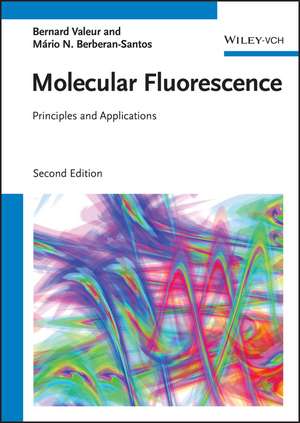
Molecular Fluorescence
Autor Bernard Valeur, Mario Nuno Berberan-Santosen Limba Engleză Paperback – 13 feb 2013
Ceea ce aduce nou a doua ediție a volumului Molecular Fluorescence este o extindere semnificativă a conținutului cu peste 30%, reflectând evoluția rapidă a tehnicilor de fotoluminescență din ultimii ani. Ne-a atras atenția în mod deosebit includerea a două capitole noi, axate exclusiv pe aplicații practice, care completează baza teoretică solidă stabilită în ediția precedentă. Structura cărții facilitează o trecere graduală de la conceptele fundamentale de fotochimie la aspectele tehnice complexe ale instrumentației moderne. Putem afirma că această lucrare reușește să mențină un echilibru rar între rigoarea științifică necesară cercetătorilor și accesibilitatea cerută de studenții aflați la început de drum. Autorii Bernard Valeur și Mario Nuno Berberan-Santos integrează numeroase sfaturi practice care pot fi aplicate direct în laborator, transformând textul dintr-o simplă monografie într-un instrument de lucru esențial. Găsim în acest volum o abordare sistemică a interacțiunii radiației cu materia, fiind tratate în detaliu atât procesele de relaxare, cât și quenching-ul sau transferul de energie. Cititorii familiarizați cu Introduction to Fluorescence de David M. Jameson vor aprecia la acest volum focalizarea mai accentuată pe chimia fizică moleculară și pe detaliile constructive ale echipamentelor de măsurare. În timp ce alte titluri similare pun accent pe microscopie sau biologie, Molecular Fluorescence rămâne ancora de referință pentru înțelegerea fenomenelor la nivel molecular, oferind suportul teoretic necesar pentru interpretarea corectă a datelor experimentale în diverse contexte științifice.
Preț: 660.32 lei
Preț vechi: 767.81 lei
-14%
Carte disponibilă
Livrare economică 06-20 noiembrie
Livrare express 23-29 octombrie pentru 61.14 lei
Specificații
ISBN-10: 3527328467
Pagini: 570
Ilustrații: 4 farbige Abbildungen
Dimensiuni: 172 x 241 x 30 mm
Greutate: 1.08 kg
Ediția:2. Auflage
Editura: Wiley-VCH GmbH
Locul publicării:Weinheim, Germany
V-ar putea interesa
-
 Atomic Force MicroscopyGreg Haugstad-9%Preț: 983.24 lei1080.49 lei
 -
 Redox BiocatalysisGamenara-9%Preț: 1074.84 lei1181.14 lei
 -
 101 Quantum QuestionsKenneth W. FordPreț: 210.42 lei
 -
 -9%Preț: 1067.68 lei1173.27 lei
 -
 Röntgenfluoreszenzanalyse in der LaborpraxisMichael Haschke-8%Preț: 562.70 lei611.63 lei
 -
 The HPLC–MS Handbook for PractitionersS Kromidas-14%Preț: 570.78 lei663.70 lei
 -
 WaschmittelGünter WagnerPreț: 408.62 lei
 -
 New Trends in Fluorescence SpectroscopyBernard ValeurPreț: 404.89 lei
 -
 Chemie der Hefe und der alkoholischen GärungHans Lindner EulerPreț: 347.93 lei
 -
 Preț: 155.98 lei
 -
 Die edlen und die radioaktiven GaseWilliam RamsayPreț: 151.65 lei
Public țintă
Physical Chemists, Photochemists, Molecular Physicists, Complex Chemists, Lecturers in Chemistry, Students in Chemistry, Lecturers in Physics, Students in Physics, Molecular Biologists, Food Chemists, LibrariesDe ce să citești această carte
Această carte este recomandată studenților și cercetătorilor care au nevoie de o bază solidă în fotochimie. Față de prima ediție, aduce actualizări esențiale în domeniul aplicațiilor, oferind cititorului nu doar teorie, ci și expertiza practică necesară pentru utilizarea corectă a instrumentației de fluorescență în cercetarea modernă.
Despre autor
Bernard Valeur este un renumit chimist francez, profesor emerit la Conservatoire National des Arts et Métiers (CNAM) din Paris, cunoscut pentru contribuțiile sale fundamentale în fotofizică și fotochimie. Alături de Mario Nuno Berberan-Santos, profesor de chimie fizică la Universitatea din Lisabona și specialist în cinetica moleculară, a creat un text de referință la nivel mondial. Expertiza lor combinată acoperă atât fundamentarea teoretică a proceselor moleculare, cât și dezvoltarea de noi metode de analiză prin fluorescență, fiind recunoscuți pentru capacitatea de a explica fenomene cuantice complexe pe înțelesul unei audiențe largi.
Notă biografică
National des Arts et Métiers (Paris) in 1979, where he is emeritus professor since 2008. Professor Valeur is a member of the laboratory Photophysique et Photochimie Supramoléculaires et Macromoléculaires at the École Normale Supérieure de Cachan since 1996. From 1995 to 2000 he served as an elected member of the French Comité National de la Recherche Scientifique. He is the winner of the 2012
Gregorio Weber Award for Excellence in Fluorescence Theory and Applications and author of over 170 articles or book chapters, five books, and the editor of one book. In addition, he is a member of several editorial boards.
Mário Nuno Berberan-Santos graduated in chemical engineering from Instituto Superior Técnico (IST, Technical University of Lisbon, Portugal). After a brief stay at the National Research Council of Canada (Ottawa), he received his PhD in chemistry from IST in 1989. He was a post-doctoral fellow with Bernard Valeur at Conservatoire National des Arts et Métiers (Paris, France), and at Laboratoire pour l'Utilisation
du Rayonnement Electromagnétique (Univ. Paris-Sud, Orsay, France). He is full professor of Physical Chemistry at IST, and was invited full professor at the École Normale Supérieure de Cachan (France). He is a member of several editorial advisory boards and is president of the Portuguese Chemical Society (2010 - 2012). He has authored over 180 publications, including 150 papers in scientific journals, several
book chapters, and was the editor of one book.
Descriere
Cuprins
What Is Luminescence?
A Brief History of Fluorescence and Phosphorescence
Photoluminescence of Organic and Inorganic Species: Fluorescence or Phosphorescence?
Various De-Excitation Processes of Excited Molecules
Fluorescent Probes, Indicators, Labels, and Tracers
Ultimate Temporal and Spatial Resolution: Femtoseconds, Femtoliters, Femtomoles, and Single-Molecule Detection
PART I: PRINCIPLES
ABSORPTION OF ULTRAVIOLET, VISIBLE, AND NEAR-INFRARED RADIATION
Electronic Transitions
Transition Probabilities: The Beer - Lambert Law, Oscillator Strength
Selection Rules
The Franck - Condon Principle
Multiphoton Absorption and Harmonic Generation
CHARACTERISTICS OF FLUORESCENCE EMISSION
Radiative and Nonradiative Transitions between Electronic States
Lifetimes and Quantum Yields
Emission and Excitation Spectra
STRUCTURAL EFFECTS ON FLUORESCENCE EMISSION
Effects of the Molecular Structure of Organic Molecules on Their Fluorescence
Fluorescence of Conjugated Polymers (CPs)
Luminescence of Carbon Nanostructures: Fullerenes, Nanotubes, and Carbon Dots
Luminescence of Metal Compounds, Metal Complexes, and Metal Clusters
Luminescence of Semiconductor Nanocrystals (Quantum Dots and Quantum Rods)
ENVIRONMENTAL EFFECTS ON FLUORESCENCE EMISSION
Homogeneous and Inhomogeneous Band Broadening - Red-Edge Effects
General Considerations on Solvent Effects
Solvent Relaxation Subsequent to Photoinduced Charge Transfer (PCT)
Theory of Solvatochromic Shifts
Effects of Specific Interactions
Empirical Scales of Solvent Polarity
Viscosity Effects
Fluorescence in Gas Phase: Supersonic Jets
EFFECTS OF INTERMOLECULAR PHOTOPHYSICAL PROCESSES ON FLUORESCENCE
EMISSION
Introduction
Overview of the Intermolecular De-Excitation Processes of Excited Molecules Leading to Fluorescence Quenching
Photoinduced Electron Transfer
Formation of Excimers and Exciplexes
Photoinduced Proton Transfer
FLUORESCENCE POLARIZATION: EMISSION ANISOTROPY
Polarized Light and Photoselection of Absorbing Molecules
Characterization of the Polarization State of Fluorescence (Polarization Ratio and Emission Anisotropy)
Instantaneous and Steady-State Anisotropy
Additivity Law of Anisotropy
Relation between Emission Anisotropy and Angular Distribution of the Emission Transition Moments
Case of Motionless Molecules with Random Orientation
Effect of Rotational Motion
Applications
EXCITATION ENERGY TRANSFER
Introduction
Distinction between Radiative and Nonradiative Transfer
Radiative Energy Transfer
Nonradiative Energy Transfer
Determination of Distances at a Supramolecular Level Using FRET
FRET in Ensembles of Donors and Acceptors
FRET between Like Molecules: Excitation Energy Migration in Assemblies of Chromophores
Overview of Qualitative and Quantitative Applications of FRET
PART II: TECHNIQUES
STEADY-STATE SPECTROFL UOROMETRY
Operating Principles of a Spectrofl uorometer
Correction of Excitation Spectra
Correction of Emission Spectra
Measurement of Fluorescence Quantum Yields
Possible Artifacts in Spectrofl uorometry
Measurement of Steady-State Emission Anisotropy: Polarization Spectra
TIME-RESOLVED FLUORESCENCE TECHNIQUES
Basic Equations of Pulse and Phase-Modulation Fluorimetries
Pulse Fluorimetry
Phase-Modulation Fluorimetry
Artifacts in Time-Resolved Fluorimetry
Data Analysis
Lifetime Standards
Time-Resolved Polarization Measurements
Time-Resolved Fluorescence Spectra
Lifetime-Based Decomposition of Spectra
Comparison between Single-Photon Timing Fluorimetry and Phase-Modulation Fluorimetry
FLUORESCENCE MICROSCOPY
Wide-Field (Conventional), Confocal, and Two-Photon Fluorescence Microscopies
Super-Resolution (Subdiffraction) Techniques
Fluorescence Lifetime Imaging Microscopy (FLIM)
Applications
FLUORESCENCE CORRELATION SPECTROSCOPY AND SINGLE-MOLECULE FLUORESCENCE
SPECTROSCOPY
Fluorescence Correlation Spectroscopy (FCS)
Single-Molecule Fluorescence Spectroscopy
PART III: APPLICATIONS
EVALUATION OF LOCAL PHYSICAL PARAMETERS BY MEANS OF FLUORESCENT PROBES
Fluorescent Probes for Polarity
Estimation of 'Microviscosity', Fluidity, and Molecular Mobility
Temperature
Pressure
CHEMICAL SENSING VIA FLUORESCENCE
Introduction
Various Approaches of Fluorescence Sensing
Fluorescent pH Indicators 412 Transfer (PET)
Design Principles of Fluorescent Molecular Sensors Based on Ion or Molecule Recognition
Fluorescent Molecular Sensors of Metal Ions
Fluorescent Molecular Sensors of Anions
Fluorescent Molecular Sensors of Neutral Molecules
Fluorescence Sensing of Gases
Sensing Devices
Remote Sensing by Fluorescence LIDAR
AUTOFL UORESCENCE AND FLUORESCENCE LABELING IN BIOLOGY AND MEDICINE
Introduction
Natural (Intrinsic) Chromophores and Fluorophores
Fluorescent Proteins (FPs)
Fluorescent Small Molecules
Quantum Dots and Other Luminescent Nanoparticles
Conclusion
MISCELLANEOUS APPLICATIONS
Fluorescent Whitening Agents
Fluorescent Nondestructive Testing
Food Science
Forensics
Counterfeit Detection
Fluorescence in Art
APPENDIX: CHARACTERISTICS OF FLUORESCENT ORGANIC COMPOUNDS
INDEX