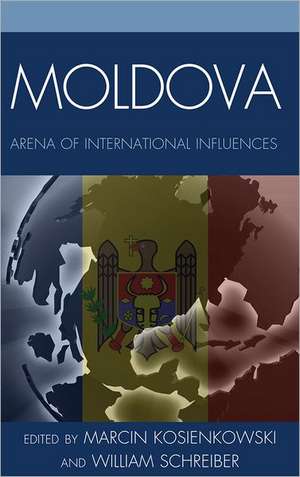
Moldova: Arena of International Influences
Editat de Marcin Kosienkowski, William Schreiber Contribuţii de Juraj Marusiak, Florent Parmentier, Özgehan Senyuva, Jos Boonstra, Dareg A. Zabarah, Andrey Devyatkov, Georgiy Byanov, Laura Kirvelyte, Nicolai Tveatcov, Vladimir Korobov, Vladislav Froltsov, Andrea Ambrus, Andrey Safonov, Natalia Shapovalova, Ronald J. Hill, Davide Zaffi, András Rácz, Octavian Milevschi, Lingqi Mengen Limba Engleză Hardback – 8 mai 2012
For the first time, leading experts and practitioners from many of the countries engaged in Moldova are brought together in a common language. The result is a detailed map of the international political landscape in Moldova, a chronicle of the past two decades, and a forecast of the country's future.
Preț: 676.82 lei
Preț vechi: 1021.72 lei
-34%
Puncte Express: 1015
Carte tipărită la comandă
Livrare economică 19 noiembrie-03 decembrie
Livrare prin curier în România Termenul estimat este afișat lângă disponibilitate.
Transport gratuit pentru acest produs Plată online sau ramburs, în funcție de opțiunile comenzii.
Retur gratuit în 14 zile Comandă securizată și suport în română.
Specificații
ISBN-13: 9780739173916
ISBN-10: 073917391X
Pagini: 286
Dimensiuni: 157 x 239 x 25 mm
Greutate: 0.59 kg
Editura: Bloomsbury Publishing
Colecția Lexington Books
Locul publicării:New York, United States
ISBN-10: 073917391X
Pagini: 286
Dimensiuni: 157 x 239 x 25 mm
Greutate: 0.59 kg
Editura: Bloomsbury Publishing
Colecția Lexington Books
Locul publicării:New York, United States
Cuprins
Foreword, Jerzy Buzek
Preface
Chapter 1: Belarus: A Pragmatic Approach toward Moldova, Vladislav V. Froltsov
Chapter 2: Bulgaria: Relations with Moldova under the Influence of the Bulgarian Diaspora, Nicolai Tveatcov
Chapter 3: China: Policy toward Moldova under the Influence of Socialism, Lingqi Meng
Chapter 4: The Czech Republic and Slovakia: Partnership with Moldova for Transformation and Europeanization, Juraj Marusiak
Chapter 5: The European Union: From Ignorance to a Privileged Partnership with Moldova, Natalia Shapovalova and Jos Boonstra
Chapter 6: France: Unfulfilled Potential as a Major EU Partner of Moldova, Florent Parmentier
Chapter 7: Germany: Increased Attention toward Moldova?, Dareg A. Zabarah
Chapter 8: Hungary: A Supporter of Moldova's Independence, András Rácz and Andrea Ambrus
Chapter 9: Italy: A Missing Actor on the Moldovan Regional Stage?, Davide Zaffi
Chapter 10: Lithuania: Restoration of Old Links with Moldova for New Goals, Laura Kirvelyte
Chapter 11: Poland: Rediscovering Moldova, Marcin Kosienkowski
Chapter 12: Romania: From Brotherly Affection with Moldova to Disillusionment and Pragmatism, Octavian Milevschi
Chapter 13: Russia: Relations with Moldova under a Paradigm of Ambiguity, Andrey Devyatkov
Chapter 14: Turkey: Politics of Balance and Caution toward Moldova, Özgehan Senyuva
Chapter 15: Ukraine: Inconsistent Policy toward Moldova, Vladimir Korobov and Georgiy Byanov
Chapter 16: United Kingdom: A Developing Engagement with Moldova, Ronald J. Hill
Chapter 17: United States: Rewriting the Post-Soviet Narrative in Moldova, William Schreiber
Chapter 18: Transnistria: A Policy of Denial, Containment and Separation from Moldova, Andrey Safonov
Preface
Chapter 1: Belarus: A Pragmatic Approach toward Moldova, Vladislav V. Froltsov
Chapter 2: Bulgaria: Relations with Moldova under the Influence of the Bulgarian Diaspora, Nicolai Tveatcov
Chapter 3: China: Policy toward Moldova under the Influence of Socialism, Lingqi Meng
Chapter 4: The Czech Republic and Slovakia: Partnership with Moldova for Transformation and Europeanization, Juraj Marusiak
Chapter 5: The European Union: From Ignorance to a Privileged Partnership with Moldova, Natalia Shapovalova and Jos Boonstra
Chapter 6: France: Unfulfilled Potential as a Major EU Partner of Moldova, Florent Parmentier
Chapter 7: Germany: Increased Attention toward Moldova?, Dareg A. Zabarah
Chapter 8: Hungary: A Supporter of Moldova's Independence, András Rácz and Andrea Ambrus
Chapter 9: Italy: A Missing Actor on the Moldovan Regional Stage?, Davide Zaffi
Chapter 10: Lithuania: Restoration of Old Links with Moldova for New Goals, Laura Kirvelyte
Chapter 11: Poland: Rediscovering Moldova, Marcin Kosienkowski
Chapter 12: Romania: From Brotherly Affection with Moldova to Disillusionment and Pragmatism, Octavian Milevschi
Chapter 13: Russia: Relations with Moldova under a Paradigm of Ambiguity, Andrey Devyatkov
Chapter 14: Turkey: Politics of Balance and Caution toward Moldova, Özgehan Senyuva
Chapter 15: Ukraine: Inconsistent Policy toward Moldova, Vladimir Korobov and Georgiy Byanov
Chapter 16: United Kingdom: A Developing Engagement with Moldova, Ronald J. Hill
Chapter 17: United States: Rewriting the Post-Soviet Narrative in Moldova, William Schreiber
Chapter 18: Transnistria: A Policy of Denial, Containment and Separation from Moldova, Andrey Safonov
Recenzii
Stereotypes of Moldova as a Russian pawn or an EU protectorate are debunked by a well-known team of authors and insiders, revealing the nuts and bolts of national policies and interests vis-a-vis Chisinau. At last, Moldova: Arena of International Influences is an in-depth study probing beyond generic EU policies for Moldova; an excellent analysis of national policies.
This is a unique updated volume, which covers the broad spectrum of bilateral relations between Moldova and eighteen countries, including the US, the United Kingdom, Russia, China, France, Germany, and Italy, set within the foreign policy perspectives of each of these countries towards Chisinau. It is an excellent collection of essays, chock full of useful facts and details, which combines foreign policy diversity with common themes such as the Europeanization of Moldova.
This is a unique updated volume, which covers the broad spectrum of bilateral relations between Moldova and eighteen countries, including the US, the United Kingdom, Russia, China, France, Germany, and Italy, set within the foreign policy perspectives of each of these countries towards Chisinau. It is an excellent collection of essays, chock full of useful facts and details, which combines foreign policy diversity with common themes such as the Europeanization of Moldova.