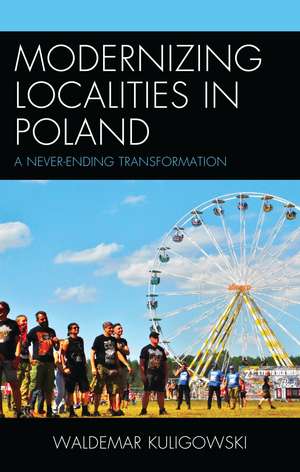
Modernizing Localities in Poland: A Never-ending Transformation
Autor Waldemar Kuligowskien Limba Engleză Hardback – 30 aug 2024
Preț: 524.11 lei
Preț vechi: 815.27 lei
-36%
Puncte Express: 786
Carte tipărită la comandă
Livrare economică 20 noiembrie-04 decembrie
Livrare prin curier în România Termenul estimat este afișat lângă disponibilitate.
Transport gratuit pentru acest produs Plată online sau ramburs, în funcție de opțiunile comenzii.
Retur gratuit în 14 zile Comandă securizată și suport în română.
Specificații
ISBN-13: 9781666950458
ISBN-10: 1666950459
Pagini: 158
Dimensiuni: 158 x 232 x 16 mm
Greutate: 0.4 kg
Editura: Bloomsbury Publishing
Colecția Lexington Books
Locul publicării:New York, United States
ISBN-10: 1666950459
Pagini: 158
Dimensiuni: 158 x 232 x 16 mm
Greutate: 0.4 kg
Editura: Bloomsbury Publishing
Colecția Lexington Books
Locul publicării:New York, United States
Cuprins
Acknowledgments
Introduction: Modernizing Localities in Poland: A Never-ending Transformation
Chapter 1: State Ideologies and Community Values: Post-war Poland in the Mirror of Festivals
Chapter 2: From "Commercial Sellout" to Community-based Event: The Paradoxes of Polish Punk Rock Music Festivals
Chapter 3: Punk Rock Beyond the Center: Critical Geography of Art
Chapter 4: Creating a Public Sphere Through a Celebration: The Case of the St. Martin's Parade
Chapter 5: Laughter, Fear, and Rural Feminization: Contemporary Carnival Shrovetide in the Polish Countryside
Chapter 6: A Wreath from a Sex Shop: Bachelorette Parties
Chapter 7: Peasanthood as Long-term Structure
Chapter 8: "How Poland Entered Europe:" The Motorway as a Space of Neoliberalism
Bibliography
About the Author
Introduction: Modernizing Localities in Poland: A Never-ending Transformation
Chapter 1: State Ideologies and Community Values: Post-war Poland in the Mirror of Festivals
Chapter 2: From "Commercial Sellout" to Community-based Event: The Paradoxes of Polish Punk Rock Music Festivals
Chapter 3: Punk Rock Beyond the Center: Critical Geography of Art
Chapter 4: Creating a Public Sphere Through a Celebration: The Case of the St. Martin's Parade
Chapter 5: Laughter, Fear, and Rural Feminization: Contemporary Carnival Shrovetide in the Polish Countryside
Chapter 6: A Wreath from a Sex Shop: Bachelorette Parties
Chapter 7: Peasanthood as Long-term Structure
Chapter 8: "How Poland Entered Europe:" The Motorway as a Space of Neoliberalism
Bibliography
About the Author
Recenzii
"This book by one of Poland's leading anthropologists is a unique portrait of the transformation of Polish society following the collapse of state socialism in Eastern Europe. Kuligowski's ethnographic focus is on the cultural realm. He takes us to the world of music, festivals, parades, weddings, carnivals and local community life to capture the fascinating tensions between cultural continuity and change in the geopolitical space exposed to sweeping modernization processes."
"This book is interesting from a cultural studies, theoretical, historical and political perspective. It analyses how Poland's idea of "modernisation via the motorway" is an argument in support of Eisenstadt's thesis that there is no one and only one "authentic" way of modernity and modernization. The analysis draws on extensive ethnographic research on Polish culture. It takes into account the deep knowledge of anthropological research on modernization and transformation. This book highlights the processes of "traditionalization" and "retraditionalization". It goes beyond a studies of localities in Poland and offers a fascinating panorama of modernizing Europe."
Reading this well-written book proves to be an exciting and instructive road trip through post-war Poland, guided by the eyes and ears of a passionate ethnographer and thorough expert of the country's (sub)culture. Committed to the paradigm of "anthropology at home", Waldemar Kuligowski takes us to music festivals, punk rock, Saint Martin's parades, processions of masqueraders, bachelorette parties, peasanthood in contemporary public debate, and to a region dealing with its newly built prestigious motorway. All case studies benefit from the author's ability to bring together dense field research material and historical sources with theoretical concepts from different disciplines, which are introduced and interwoven in an easily approachable manner. Taken together, the unfolded polyphony of actors and situations provides a deep insight into the far-reaching cultural, economic and political transformation processes in the Polish (post-)socialist and (post-)Cold War period. Highly recommended, not only for cultural anthropologists!
Kuligowski's book offers a valuable analysis of key processes that have shaped Poland.
"This book is interesting from a cultural studies, theoretical, historical and political perspective. It analyses how Poland's idea of "modernisation via the motorway" is an argument in support of Eisenstadt's thesis that there is no one and only one "authentic" way of modernity and modernization. The analysis draws on extensive ethnographic research on Polish culture. It takes into account the deep knowledge of anthropological research on modernization and transformation. This book highlights the processes of "traditionalization" and "retraditionalization". It goes beyond a studies of localities in Poland and offers a fascinating panorama of modernizing Europe."
Reading this well-written book proves to be an exciting and instructive road trip through post-war Poland, guided by the eyes and ears of a passionate ethnographer and thorough expert of the country's (sub)culture. Committed to the paradigm of "anthropology at home", Waldemar Kuligowski takes us to music festivals, punk rock, Saint Martin's parades, processions of masqueraders, bachelorette parties, peasanthood in contemporary public debate, and to a region dealing with its newly built prestigious motorway. All case studies benefit from the author's ability to bring together dense field research material and historical sources with theoretical concepts from different disciplines, which are introduced and interwoven in an easily approachable manner. Taken together, the unfolded polyphony of actors and situations provides a deep insight into the far-reaching cultural, economic and political transformation processes in the Polish (post-)socialist and (post-)Cold War period. Highly recommended, not only for cultural anthropologists!
Kuligowski's book offers a valuable analysis of key processes that have shaped Poland.