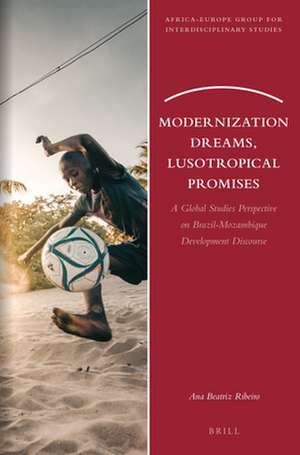
Modernization Dreams, Lusotropical Promises
Autor Ana Beatriz Ribeiroen Limba Engleză Paperback – 18 iun 2020
What history and motivations make up the discourses we are taught to hold, and spread, as common sense? As a member of Brazil's upper middle class, Ana Beatriz Ribeiro grew up with the image that to be developed was to be as European as possible. However, as a researcher in Europe during her country's Workers' Party era, she kept reading that Africans should be repaid for developing Brazilian society – via Brazil's "bestowal" of development upon Africa as an "emerging power." In Modernization Dreams, Lusotropical Promises, the researcher investigates where these two worldviews might intersect, diverge and date back to, gauging relations between representatives and projects of the Brazilian and Mozambican states, said to be joined in cooperation more than others.
Preț: 621.18 lei
Preț vechi: 697.96 lei
-11%
Puncte Express: 932
Carte tipărită la comandă
Livrare economică 07-21 decembrie
Livrare prin curier în România Termenul estimat este afișat lângă disponibilitate.
Transport gratuit pentru acest produs Plată online sau ramburs, în funcție de opțiunile comenzii.
Retur gratuit în 14 zile Comandă securizată și suport în română.
Specificații
ISBN-13: 9789004420106
ISBN-10: 900442010X
Pagini: 340
Dimensiuni: 155 x 234 x 19 mm
Greutate: 0.51 kg
Editura: Brill
ISBN-10: 900442010X
Pagini: 340
Dimensiuni: 155 x 234 x 19 mm
Greutate: 0.51 kg
Editura: Brill
Cuprins
Preface
Acknowledgments
List of Images, Figures and Maps
Acronyms and Abbreviations
Introduction: The “dreams” and the “promises”
Genesis
History
Definitions
Layout
1 Opinion-makers and the Making of Cooperation
1.1 Brazil-Mozambique Studies: What’s Missing?
1.2 Builders and Subjects of Lusofonia
1.3 Creating and Sculpting the Lusotropical Group
1.4 The Discursive Struggle against Lusotropicalism
2 (Luso)tropical Development as Policy in Brazil
2.1 Between the Old Empire and Nascent States
2.2 Africa in Brazil’s “Independent Foreign Policy”
2.3 Pragmatism as a Rapprochement Instrument
2.4 Channeling Slavery-era Bonds into Politics
3 Diplomats, Technocrats and Reality Checks
3.1 A Gap between “promises” and Actions?
3.2 Africa as Kindred Continent and Priority
3.3 “Demand-driven” Cooperation in Mozambique
3.4 Technical Cooperation versus Profit-seeking?
4 Aid, Agency and Extraction in Mozambique
4.1 From “donor darling” to Donor and Investor
4.2 From Colonial Endeavor to National Enterprise
4.3 History and Diplomacy of Moatize Mining
4.4 Mines Spill into Farms, Spill into Factories
5 Dependency, Development and Liberalization
5.1 Constructing Mozambique’s Modernization
5.2 A “South-South” Alliance in Public Health
5.2.1Turning the smm Factory into Business
5.2.2Growing Local Industry or Dependency?
5.3 A Triangular Alliance in Agricultural Production
5.4 The Uncertain Outlook of ProSavana Ambitions
6 The Enduring Legacy of Lusotropicalism
6.1 Post-colonial Self-affirmation and CPLP
6.2 Takes on 21st century “lusophone” Leadership
6.3 Brazil Memories of a Mozambican in Lisbon
Conclusion
Overarching Reflections and Findings
Further Measuring the “dreams” and “promises”
Bibliography
Index
Acknowledgments
List of Images, Figures and Maps
Acronyms and Abbreviations
Introduction: The “dreams” and the “promises”
Genesis
History
Definitions
Layout
1 Opinion-makers and the Making of Cooperation
1.1 Brazil-Mozambique Studies: What’s Missing?
1.2 Builders and Subjects of Lusofonia
1.3 Creating and Sculpting the Lusotropical Group
1.4 The Discursive Struggle against Lusotropicalism
2 (Luso)tropical Development as Policy in Brazil
2.1 Between the Old Empire and Nascent States
2.2 Africa in Brazil’s “Independent Foreign Policy”
2.3 Pragmatism as a Rapprochement Instrument
2.4 Channeling Slavery-era Bonds into Politics
3 Diplomats, Technocrats and Reality Checks
3.1 A Gap between “promises” and Actions?
3.2 Africa as Kindred Continent and Priority
3.3 “Demand-driven” Cooperation in Mozambique
3.4 Technical Cooperation versus Profit-seeking?
4 Aid, Agency and Extraction in Mozambique
4.1 From “donor darling” to Donor and Investor
4.2 From Colonial Endeavor to National Enterprise
4.3 History and Diplomacy of Moatize Mining
4.4 Mines Spill into Farms, Spill into Factories
5 Dependency, Development and Liberalization
5.1 Constructing Mozambique’s Modernization
5.2 A “South-South” Alliance in Public Health
5.2.1Turning the smm Factory into Business
5.2.2Growing Local Industry or Dependency?
5.3 A Triangular Alliance in Agricultural Production
5.4 The Uncertain Outlook of ProSavana Ambitions
6 The Enduring Legacy of Lusotropicalism
6.1 Post-colonial Self-affirmation and CPLP
6.2 Takes on 21st century “lusophone” Leadership
6.3 Brazil Memories of a Mozambican in Lisbon
Conclusion
Overarching Reflections and Findings
Further Measuring the “dreams” and “promises”
Bibliography
Index
Notă biografică
Ana Beatriz Ribeiro, Ph.D. (2018), Leipzig University, has been researching Brazil-Mozambique relations for a decade. She has lived in Germany, Poland, Denmark, the US and Brazil. Her work has been featured in journals such as Portuguese Studies Review and Comparativ.