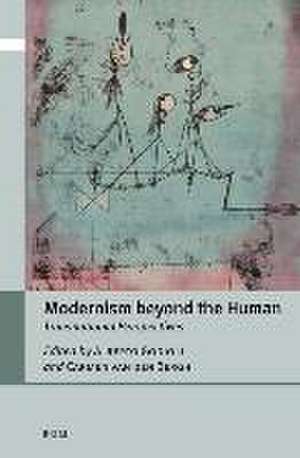
Modernism beyond the Human
Editat de Alberto Godiolien Limba Engleză Hardback – 11 oct 2023
On the one hand, this collection sheds new light on the modernist contribution to posthumanism, providing a valuable reference point for future studies on the topic. On the other, it offers a new take on the transnational dimension of modernism, highlighting unexplored convergences between modernist authors from several different national contexts.
Preț: 671.97 lei
Preț vechi: 872.69 lei
-23%
Puncte Express: 1008
Preț estimativ în valută:
118.92€ • 138.99$ • 103.25£
118.92€ • 138.99$ • 103.25£
Carte tipărită la comandă
Livrare economică 20 februarie-06 martie
Preluare comenzi: 021 569.72.76
Specificații
ISBN-13: 9789004549678
ISBN-10: 9004549676
Pagini: 318
Dimensiuni: 155 x 234 x 19 mm
Greutate: 0.62 kg
Editura: de Gruyter Brill
ISBN-10: 9004549676
Pagini: 318
Dimensiuni: 155 x 234 x 19 mm
Greutate: 0.62 kg
Editura: de Gruyter Brill
Notă biografică
Alberto Godioli is Associate Professor in European Culture and Literature at the University of Groningen, and Programme Director of the Netherlands Research School for Literary Studies (OSL). His publications on modernism include Laughter from Realism to Modernism (2015) and La scemenza del mondo (2011; Edinburgh Gadda First Prize). He is principal investigator of an NWO Vidi project on humor andfree speech jurisprudence (2022-2027), and founder of the Forum for Humor and the Law (www.forhum.org).
Carmen van den Bergh is Assistant Professor in Italian Literature at the Leiden University Centre for Arts in Society (LUCAS) in the Netherlands, where she is director of the Italian Language and Culture Department. Simultaneously she works in Belgium at the University of Leuven (KU Leuven) as a senior research fellow for the Flemish Council for Scientific Research (FWO) with a project on the role of writers in newspapers and magazines of the Italian Novecento. Her specializations include Italian modernism, prose writings during the Italian interwar, (neo)realism in film and literature, the literary canon and the function of anthologies.
Carmen van den Bergh is Assistant Professor in Italian Literature at the Leiden University Centre for Arts in Society (LUCAS) in the Netherlands, where she is director of the Italian Language and Culture Department. Simultaneously she works in Belgium at the University of Leuven (KU Leuven) as a senior research fellow for the Flemish Council for Scientific Research (FWO) with a project on the role of writers in newspapers and magazines of the Italian Novecento. Her specializations include Italian modernism, prose writings during the Italian interwar, (neo)realism in film and literature, the literary canon and the function of anthologies.
Cuprins
List of Figures
Notes on Contributors
Introduction
Alberto Godioli and Carmen van den Bergh
Part 1
Modernism and the Nonhuman
1 Prefiguring Modernist Posthumanism: Baudelaire, Rimbaud and the Objectification of the Lyric Self
Alessandro Cabiati
2 Becoming-Digit: Valentine de Saint-Point’s Posthumanist Futurism
Pavlina Radia
3 Politics of Identity: Giuseppe Ungaretti’s Poetry of the Great War Between Nomadic Subjectivity and Performative Realism
Enrica Maria Ferrara
4 Variations On “Maquinismo”: Looking Beyond the Human in Ramón Gómez de la Serna’s Writings
Ângela Fernandes
5 The Tender Being of Something Else: Geography and Lists in Gertrude Stein’s Ida
Laura Oulanne
6 Samuel Beckett and Modernist Vitalism
Marc Farrant
Part 2
Modernist Animals
7 Rumination of a Serbian Ox: Radoje Domanovic’s Satire of Anthropocentric Folly
Vedran Catovic
8 “Come se”: Transcending the Human-Animal Divide in Pirandello’s Short Stories
Santi Luca Famà
9 Modernist Exiles: the Berlin Years of Viktor Shklovsky, Aleksei Remizov, and the Masturbating Ape
Asiya Bulatova
10 “Brandishing Her Plumes”: Virginia Woolf, Feather Tropes, and the Plumage (Prohibition) Bill
Saskia McCracken
11 Posthumanism avant la lettre: Robert Musil’s The Man without Qualities and the Boundaries of Humankind
Florian Kappeler
12 Animals and Logos in Samuel Beckett’s Molloy, Malone Dies, and The Unnamable
Laura Lainväe
13 Towards an Interpretation of a Modernist Bestiary in Color: Palazzeschi’s Bestie Del 900 and Maccari’s Illustrations
Sarah Bonciarelli
Index
Notes on Contributors
Introduction
Alberto Godioli and Carmen van den Bergh
Part 1
Modernism and the Nonhuman
1 Prefiguring Modernist Posthumanism: Baudelaire, Rimbaud and the Objectification of the Lyric Self
Alessandro Cabiati
2 Becoming-Digit: Valentine de Saint-Point’s Posthumanist Futurism
Pavlina Radia
3 Politics of Identity: Giuseppe Ungaretti’s Poetry of the Great War Between Nomadic Subjectivity and Performative Realism
Enrica Maria Ferrara
4 Variations On “Maquinismo”: Looking Beyond the Human in Ramón Gómez de la Serna’s Writings
Ângela Fernandes
5 The Tender Being of Something Else: Geography and Lists in Gertrude Stein’s Ida
Laura Oulanne
6 Samuel Beckett and Modernist Vitalism
Marc Farrant
Part 2
Modernist Animals
7 Rumination of a Serbian Ox: Radoje Domanovic’s Satire of Anthropocentric Folly
Vedran Catovic
8 “Come se”: Transcending the Human-Animal Divide in Pirandello’s Short Stories
Santi Luca Famà
9 Modernist Exiles: the Berlin Years of Viktor Shklovsky, Aleksei Remizov, and the Masturbating Ape
Asiya Bulatova
10 “Brandishing Her Plumes”: Virginia Woolf, Feather Tropes, and the Plumage (Prohibition) Bill
Saskia McCracken
11 Posthumanism avant la lettre: Robert Musil’s The Man without Qualities and the Boundaries of Humankind
Florian Kappeler
12 Animals and Logos in Samuel Beckett’s Molloy, Malone Dies, and The Unnamable
Laura Lainväe
13 Towards an Interpretation of a Modernist Bestiary in Color: Palazzeschi’s Bestie Del 900 and Maccari’s Illustrations
Sarah Bonciarelli
Index