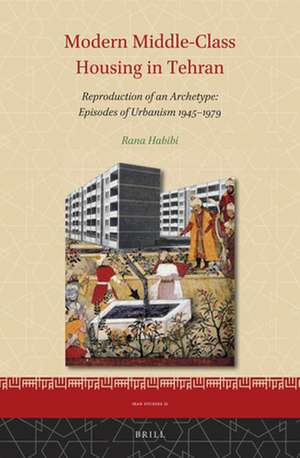
Modern Middle-Class Housing in Tehran
Autor Rana Habibien Limba Engleză Hardback – 19 noi 2020
Preț: 754.05 lei
Preț vechi: 979.28 lei
-23%
Puncte Express: 1131
Carte tipărită la comandă
Livrare economică 05-19 iunie
Specificații
ISBN-13: 9789004443686
ISBN-10: 9004443681
Pagini: 214
Dimensiuni: 155 x 234 x 14 mm
Greutate: 0.5 kg
Editura: Brill
ISBN-10: 9004443681
Pagini: 214
Dimensiuni: 155 x 234 x 14 mm
Greutate: 0.5 kg
Editura: Brill
Cuprins
Acknowledgments
List of Illustrations
Persian Transcription
Introduction
1 Middle-Class Housing Development in Tehran and the Question of Non-Western Modernity
2 Iran’s Position Amidst Non-Western Architectural Modernism
3 Modernism as Institutionalism
4 From Ideal Modernism to Popular Modernism
5 Modernism as a Taste
6 Modernism as a Transnational Model
7 Tehran Urban Modernization: Articulation of the Walled Gardens and Urban Planning Laws
8 Modern Middle-Class Quarters: A Reproduction of Archetype
1 The Unveiled House – The Institutionalization of Modern Middle-Class Neighborhoods in 1940s Tehran: Chahārsad Dastgāh, 1946
1 Growth of the Middle Class, the Question of Modern Collective Housing, and the Birth of Tehran’s First Modern Neighborhood
2 Modern District: The Courtyard House New Urban Block Configuration – Chahārsad Dastgāh
3 A Modern House by Law: Expansion of Modernity
4 Conclusion
2 Architects and Architecture without Architects: Nārmak, 1952
1 Introduction
2 Reformers
3 A Modernist Vision for a Middle-Class Neighborhood – Nārmak
4 A Yard: Contextualization of the Modern
5 Builders: Negotiating the Modern
6 Conclusion
3 Modern Taste – Iranian Domestic Cultural Transformation and the Excellence of the Car-Urban Landscape: Kuy-e Farah, 1961 and Kuy-e Chahārom-e Ābān, 1969
1 Introduction
2 The Modern Iranian House as Embodiment of Global Taste
3 A Car-Garden Neighborhood: Transformation of an Iranian Courtyard House: The Case of Kuy-e Farah, 1961
4 The Automobile Society and the Appearance of the Apartment Building: The Case of Kuy-e Chahārom-e Ābān, 1969
5 Conclusion
4 A Transnational Model – Internationalist Discourses and Practices in Tehran: The Case of Ekbātān, 1976
1 From Oil Exporting Economy to the Internationalization of Tehran
2 Iranian Internationalism: In Search of Methodology
3 Iranian Internationalism in Practice: Modernist Architectural Experiments
4 Ekbātān: A Transnational Architectural Model
5 Neglecting Internationalism and Continuations of Modernism in Practice
Coda
1 International Modernism and the Reproduction of Archetype 2 Row Courtyard House Model + Grid
3 Linear Courtyard House Model + Grid
4 Super Courtyard House Model + Grid
5 Tehran: Speculative and Fragmented Middle-Class Urban Landscape
6 Epilogue: Chahārbāgh as the Main Structure of the New Center of Tehran
Timeline
Bibliography
Index
List of Illustrations
Persian Transcription
Introduction
1 Middle-Class Housing Development in Tehran and the Question of Non-Western Modernity
2 Iran’s Position Amidst Non-Western Architectural Modernism
3 Modernism as Institutionalism
4 From Ideal Modernism to Popular Modernism
5 Modernism as a Taste
6 Modernism as a Transnational Model
7 Tehran Urban Modernization: Articulation of the Walled Gardens and Urban Planning Laws
8 Modern Middle-Class Quarters: A Reproduction of Archetype
1 The Unveiled House – The Institutionalization of Modern Middle-Class Neighborhoods in 1940s Tehran: Chahārsad Dastgāh, 1946
1 Growth of the Middle Class, the Question of Modern Collective Housing, and the Birth of Tehran’s First Modern Neighborhood
2 Modern District: The Courtyard House New Urban Block Configuration – Chahārsad Dastgāh
3 A Modern House by Law: Expansion of Modernity
4 Conclusion
2 Architects and Architecture without Architects: Nārmak, 1952
1 Introduction
2 Reformers
3 A Modernist Vision for a Middle-Class Neighborhood – Nārmak
4 A Yard: Contextualization of the Modern
5 Builders: Negotiating the Modern
6 Conclusion
3 Modern Taste – Iranian Domestic Cultural Transformation and the Excellence of the Car-Urban Landscape: Kuy-e Farah, 1961 and Kuy-e Chahārom-e Ābān, 1969
1 Introduction
2 The Modern Iranian House as Embodiment of Global Taste
3 A Car-Garden Neighborhood: Transformation of an Iranian Courtyard House: The Case of Kuy-e Farah, 1961
4 The Automobile Society and the Appearance of the Apartment Building: The Case of Kuy-e Chahārom-e Ābān, 1969
5 Conclusion
4 A Transnational Model – Internationalist Discourses and Practices in Tehran: The Case of Ekbātān, 1976
1 From Oil Exporting Economy to the Internationalization of Tehran
2 Iranian Internationalism: In Search of Methodology
3 Iranian Internationalism in Practice: Modernist Architectural Experiments
4 Ekbātān: A Transnational Architectural Model
5 Neglecting Internationalism and Continuations of Modernism in Practice
Coda
1 International Modernism and the Reproduction of Archetype 2 Row Courtyard House Model + Grid
3 Linear Courtyard House Model + Grid
4 Super Courtyard House Model + Grid
5 Tehran: Speculative and Fragmented Middle-Class Urban Landscape
6 Epilogue: Chahārbāgh as the Main Structure of the New Center of Tehran
Timeline
Bibliography
Index
Notă biografică
Rana Habibi, Ph.D.(2015) is a practicing Brussels-based urbanist and architectural historian. She has written extensively on modernity and urbanism. She has authored several book chapters, including The Routledge Companion to Modernity, Space and Gender (Routledge, 2018).