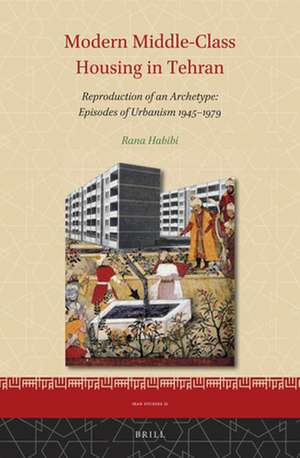
Modern Middle-Class Housing in Tehran: Modern Middle-Class Housing in Tehran, cartea 21
Autor Rana Habibien Limba Engleză Hardback – 19 noi 2020
Preț: 783.85 lei
Preț vechi: 1017.98 lei
-23%
Puncte Express: 1176
Carte tipărită la comandă
Livrare economică 05-19 octombrie
Livrare prin curier în România Termenul estimat este afișat lângă disponibilitate.
Transport gratuit pentru acest produs Plată online sau ramburs, în funcție de opțiunile comenzii.
Retur gratuit în 14 zile Comandă securizată și suport în română.
Specificații
ISBN-13: 9789004443686
ISBN-10: 9004443681
Pagini: 232
Dimensiuni: 155 x 234 x 14 mm
Greutate: 0.5 kg
Editura: Koninklijke Brill Bv
Colecția Modern Middle-Class Housing in Tehran
Seriile Modern Middle-Class Housing in Tehran, Brill
ISBN-10: 9004443681
Pagini: 232
Dimensiuni: 155 x 234 x 14 mm
Greutate: 0.5 kg
Editura: Koninklijke Brill Bv
Colecția Modern Middle-Class Housing in Tehran
Seriile Modern Middle-Class Housing in Tehran, Brill
Cuprins
Acknowledgments
List of Illustrations
Persian Transcription
Introduction
1 Middle-Class Housing Development in Tehran and the Question of Non-Western Modernity
2 Iran’s Position Amidst Non-Western Architectural Modernism
3 Modernism as Institutionalism
4 From Ideal Modernism to Popular Modernism
5 Modernism as a Taste
6 Modernism as a Transnational Model
7 Tehran Urban Modernization: Articulation of the Walled Gardens and Urban Planning Laws
8 Modern Middle-Class Quarters: A Reproduction of Archetype
1 The Unveiled House – The Institutionalization of Modern Middle-Class Neighborhoods in 1940s Tehran: Chahārsad Dastgāh, 1946
1 Growth of the Middle Class, the Question of Modern Collective Housing, and the Birth of Tehran’s First Modern Neighborhood
2 Modern District: The Courtyard House New Urban Block Configuration – Chahārsad Dastgāh
3 A Modern House by Law: Expansion of Modernity
4 Conclusion
2 Architects and Architecture without Architects: Nārmak, 1952
1 Introduction
2 Reformers
3 A Modernist Vision for a Middle-Class Neighborhood – Nārmak
4 A Yard: Contextualization of the Modern
5 Builders: Negotiating the Modern
6 Conclusion
3 Modern Taste – Iranian Domestic Cultural Transformation and the Excellence of the Car-Urban Landscape: Kuy-e Farah, 1961 and Kuy-e Chahārom-e Ābān, 1969
1 Introduction
2 The Modern Iranian House as Embodiment of Global Taste
3 A Car-Garden Neighborhood: Transformation of an Iranian Courtyard House: The Case of Kuy-e Farah, 1961
4 The Automobile Society and the Appearance of the Apartment Building: The Case of Kuy-e Chahārom-e Ābān, 1969
5 Conclusion
4 A Transnational Model – Internationalist Discourses and Practices in Tehran: The Case of Ekbātān, 1976
1 From Oil Exporting Economy to the Internationalization of Tehran
2 Iranian Internationalism: In Search of Methodology
3 Iranian Internationalism in Practice: Modernist Architectural Experiments
4 Ekbātān: A Transnational Architectural Model
5 Neglecting Internationalism and Continuations of Modernism in Practice
Coda
1 International Modernism and the Reproduction of Archetype 2 Row Courtyard House Model + Grid
3 Linear Courtyard House Model + Grid
4 Super Courtyard House Model + Grid
5 Tehran: Speculative and Fragmented Middle-Class Urban Landscape
6 Epilogue: Chahārbāgh as the Main Structure of the New Center of Tehran
Timeline
Bibliography
Index
List of Illustrations
Persian Transcription
Introduction
1 Middle-Class Housing Development in Tehran and the Question of Non-Western Modernity
2 Iran’s Position Amidst Non-Western Architectural Modernism
3 Modernism as Institutionalism
4 From Ideal Modernism to Popular Modernism
5 Modernism as a Taste
6 Modernism as a Transnational Model
7 Tehran Urban Modernization: Articulation of the Walled Gardens and Urban Planning Laws
8 Modern Middle-Class Quarters: A Reproduction of Archetype
1 The Unveiled House – The Institutionalization of Modern Middle-Class Neighborhoods in 1940s Tehran: Chahārsad Dastgāh, 1946
1 Growth of the Middle Class, the Question of Modern Collective Housing, and the Birth of Tehran’s First Modern Neighborhood
2 Modern District: The Courtyard House New Urban Block Configuration – Chahārsad Dastgāh
3 A Modern House by Law: Expansion of Modernity
4 Conclusion
2 Architects and Architecture without Architects: Nārmak, 1952
1 Introduction
2 Reformers
3 A Modernist Vision for a Middle-Class Neighborhood – Nārmak
4 A Yard: Contextualization of the Modern
5 Builders: Negotiating the Modern
6 Conclusion
3 Modern Taste – Iranian Domestic Cultural Transformation and the Excellence of the Car-Urban Landscape: Kuy-e Farah, 1961 and Kuy-e Chahārom-e Ābān, 1969
1 Introduction
2 The Modern Iranian House as Embodiment of Global Taste
3 A Car-Garden Neighborhood: Transformation of an Iranian Courtyard House: The Case of Kuy-e Farah, 1961
4 The Automobile Society and the Appearance of the Apartment Building: The Case of Kuy-e Chahārom-e Ābān, 1969
5 Conclusion
4 A Transnational Model – Internationalist Discourses and Practices in Tehran: The Case of Ekbātān, 1976
1 From Oil Exporting Economy to the Internationalization of Tehran
2 Iranian Internationalism: In Search of Methodology
3 Iranian Internationalism in Practice: Modernist Architectural Experiments
4 Ekbātān: A Transnational Architectural Model
5 Neglecting Internationalism and Continuations of Modernism in Practice
Coda
1 International Modernism and the Reproduction of Archetype 2 Row Courtyard House Model + Grid
3 Linear Courtyard House Model + Grid
4 Super Courtyard House Model + Grid
5 Tehran: Speculative and Fragmented Middle-Class Urban Landscape
6 Epilogue: Chahārbāgh as the Main Structure of the New Center of Tehran
Timeline
Bibliography
Index
Notă biografică
Rana Habibi, Ph.D.(2015) is a practicing Brussels-based urbanist and architectural historian. She has written extensively on modernity and urbanism. She has authored several book chapters, including The Routledge Companion to Modernity, Space and Gender (Routledge, 2018).